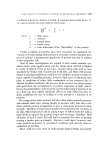
SOME ASPECTS OF HANDLING POWDERS IN MECHANICAL EQUIPMENT t305 conditions is given by Ashton et al (10). A constant shear index factor, N, for a given poxvder has been derived of the form where ¾ : shear stress C • cohesion c• = normal stress T = tensile stress N = some indication of the "flowability" of the powder. Tensile strengths of powders have been measured by equipment de- veloped at Warren Spring Laboratory (11) and some evidence has •also been given to indicate a fundamental significance of particle size only in relation to flow properties (12). Most of these investigations are related to flow within confined con- ditions under some applied stress and the Jenike shear cell (12) is limited to study of limited strain at low rates. Annular shear cells such as that described by Walker (14), Scarlett and Todd (15), and Birks (1t3) provide means of reaching equilibrium conditions for indefinite periods of strain. In many regions of handling powders, however, high rates of distortion take place in conditions of either little confinement or low pressures due to dilation. In dilate conditions, the presence of air creates a two phase system and apart from the circumstances of particle separation or light contact forces, the permeability of the material and the lubricating properties of air as a fluid can have highly significant effects on bulk behaviour (17). In static conditions the rate of settling of a fine powder is a function of its porosity. The escape of air under pressure will then allow higher particle pressures and reduced voids ratio, causing density to increase with time due to the closer particle packing arrangement to give a consequent increase in shear strength. The effect of temperature should not be ignored as the viscosity of air rises with temperature and in taking longer to diffuse from the bulk is more likely to support the particles longer and encourage "flooding". Mild vibration of such a static bed will tend to increase the order of packing causing a further gain in strength. Excessive work input, however, may cause particle separation in unconfined conditions and prevent close co- ordination of particles. Much work has been done on bulk storage hopper design and specific

JOURNAL OF THE SOCIETY OF COSMETIC CHEMISTS design technique is available with supporting theory (18, 19). Modulations of various kinds have been proposed (20-25) and a comprehensive collection of many aspects of powder storage and flow has been published (26). The influence of gravity in the effective regions of mechanical equipment is significant by stimulating motion in a preferential direction. Notes on gravity flow of solids in bulk (27) are equally relevant to the behaviour of powder in machines. MECHANISMS OF POWDER MOVEMENT A detailed study of the elemental mechanisms and regimes of motion for bulk solids in live conditions will often outline significant characteristics of equipment which may or may not be dominant operational features. The mechanisms repeat in different classes of equipment and often may be isolated for tests. (a) With references to the machine walls, bed, blades, buckets etc., the boundary layers may be either static or sliding. (b) The internal particle structure may be virtually rigid, i.e. static or moving En masse, possess narrow failure planes where one section is moving relative to another, or be in bulk shear where there is a general flow or readjustment of particle arrangement. (a) "Static" powder/wall effects are mainly due to wall pressure but the duration of contact may also contribute to time compaction or increased adhesion to the surface. The main point to consider is whether the forces acting on the powder will cause a firrn compact to be created which will not fail when required to do so in the equipment. In the case of hoppers, such a prediction can be made from a Jenike cell test (13). In mechanical equip- ment the compacting forces and stresses available to cause failure are less easy to establish but if the relationship is understood one can draw general guide lines. In respect of adhesion, one should take account not only of surface relationships of the wall outside solid and contact pressure but also the effect of contact surface area and sh.ape in relation to prospective attached masses, e.g. in vertical 90 ø crevices with bulk material tending to hold up in a simple radiused crevice, the cross-sectional area of solid, hence weight of fillet, is proportional to R2 1--• whereas the surface area is proportional to 2R. Thus there is a linear function a- 1-- tending to 2
Purchased for the exclusive use of nofirst nolast (unknown)
From: SCC Media Library & Resource Center (library.scconline.org)