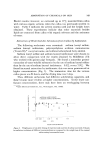
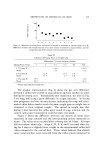
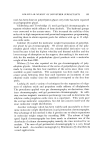
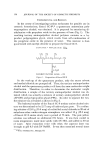
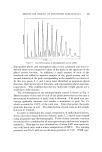
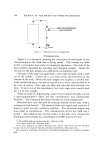
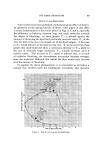
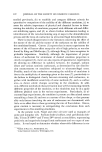
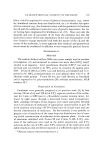
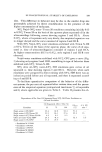
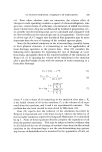
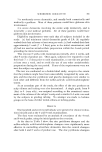
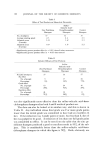
156 JOURNAL OF THE SOCIETY OF COSMETIC CHEMISTS EXPERIMENTAL AND RESULTS In the course of investigating various surfactants for possible use in cosmetic formulations, Eracol CC-9©, *• a quaternary ammonium poly- oxypropylene alcohol, was obtained. It is prepared by autoclaving di- ethylamine with propylene oxide in the presence of base (Fig. 1). The resulting tertiary aminopolyether alcohol polymer contains as a by- product polypropylene glycol, which results from self-condensation of the propylene oxide in the presence of water. This mixture is then quaternized with methyl chloride to prepare the Emcol CC-9. DIETHYLAMINE + PROPYLENE OXIDE C2H5 iH3 •H3 C2H5-N-iH2-CH-O-(CHPi+ G CH3CL a,CH30H QUATERNARY POLYETHER ALCOHOL + PPG Figure 1. Preparation of Emcol CC-9 In the work-up of the quaternary product, only the excess solvent and methyl chloride are pumped off. Thus, the tertiary aminopolyether alcohol and the quaternary product will have the same molecular weight distribution. Therefore, in order to determine the molecular weight distribution, a sample of the tertiary aminopolyether alcohol was ob- tained which was actually a mixture of tertiary aminopolyether alcohol (AP-OH) and polypropylene glycol (PPG). In order to separate the two, the mixture was acetylated as shown in Fig. 2. The hydroxyl number of the Emcol CC-9 tertiary amino alcohol mix- ture was determined to be 2.17 meq of hydroxyl per gram. To a reflux- ing solution of 2.81 g (35.8 meq) of redistilled acetyl chloride in 20 ml of anhydrous ether under nitrogen atmosphere was added 15 g (32.5 meq) of Emcol CC-9 amine slowly over a period of 75 min. The pale yellow solution was refluxed an additional 2« hours. It was then cooled to room temperature, made more acidic with 2N HC1, and added to 40 ml of water. After extraction twice with ether, the aqueous layer was brought to pH 9.5 with 5N NaOH. It was then extracted several times * Witco Chemical Co., Chicago, Ill.

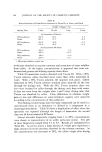
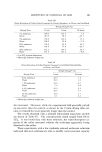
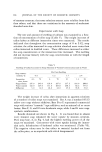
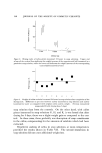
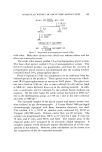
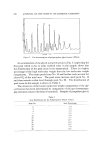
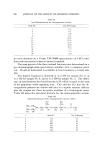
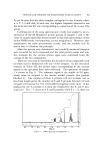
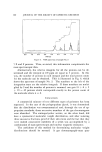
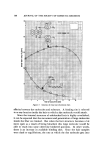
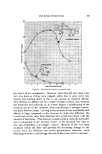
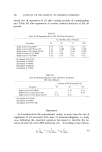
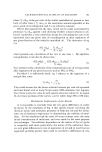
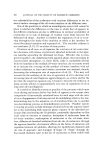
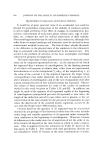
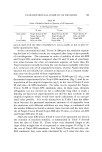
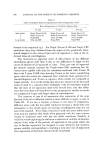
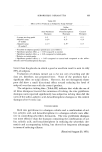
MOLECULAR WEIGHT OF POLYETHER SURFACTANTS 157 AP-OH + PPG CH•COC[ APA + PPGA I 1) 2N HCL 2) ETHER • H20 S ETHER APA.HCL PPGA 1) DIL.NAOH 2) ETHER AP^ PREPARATION OF QUATERNARY CH3CL APA a, ACETON• QUATERNARY APA Figure 2. Preparation of aminopolyether acetate (APA) with ether. Both ether extracts were dried over sodium sulfate and the ether was removed in vacuo. The acidic ether extract yielded 1.9 g of polypropylene glycol acetate. The basic ether extract yielded 13.5 g of aminopolyether acetate. The yield of combined product was quantitative and from the recovery of polypropylene glycol acetate it was determined that the starting mixture contained about 10% polypropylene glycol. Proof of separation of the two components can be confirmed from the infrared spectra of the products. These spectra were obtained on a Beck- man IR-10 spectrophotometer as smears on NaG1 plates. The glycol ace- tate has a band at 1740 cm -• due to ester carboxyl (G=O) and no band at 3400 cm -• where hydroxyl shows up in the starting material. In addi- tion, a qualitative test for nitrogen by the sodium fusion method was negative. On the other hand, the amino acetate has bands at 2805 cm -• due to the diethylamino group at 1740 cm% due to the ester carboxyl and none at 3400 cm q. The separated samples of the glycol acetate and amino acetate were then analyzed by gas chromatography. A Varian Model 1860 gas-liquid chromatograph, equipped with flame ionization detectors, was used. The column, 5 ft X 0.125 in. stainless steel, contained 3% SE-30 on Varaport (100/200 mesh). Helium carrier flow was 25 ml/min. The column was programmed from 120øC at 15ø/min for 5 min 6ø/min for 10 min and 4ø/min until 325øC and held. The relative areas of the observed peaks were measured by an electronic digital integrator. A complete analysis would obviously require identification of all the com- ponents in the mixture. However, sonhe conclusions can be drawn as to the composition of the two separated materials.
Purchased for the exclusive use of nofirst nolast (unknown)
From: SCC Media Library & Resource Center (library.scconline.org)