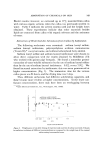
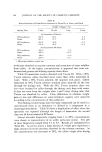
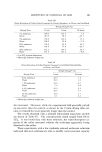
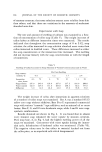
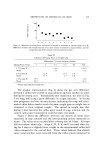
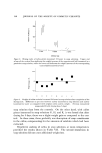
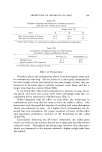
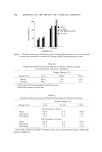
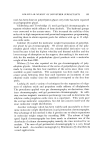
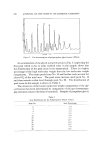
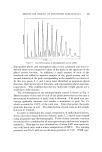
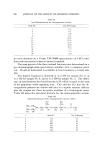
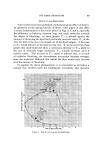
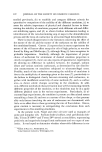
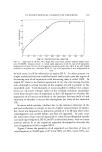
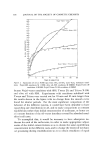
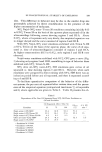
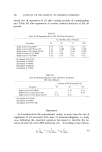
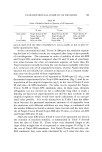
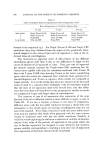
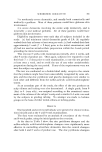
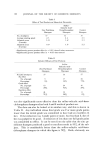
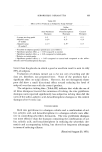
180 JOURNAL OF THE SOCIETY OF COSMETIC CHEMISTS served rate of separation of oil after varying periods of centrifugation and Table III a15ter separation ot5 various constant 15ractions of the oil present. Table II Rate of Oil Separation from 50% Oil-Water Emulsions % Oil/Min After t Minutes Emulsion 25 50 75 100 Nujol-water-0.2% SDS• 0.53 0.53 Nujol-water-0.2% Tween 20 b 0.21 0.068 Nujol-water-0.2% Triton X-100 c 0.09 0.07 Olive oil-water-0.2% SDS a 0.51 0.20 Nujol-water-0.1% CPC • 0.24 0.17 0.53 0.53 0.033 0.020 0.047 0.030 0.11 0.07 0.16 0.15 Emulsions M 111968. Emulsions A 091069. Emulsions A 090969. Emulsions M 060669. Emulsions A 112669. Table III Rate of Oil Separation from 50% Oil-Water Emulsions (Per Cent/Minute) Amount of Oil Separated (%) Emulsion 10 20 30 Nujol-water-0.2 % SDS• ... Nujol-water-0.15% Tween 20• 3.0 Nujol-water-0.12 % Triton X-100 c 0.13 0.53 1.2 0.01 0.53 0.24 . . . Emulsions M 111968: Emulsions A 091069. Emulsions M 111969 TR. DISCUSSION As is evident from the experimental results, in most cases the rate of separation o15 oil decreased with time of ultracentrifugation, in many cases following the empirical equation developed to describe the be- havior of olive oil-water-SDS emulsions (11). According to this relation, t 1 t - + % oil..• b. % Oilm=,• % Oilm=,•

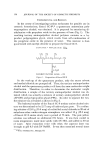
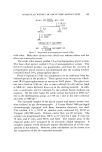
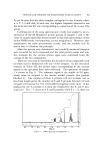
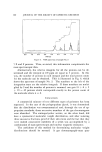
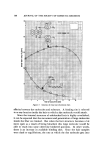
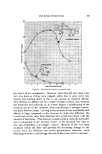
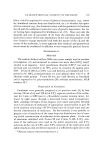
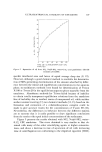
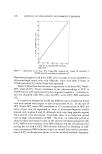
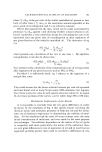
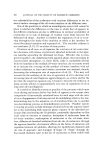
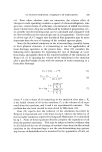
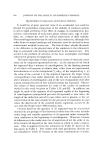
ULTRACENTRIFUGAL STABILITY OF EMULSIONS 181 where % oilsep is the per cent of the initial emulsified oil present as free bulk oil after time t, % Oilma• is the maximum amount separable at the given speed of centrifugation, and b is an arbitrary constant. Where this equation fits the data, which can be easily ascertained by plotting t/% oilsep against t and checking whether a linear relation is ob- tained, it provides a very convenient means for calculating the rate of oil separation after any given time of centrifugation or after separation of any given fraction of the initially emulsified oil. The derivative of eq 1 is d(•o oil•ep) % oilm•x.b - (2) dt (1 q- bt) 2 which permits easy calculation of the rate at any time t. By algebraic manipulation, it can also be shown that d(• oil•ep) b(•o Oilmax -- •0 oilsep) 2 - (3) dt • Oilm• Eq 3 permits ready calculation of the instantaneous rate of oil separation after separation of any given fraction, such as 10% or 30%. Provided b is sufficiently small, eq 1 reduces to the equation of a straight line, since Kt % oilsop -- 1 q- bt (4) This could account for the linear relation between per cent oil separated and time found with so many Nujol-water-SDS emulsions, but requires that b have a very low value in such systems since the values of t in region II--the linear portions of the curves--can be rather large (90 to 120 min). Mechanistic Implications of the Results It is reasonable to conclude from the very great differences in stabil- ity shown by the emulsions of Fig. 2 that specific factors involving the chemical nature and molecular geometry of both the oils and the suffac- rants are of dominant importance in determining the stability of emul- sions. All the emulsions had the same oil-water volume ratio, the same initial concentration of suffactant, and were made by the same prepara- tive technique. Nevertheless, dependent on the nature of the oil (polar rs. nonpolar), and, more particularly, the nature of the suffactant, there are very great differences in rate of separation of oil and in total fraction separated, probably greater than could be ascribed to differences in rela-
Purchased for the exclusive use of nofirst nolast (unknown)
From: SCC Media Library & Resource Center (library.scconline.org)