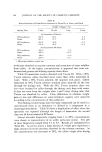
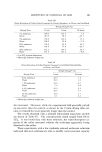
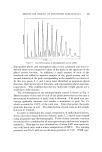
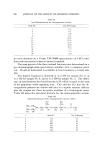
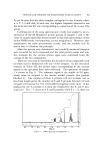
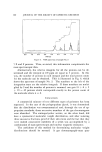
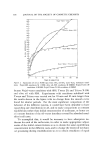
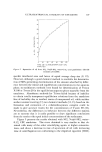
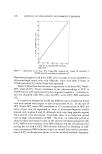
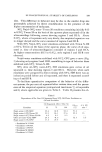
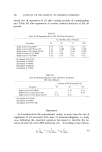
184 JOURNAL OF THE SOCIETY OF COSMETIC CHEMISTS Quantitative Comparison o[ Emulsion Stability It would be of great practical value if an accelerated test could be devised for quantitative comparison of the stability of emulsion systems to aid in rapid screening of the effect of changes in emulsification pro- cedures, concentration of surfactants, phase volume ratio, type of emul- sifier, etc., without the need for tedious observation of shelf stability. Ultracentrifugal methods may be useful in this connection, although they suffer from two major handicaps and ultimately must be checked by more conventional methods in any case. The first of these, already discussed, is the difference in the physical state of the emulsion in the ultracentri- fuge as contrasted with standing undisturbed in the natural state. The second is the problem of selection of the most meaningful centrifugal criterion for purposes of comparison. The more important of these parameters in terms of which the emul- sions can be compared quantitatively are: (a) the amount of oil which has separated after t minutes of centrifugation (b) the limiting amount of oil which will separate at infinite time, either from an experimental determination or as the extrapolated % 0ilmax Of the empirical eq 1 (c) the value of the constant b in the empirical equation, the larger values corresponding to less stable emulsions (d) the rate of separation of oil after t minutes of centrifugation and (e) the rate of separation of oil after a given constant fraction of that initially present has separated. Illustra- tive values of these parameters for some of the variety of emulsions studied in this work are given in Tables I, II, and III. In addition, use might be made of the quantity of oil separated rapidly at the beginning of centrifugation (extrapolated per cent oil separated at zero time), the length of the induction period in cases where such is present, or the cal- culated value of the rate constant for the process of oil separation in cases where the data fit one of the standard kinetic equations, as may be the case with the Nujol-water-SDS emulsion data. Criteria based on the quantity of oil separated may be of practical interest but are perhaps of less theoretical value since the value includes rather large and variable quantities of oil separated under nonequilib- rium conditions at the beginning of centrifugation. Moreover, because of differences in the steady-state rate of separation of oil, the order of sta- bility found will depend on the time chosen at which to make compari- sons. This is apparent from the tabulation in Table IV based on the data given in Table I. The results with cetyl pyridinium chloride are not included in Table IV because at the same concentration o1• surfac-

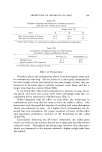
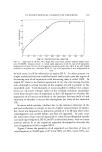
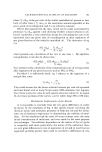
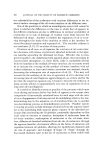
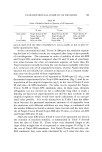
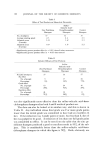
ULTRACENTRIFUGAL STABILITY OF EMULSIONS Table IV Order of Stability Based on Quantity of Oil Separated 185 % Oil Separated After Oilmax 25 min 75 min (%) Most stable Nujol-Triton X-100 Nujol-Triton X-100 Nujol-Tween 20 • Nujol-Tween 20• Nujol-Tween 20 Olive oil-SDS Nujol-SDS Olive oil-SDS• Nujol-SDS Least stable Olive oil-SDS Nujol-SDS j tant as used with the other emulsifiers it was so stable as not to give re- liable quantitative data. At the concentrations used, Triton X-100 gave the emulsion separat- ing the least oil whether results are compared after long or short periods of centrifugation. The inversion in order of stability of olive oil-SDS and Nujol-SDS emulsions compared after 25 and 75 min of centrifuga- tion arises because the olive oil emulsions separate oil faster than the Nujol emulsions initially but then the rate decreases markedly with time (i.e., as the per cent of oil separated increases), whereas Nujol emulsions separate less oil initially but continue to separate it at a constant steady- state rate over the period of these experiments. The maximum amount of oil separated at 39,400 rpm (% oilmax) was determined experi•nentally for Nujol-SDS emulsions (Fig. 1) and by ex- trapolation of the empirical equation (eq 1) in the case of Nujol-Tween 20 and olive oil-SDS emulsions. No value can be reported for Nujol- Triton X-100 or Nujol-CPC emulsions since, in these cases, ultracen- trifugation was not carried out for a sufficiently long time to reach a limiting oil separation experimentally nor did the data conform to the empirical equation which would have made calculation of an extrapo- lated value possible. It is worth noting here in Table I that the differ- ences between the presumed maximum amounts of oil separable from the emulsions with different stabilizers are very large, as contrasted with the smaller differences found at shorter time intervals and the near-iden- tity of Nujol-Tween 20 and Nujol-SDS after 25 min, or of olive oil-SDS and Nujol-SDS after 75 min. Much the same difficulty is found if rates of oil separation are used as the criterion of emulsion stability, as summarized in Table V derived from the data of Table II. These values were obtained simply as the slope of the straight line of oil separated rs. time (region II of Fig. 1) in the case of Nujol-SDS emulsions. For Nujol-Tween 20 and olive oil- SDS emulsions, they were easily calculated by eq 2, since the data con-
Purchased for the exclusive use of nofirst nolast (unknown)
From: SCC Media Library & Resource Center (library.scconline.org)