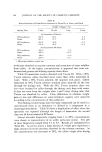
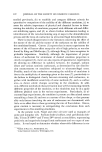
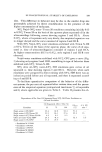
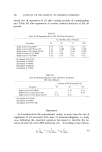
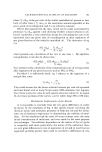
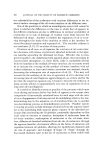
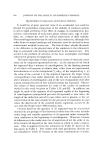
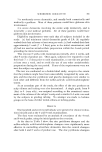
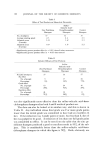
186 JOURNAL OF THE SOCIETY OF COSMETIC CHEMISTS Table V Order of Stability Based on Instantaneous Rate of Separation of Oil Rate of Separation in % Oil Per Minute After 25 min 75 min 100 rain Most stable Nujol-Triton X-100 Nujol-Tween 20 Nujol-Tween 20 • Nujol-Tween 20 Nujol-Triton X-100 Nujol-Triton X-100 Nujol-SDS Olive oil-SDS Olive oiI-SDS Least stable Olive oil-SDS Nujol-SDS Nujol-SDS formed to the empirical eq 1. For Nujol-Triton X-100 and Nujol-CPC emulsions, they were obtained from the slopes of the graphically deter- mined tangents to the curves of per cent oil separated rs. time at the in- dicated times of centrifugation. The inversions in apparent order of effectiveness of the different emulsifying agents with time is due to the differences in shape of the curves of amount of oil separated vs. time. Thus, per cent oil separated per minute remains constant for Nujol-water-SDS emulsions but de- creases more rapidly with time for emulsions stabilized with Tween 20 than with Triton X-100, thus showing Triton as the better emulsifying agent when the results are compared after relatively short periods of ul- tracentrifugation and Tween as superior when results are compared at longer periods. It is worth noting that since the amount of oil separated seems to tend to a constant limit ultimately with all emulsions studied that the rates of oil separation must tend toward zero, and that differ- ences between them will therefore become progressively smaller as results are compared at longer and longer times of centrifugation. The criterion of rate of oil separation after separation of the same fraction of the oil in different systems is more difficult to apply, as seen in Table III. If too low a fraction is chosen as the basis of comparison, difficulty arises with the less stable emulsions because a steady-state rate subsequent to the initial spurt on starting centrifugation may not yet have been reached. If too high a fraction is used, the more stable emul- sions may not separate that much when prepared with the same concen- tration of surfactant used with the less stable emulsions. Possibly, it would be worth exploring the utility as a criterion of stability of determi- nation of the value of the percent oil separated at the point where the rate of further separation has dropped to some arbitrary low number, greater stability corresponding to reaching a near zero rate of separation after separation of the lesser amount of the oil present.

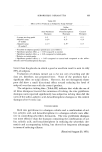
ULTRACENTRIFUGAL STABILITY OF EMULSIONS 187 In conclusion, there appears to be no single universally applicable cri- terion for the quantitative characterization of the rate of demulsification, unless it were to be an actual specific reaction rate constant for the pro- cess, a parameter which cannot be unambiguously obtained from the present data without additional assumptions. It is therefore necessary to choose rather empirically that parameter which seems most likely to pro- vide useful data for the particular application. ACKNOWLEDGMENT The authors wish to express their appreciation to Miss Milagros Acevedo for her assistance in the preparation and ultracentrifugation of several of the emulsions and analysis of the solutions. (Received September 8, 1971) REFERENCES (1) Garrett, E. R., Stability of oil-in-water emulsi,ons, J. Pharm. Sci., 54, 1557-70 (1965). (2) Garrett, E. R., Prediction and evaluation of emulsion stability with ultracentrifugal stress, J. Soc. Cosmet. Chern., 21, 393-415 (1970). (3) King, A., and Mukherjee, L. N., The stability of emulsions. I. Soap-stabilized emul- sions, .l. Soc. Chem. Ind. (London), 58, 243 (1939). (4) King, A., Some factors governing the stability of oil-in-water emulsions, Trans. Fara- day Soc., 37, 168-80 (1941). (5) Beeher, P., Emulsions: Theory and Practice, Reinhold Publishing Co., New York, N.Y., 1965, Chap. 4. (6) Cockton, J. R., and Wynn, J. B., The use of surface active agents in pharmaceutical preparations: The evaluation of emulsifying power, J. Pharm. Pharmacol., 4, 959-71 (1952). (7) Void, R. D., and Groot, R. C., Parameters of emulsion stability, J. Soc. Cosmet. Chem., 14, 23344 (1963). (8) Vold, R. D., and Groot, R. C., An ultracentrifugal method for the quantitative determi- nation of emulsion stability, J. Phys. Chem., 66, 1969-75 (1962). (9) Vold, R. D., and Groot, R. C., The effect of electrolytes on the ultracentrifugal stability of emulsions, .I. Colloid Sci., 19, 384-98 (1964). (10) $chulman, J. H., $toeckenius, W., and Prince, L. M., Mechanism of formation and structure of micro emulsions by electron microscopy, J. Phys. Chem., 63, 1677-80 (1959). (11) Void, R. D., and Mittal, K. L., The effect of lauryl alcohol on the stability of oil-in- water emulsions, J. Coll. Inter]ace Sci., 38, 451-9 (1972). (12) Void, R. D., and Groot, R. C., The effect of varying centrifugal field and interfacial area on the ultracentrifugal stability of emulsions, ]. Phys. Chem., 68, 3477-84 (1964). (13) Ottewill, R. H., and Walker, T., The influence of non-ionic surface active agents on the stability of polystyrene latex dispersions, Kolloid-Z., 227, 108-16 (1968). (14) Brown, E.G., and Hayes, T. J., The absorptiometric determination of polyethylenegly- col mono-olcate, Analyst, 80, 755-67 (1955). (15) Weber, J. R., Degner, E. F., and Bahjat, K. S., Determination of nonionic ethylene oxide adduct in some commercial products, Anal. Chem., 36, 678-9 (1964).
Purchased for the exclusive use of nofirst nolast (unknown)
From: SCC Media Library & Resource Center (library.scconline.org)