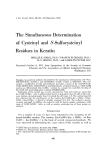
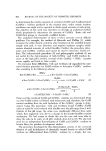
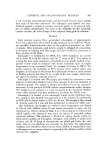
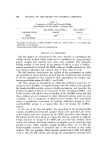
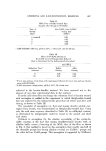
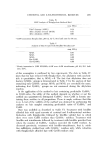
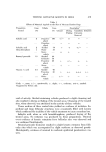
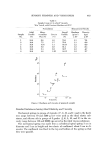
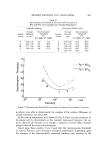
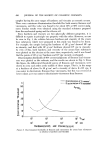
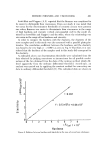
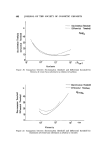
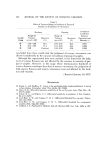
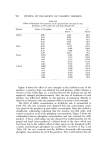
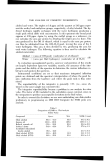
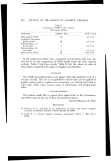
466 JOURNAL OF THE SOCIETY OF COSMETIC CHEMISTS Table I Comparison of MNP• and Elsworth-Phillips Determinations of Ker-CySSO,- in Human Hair a (Ker-CySH + Ker-CySSOa-) (Ker-CySSOa-) Analytical Method (meq/g) (meq/g) MNP• 0.60 b . . . Elsworth-Phillips ... 0.30 Immersion for 60 min in 1.0M NH•HSO•-3.0M urea, pH 5.8, 32øC, 50:1 bath ratio followed by centrifugation. Corrected for Ker-CySH content of untreated hair. RESULTS AND DISCUSSION The first phases of experimental •vork •vere directed at establishing the validity of this method •vhich could not be established by using standard keratin samples and controls since none •vere available. The Elsworth- Phillips method (1) •vas found, in one instance (Table I), to give a CySSOa- content equivalent to one-half the MNP• value on bisulfite-treated hair. This was, ho•vever, laborious and required close to three days of work. We did, however, demonstrate the validity of the assumptions on which our procedure is based and then sho•ved that the analytical results obtained in several experiments •vere consistent •vith expectations for samples con- raining predictable ratios of CySSOa- and CySH. The three groups of assumptions on •vhich this method is based are: (a) rinsing treated (bisulfite, mercaptan) keratin with 6N sulfuric acid quenches the keratin-bisulfite reaction, removes soluble mercaptans, and quenches the keratin-mercaptan reactions (b) treatment of hair containing CySSOa- ancl CySH residues •vith alkali causes rebuilding of the disulfide bonds and that these residues are not consumed by other chemical reactions under reversal conditions and (c) treatment of alkali-reversed keratin •vith acrylonitrile causes a quantitative conversion of cysteinyl sulfhydryl groups to /•-cy- anoethylsulfide groups in a manner that does not change the CySSOa- content. In the case of the first assumption, the quenching of the keratin-bisulfite reaction, bisulfite-treated keratin samples •vhich were quenched and rinsed in 6N sulfuric acid •vere analyzed by the MNP• procedure after storage in 6N suloeuric acid oeor from 10 rain to 7 days. The data are reported in Table II. Clearly one sees no change in the MNP• titer over the time studied. These results also indicate that large numbers of samples can be stored for long periods of time •vhich expedites sample handling. Thus, •ve see that the keratin-bisulfite reaction is quenched and is not reversed in this acidic medium. The one question which remains unanswered in this and others' work is: does the 6N sulkuric acid change the instantaneous cleavage level

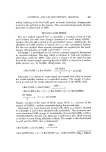
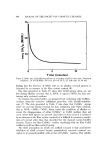
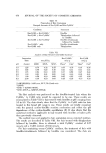
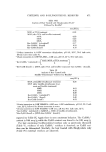
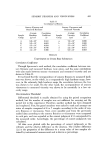
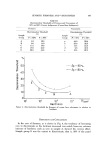
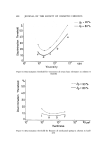
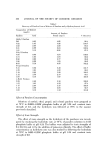
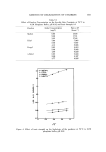
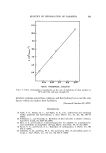
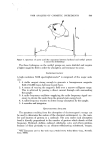
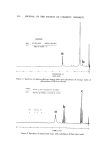
CYSTEINYL AND S-SULFOCYSTEINYL RESIDUES Time of Storage (days) Table II MNP• Titer of Sulfite-Treated Hair Samples After Storage in 6N H2SO• • Ker-CySH q- Ker-CySSOa- meq/g hair (MNP•) 467 0 (control) 0.81 2 0.81 5 0.82 7 0.82 a 1.0M NH4HSOa-3M urea, pH 5.8, 32øC, 50:1 bath ratio for 30 min. Table III Effect of 6N H_oSO• Rinsing on Ker-CySH Level of Thioglycolate-Reduced Hair as Determined by the Iodoacetamide Procedure s meq SH/g Reduction Time b Before After (minutes) Rinsing Rinsing 5 0.25 0.23 10 0.41 0.41 Two 1-min and one 3-min rinses with isopropanol followed by two 1-min and one 13-min rinses with 6N H•SO4. 0.30N ammonium thioglycolate, pH 9.2, 32øC, 50:1 bath ratio. achieved in the keratin-bisulfite mixture? We have assumed not in the absence of any clear experimental data to the contrary. That the acid rinse does not change the reduction level of keratin treated with mercaptan is verified in the experiment in which thioglycolate-treated hair was analyzed by the iodoacetamide procedure (2) before and after acid rinsing, as shown in Table III. The remainder of assumption (a), that acid rinsing desorbs soluble mer- captan from keratin, was demonstrated on thioglycolate-treated hair. Using only the acid rinse sequence described in Table III, no sulfhydryl content, as determined by nitroprusside, could be found in the second and third acid rinses. Pertinent to assumption (b), the alkaline reversibility of the cystine-bi- sulfite reaction, is the fact that rinsing bisu]fite-treated keratin with an alkaline buffer causes a lowering of the MNP• titer of the fiber as shown in Fig. 2. Our method is based on the assumption that exactly one-half of the titratable groups lost during alkaline reversal are CySSO.•- groups and the other half are CySH groups. This assumption is supported by Wolfram's
Purchased for the exclusive use of nofirst nolast (unknown)
From: SCC Media Library & Resource Center (library.scconline.org)