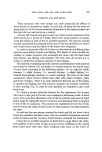
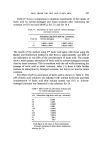
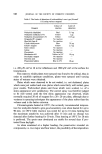
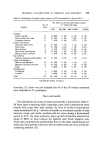
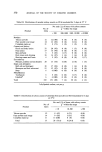
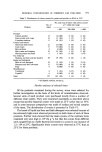
SKIN CREAM FOR DRY AND FLAKY SKIN 529 had been lost during the rinsing period. No detectable increase in water holding capacity remained after rinsing corneum treated with lactic acid. These experiments showed that adsorption of lactic acid resulted in the corneum maintaining an increased extensibility after rinsing in water under conditions where the effect of other humectants was lost. Effect of hand lotions containing lactic acid on corneum water holding and extensibility The pH of lactic acid itself is too low for incorporation into hand lotions. Hand lotions containing lactic acid were prepared by partially neutralizing lactic acid with sodium hydroxide to give a pH of 4, and incorporating this into the aqueous phase of a lotion to give a product containing 10• by weight of the lactic acid-sodium lactate mixture, calculated as lactic acid. Similar lotions containing 10•o sodium lactate, and a control lotion con- taining water in place of the lactic acid or lactate, were also prepared. The lotions were rubbed into both sides of pieces of solvent-damaged guinea pig footpad corneum for a total period of 90 s with the fingertips while wearing rubber gloves. Excess lotion was removed by wiping with tissues and the treated corneum was either equilibrated at 81• r.h. or rinsed by immersion in water for 30 min before equilibration. The control pieces of corneum from the same animals were either left untreated or were immersed in water for 30 min as appropriate. Table VII shows the effect of the lotions on corneum water holding capacity and extensibility. Table VII. Effect of hand lotions on water holding and extensibility of solvent- damaged guinea pig footpad corneum at 81 •o r.h. Water held Extensibility Treatment (mg 100 mg -• corneum) (•o per 100 g load) Unrinsed Rinsed Unrinsed Rinsed Control lotion 17.6 (9) 18.6 (12) 0.68 (10) 0.93 (12) Untreated 17.7 (9) 18.1 (12) 0.59 (10) 0.87 (12) Lacticacid lotion 17.4 (16) 18.3 (19) 1.19 (10) 0.98 (ll) Untreated 16.4' (16) 18.3 (19) 0.58* (10) 0.59* (11) Sodium lactate lotion 19.9 (10) 18.1 (11) 0.81 (10) 0.74 (11) Untreated 17.8' (10) 17.4 (11) 0.59* (10) 0.75 (11) Figures in parentheses are numbers of replicates. Treatment time with lotions was 90 s, rinsing time was 30 min. * Denotes significant difference (P 0.05).

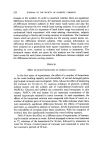
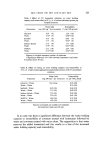
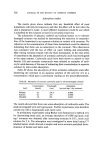
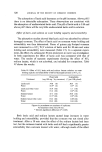
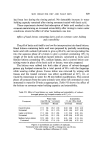
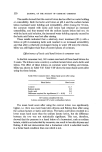
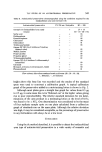
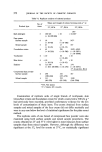
530 JOURNAL OF THE SOCIETY OF COSMETIC CHEMISTS The results showed that the control lotion had no effect on water holding or extensibility. Both the lactic acid lotion at pH 4 and the sodium lactate lotion increased water holding and extensibility. After rinsing for 30 min, the corneum treated with lactic acid lotion had retained an increased extensibility, and that treated with the sodium lactate lotion had not. As with the lactic acid solution, the increased water holding capacity caused by the lactic acid lotion was lost after rinsing. These results indicated that a relatively short treatment (90 s) with a lotion at pH 4 containing lactic acid resulted in an increased extensibility and that after a relatively prolonged rinsing in water (30 min) the extensi- bility was still higher than that of control pieces of corneum. Effectiveness of lactic acid hand lotions in consumer tests In the first consumer test, 143 women used each of three hand lotions for 2 weeks. The lotions were a control, a sodium lactate lotion and a lactic acid lotion. The effect of these lotions on corneum water holding and extensi- bility was shown in Table VII. Table VIII shows the mean hand scores after using the three lotions. Table Viii. Consumer test 1. Mean hand scores after using hand lotions Hand lotion Hand score Control 12.3 Sodium lactate 9.6 Lactic acid 9.0 Difference required for significance (P = 0.05) 1.2 143 women completed the test. Lotions contained 10 % lactic acid/sodium lactate. The mean hand score after using the control lotion was significantly higher, i.e. there was more hand skin dryness and flaking than after using the sodium lactate or lactic acid lotion. The lactic acid lotion resulted in a lower mean hand score than the sodium lactate lotion, but the difference between the two was not statistically significant. This test, therefore, showed that the presence in a hand lotion of a humectant, such as sodium lactate, which is not adsorbed by corneum, can result in less skin dryness and flaking. It did not demonstrate that a humectant which is adsorbed results in a better hand condition than one which is not.
Purchased for the exclusive use of nofirst nolast (unknown)
From: SCC Media Library & Resource Center (library.scconline.org)