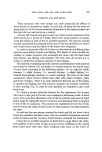
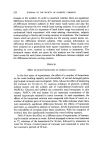
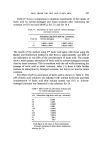
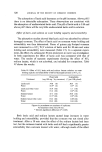
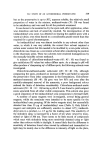
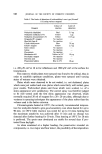
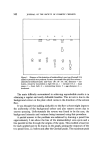
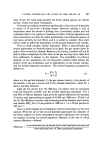
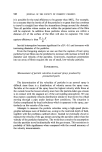
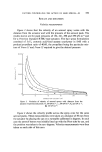
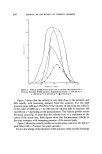
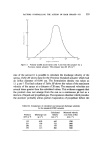
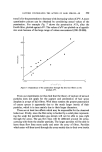
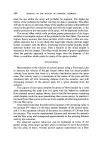
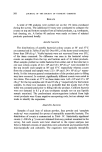
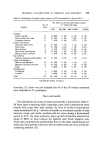
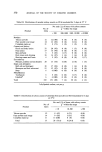
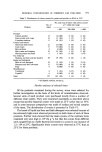
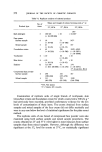
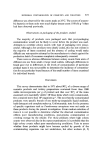
FACTORS CONTROLLING THE ACTION OF HAIR SPRAYS--Ill 553 RESULTS AND DISCUSSION Velocity measurements Figure 3 shows that the velocity of an aerosol spray varies with the distance from the actuator and with the pressure of the aerosol pack. The results shown are for pack pressures of 152, 221,290 and 359 kN m -• and for a Precision Standard RTBU type actuator. The hair spray formulation consisted of 5.6• crotonic acid/vinyl acetate copolymer in IMS with a product/propellant ratio of 40/60, the propellant being the particular mix- ture of Freon 11 and Freon 12 required to give the desired pressure. 6000 - 4500 3000 1500 o I I © I I o. 5 I0 15 20 25 Distance from actuator (cm) Figure 3. Variation of velocity of aerosol sprays with distance from the actuator. Experimental points: O, 359 kN m-U A, 290 kN m-U X, 221 kN O, 152 kN m -2. Figure 4 shows the velocity profile across the spray cone for the same aerosol packs. These measurements were taken at a distance of 50 mm from the actuator by placing the can on a turntable calibrated in degrees. In each case the aerosol button was initially lined up with the Pitot tube by eye, and the position was taken to be zero degrees. Velocity measurements were then taken on each side of this zero.

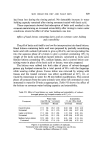
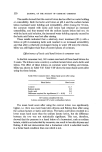
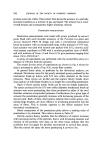
554 JOURNAL OF THE SOCIETY OF COSMETIC CHEMISTS 2O O__ I 20 ø I0 ø 0 ø i0 ø 20 ø Degrees of rotation Figure 4. Velocity profile across spray cone 5 cm from the actuator for a Precision Standard RTBU actuator. Experimental points: ¸, 359 kN m-2 A, 290 kN m-S X, 221 kN m-S O, 152 kN m -•. Figure 3 shows that the velocity is very high close to the actuator and falls rapidly with increasing distance from the actuator. For the high pressure packs (290 and 359 kN m -•') the velocity 10 mm from the orifice is of the order of 6000 cm s -•. At 250 mm the velocity falls to betweeen 100 and 500 cm s -• depending on the pack pressure. The velocity profiles across the spray cone (Fig. 4) show that the velocity rises to a maximum at the centre of the spray cone. Both figures show that the maximum velocity in the cone increases with increasing pressure of the aerosol pack. Figure 5 shows the velocity profile across the spray cone for a 221 kN m -•' pack fitted with a Precision two-piece actuator. From a know_ledge of the diameter of the actuator orifice and the discharge
Purchased for the exclusive use of nofirst nolast (unknown)
From: SCC Media Library & Resource Center (library.scconline.org)