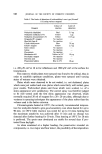
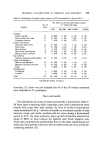
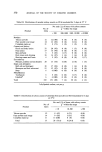
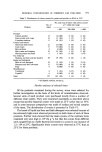
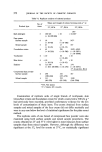
574 JOURNAL OF THE SOCIETY OF COSMETIC CHEMISTS have demonstrated that deterioration can occur in products which are inadequately preserved. The incidence of significantly contaminated samples (i.e. containing 300 cfu g-X) in the present investigation is similar to the levels previously reported from the U.S.A. Wolven and Levenstein (16) reported an incidence of contamination of 24.4• (61 out of 250 items examined) whilst Dunnigan and Evans (17) observed contamination in 33 (19.5•o) out of 165 items of cosmetic examined. Unfortunately, although the latter workers identified the predominant microflora they gave no information of the nature of the contaminated products. More recently, Wolven and Levenstein (18) have shown a much lower incidence of contamination of cosmetic products in the U.S.A., only eight (3.5•o) of 223 items examined being contaminated. It is not unreasonable to suppose that similar improvements in the quality of cosmetics may have occurred during the past two years in the U.K. In particular, awareness of the need to ensure good microbiological quality in raw materials, especially natural pigments and fillers, will have had an effect on the levels of microorganisms present in many products (D. Spooner, personal communication). In devising any 'Code of Good Manufacturing Practice' the absence of specific pathogens must be considered in addition to control of the overall level of microbial contamination of the product. When complete product sterility is not feasible, cosmetic and toiletry preparations should be free from viable pathogens such as Pseudomonas aeroginosa, salmonellae, Escherichia coli, Staphylococcus aureus and certain clostridia. Raw materials of mineral origin, such as talc, may be contaminated with spores of soil clostridia including CI. tetani (19) and Cl. perfringens. Whilst C1. tetani contamination of talc is known to have caused at least one outbreak of tetanus in babies (9, 19) the significance of C1. perfringens spores is less clear. Strains of C1. perfringens are known to cause gas gangrene in man and animals, the route of entry to the body tissues being via wounds and abrasions in the skin (20). However, the minimum infective dose of CI. perfringens strains is probably considerably above the level at which any area of skin would become contaminated by a cosmetic preparation containing a relatively low number of spores per gram. ACKNOWLEDGMENTS The authors are indebted to the Select Committee of the Toilet Prepara- tion Federation and the Society of Cosmetic Chemists of Great Britain for

MICROBIAL CONTAMINATION OF COSMETICS AND TOILETRIES 575 sponsoring this investigation and for permission to publish the results. We are grateful to Mr A. Rangnikar for technical assistance during the investi- gation. (Received: 5th April 1974) REFERENCES (13) (14) (15) (16) 08) (17) (19) (20) (1) Tenebaum, S. Pseudomonads in cosmetics. J. Soc. Cosmet. Chem. 18 797 (1967). (2) Van Abb•, N.J., Dixon, H., Hughes, O. and Woodruffe, R. C. S. The hygienic manufac- ture and preservation of toiletties and cosmetics. J. Soc. Cosmet. Che•n. 21 719 (1970). (3) Bean, H. S. Preservatives for pharmaceuticals. J. Soc. Cosmet. Chem. 23 703 (1971). (4) Anderson, D. W. and Ayres, M. Microbiological profile of selected cosmetics with and without preservatives after use. J. $oc. Cosmet. Cheln. 23 863 (1972). (5) Butler, N. J. The microbiological deterioration of cosmetic and pharmaceutical products. In: Biodeterioration of materials Vol. 1 (Ed. by A. H. Walters and J. J. Elphick) 269 (1968) (Elsevier Pub. Co., Amsterdam). (6) Smart, R. and Spooner, D. F. Microbial spoilage in pharmaceuticals and cosmetics. J. Soc. Cosmet. Chem. 18 797 (1972). (7) Wilson, L. A., Ahearn, D. G., Jones, D. B. and Sexton, R. R. Fungi from the normal outer eye. Amer. J. Ophthalmol. 67 52 (1969). (8) Wilson, L. A., Kuehne, J. W., Hall, S. W. and Ahearn, D. G. Microbial contamination in occular cosmetics. Amer. J. Ophthalmol. 67 52 (1969). (9) Tremewan, H. C. Tetanus neonatorum in New Zealand. N.Z. Med. J. 45 312 (1946). (10) Bruch, C. W. Microbiological products of topical quality: types versus numbers of micro- organisms. Drug Cosmet. Ind. 109 26 and 105 (1971). (11) Bruch, C. W. Objectionable microorganisms in non-sterile drugs and cosmetics. Drug Cosmet. Ind. 111 51 and 150 (1972). (12) Pugh, C. Further developments with the British Code of Good Practice for the cosmetic industry. Symposium on Microbial Control, organized by the Pharmaceutical Society and the Society of Cosmetic Chemists of Great Britain. London, September 1971. Willis, A. T. Anaerobic bacteriology in clinical medicine 2nd edn (1964) (Butterworth, London). Wilcoxon, F. Some rapid approximate statistical procedures (1949) (American Cyanamid Co., Stamford, Conn., U.S.A.). Jarvis, B. Comparison of an improved rose bengal-chlortetracycline agar with other media for the selective isolation and enumeration of moulds and yeasts in foods. J. Appl. Bacteriol. 36 723 (1973). Wolven, A. and Levenstein, I. Cosmetics--contaminated or not? T.G.A. Cosmet. J. 1 34 (1969). Wolven, A. and Levenstein, I. Microbiological examination of cosmetics. Amer. Cosmet. Perrum. 87 63 (1972). Dunnigan, A. P. and Evans, J. R. Report of a special survey: microbiological contamina- tion of topical drugs and cosmetics. T.G.A. Cosmet. J. 2 39 (1970). Hills, S. The isolation of C1. tetani from infected talcs. N.Z. Med. J. 45 419 (1946). Boyd, N. A., Thompson, R. O. and Walker, P. D. The prevention of experimental C1. novyi and CI. perfringens gas gangrene in high velocity missile wounds by active immunization. J. Med. Microbiol. $ 467 (1972).
Purchased for the exclusive use of nofirst nolast (unknown)
From: SCC Media Library & Resource Center (library.scconline.org)