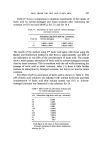
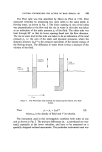
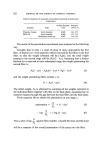
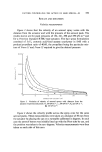
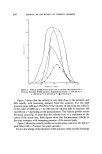
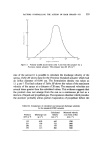
FACTORS CONTROLLING THE ACTION OF HAIR SPRAYS--Ill 561 which is open at both ends so that the gas stream and the particles can flow right through. Larger particles are then more efficiently captured by a com- bination of the inertial and direct interception mechanisms. When the array of fibres is backed by a solid plate most of the gas stream will be deflected around the front of the array. Small, low inertia particles will tend to follow the gas flow lines and any particles which do enter the array will travel only a small distance before losing their remaining inertia since the air within the array will be largely stagnant. Large particles will leave the gas flow lines much more easily to enter the fibre array and will then travel further because of their greater inertia. A second factor which could help to achieve greater penetration with larger particles is splitting of droplets on impact with hair fibres. This splitting is liable to be greater the greater the particle inertia. The droplet fragments so produced are then capable of further penetration into the array. (Received: 2nd May 1974) REFERENCES (1) Rance, R. W. Studies of the factors controlling the action of hair sprays--I: The spreading of hair spray resin solutions on hair. J. Soc. Cosmet. Chem. 24 501 (1973). (2) Rance, R. W. Studies of the factors controlling the action of hair sprays--II: The adhesion of hair spray resins to hair fibres. J. Soc. Cosmet. Chem. 25 297 (1974). (3) Rance, R. W. Particle size distribution measurement of hair sprays using an image-splitting particle size analyser. J. Soc. Cosmet. Chem. 23 177 (1972). (4) Light, W. The movement of aerosol particles. J. Soc. Cosmet. Chem. 23 657 (1972).

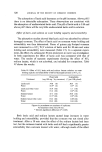
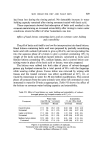
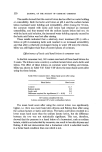
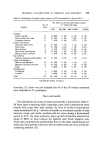
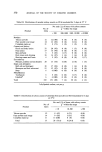
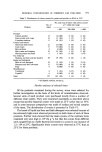
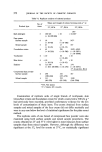
J. Soc. Cosmet. Chem. 25 563-575 (1974) ¸ 1974 Society of Cosmetic Chemists of Great Britain A survey of microbiological contamination in cosmetics and toiletries in the U.K. (97 BASIL JARVIS t, ALAN J. REYNOLDS, ANNETTE C. RHODES? and MICHAEL ARMSTRONG* Synopsis--One hundred and seventy-two toiletry and cosmetic items purchased in 1971 from retail outlets throughout England and Wales were examined microbiologically. Viable MICRO- ORGANISMS were not recovered from over 50 •o of the items tested and about 90 % contained fewer than 1000 organisms g-•. 75 •o of all POWDER PREPARATIONS tested did not contain viable SPORES of ANAEROBIC BACTERIA and none contained more than 300 spores of anaerobic bacteria g-L Of the anaerobes isolated, none was identified as Clostridium tetani. Coliform bacteria were not detected in any preparation of toothpaste or lipstick examined. Comparison of counts from the top and bottom ends of metal foil tubed products showed almost identical counts in most cases, but in two instances significantly higher counts were observed in the top (nozzle end) sample. Further analyses were performed on six or twelve replicate items of a single brand of seven product types to check the inter-sample variation in count. The results obtained confirmed the overall level of colony count observed previously for these products in some instances marked inter-sample variation in count was seen. INTRODUCTION Although many cosmetic, toiletry and pharmaceutical preparations contain preservatives (1-4) microbiological spoilage can still occur (5, 6). * National College of Food Technology, University of Reading, St. George's Avenue, Wey- bridge. •' Present address: British Food Manufacturing Industries Research Association, Randalls Road, Leatherhead, Surrey. 563
Purchased for the exclusive use of nofirst nolast (unknown)
From: SCC Media Library & Resource Center (library.scconline.org)