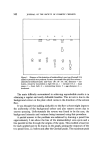
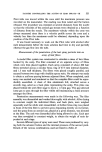
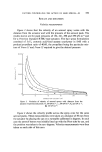
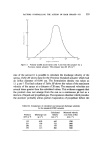
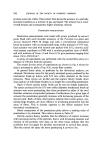
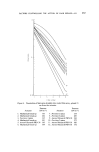
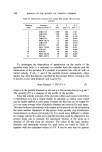
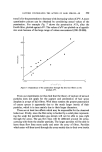
FACTORS CONTROLLING THE ACTION OF HAIR SPRAYS--III 559 trend is for the penetration to decrease with decreasing values of d 2 V. A more quantitative picture can be obtained by considering actual values of the penetration. For example Fig. 7 shows the penetration N/No after the fourth filter, plotted against d a V. The values of d a V are plotted on a logarith- mic scale because of the large range of values encountered (200-20 000). 0'3 0'2 0'1 o ol ¸ I I IO •'• •,(crn • Figure 7. Dependence of the penetration through the first four filters on the product d 2 V. From our experiments we thus find that the theory of capture of aerosol particles does not apply for the capture and penetration of hair spray droplets in arrays of hair fibres. With these systems the greater penetration of coarse sprays is apparently due to the much larger inertia of their particles, which is in turn mainly due to their larger diameters. There are at least two effects which may be responsible for the observed behaviour. Firstly, since the fibre array is backed by a solid plate represent- ing the scalp the particle-laden gas stream will not be able to pass right through the array. The gas flow lines will be deflected around the array, carrying with them the smaller particles. The larger particles will be able to leave these flow lines more easily and enter the array of fibres. Particles which enter will then travel through the array mainly due to their own inertia

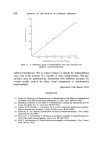
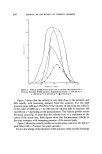
560 JOURNAL OF THE SOCIETY OF COSMETIC CHEMISTS since the gas within the array will probably be stagnant. The higher the inertia of the particles the further will they be able to penetrate. This effect will also be shown on the head. Many of the smaller particles will be deflected away by the gas flow around the head and only the larger particles, or the smaller particles at the very centre of the spray, will be deposited on the hair. The second effect which could produce greater penetration of the larger particles is incomplete capture of the particles by the hair fibres. The aerosol capture theory assumes that those particles which contact a fibre are com- pletely captured, but it is very likely that large high velocity particles might shatter on impact with the fibres, producing several smaller droplets which penetrate further into the array. Only a fraction of the initial droplet is retained at the first impact. This effect would become of greater significance when the particles approach or become larger than the diameter of the fibres, a condition which exists for many of the sprays studied. CONCLUSIONS Measurement of the velocity of aerosol sprays using a Pitot-static tube to measure the velocity of the gas stream rather than the actual particle velocity have shown that there is a velocity distribution across the spray cone. The velocity rises to a maximum at the centre of the cone and this maximum falls off with increasing distance from the actuator, and with decreasing pressure of the aerosol pack for a given distance from the actuator. The capture of hair spray droplets by arrays of fibres backed by a solid plate representing the scalp does not agree with the behaviour predicted from classical aerosol capture theory, that is that the fine sprays containing small droplets would be more penetrating than coarse sprays. In practice it has been found that coarse sprays are more capable of achieving penetration into the fibre array. It has been found that the penetration increases with increasing value of the product d•V where d is the mass median diameter of the aerosol spray, and V is the maximum velocity of the spray at a distance of 150 mm from the actuator. This was the experimental distance used between the actuator and the fibre array and corresponds approximately to the spraying distance used by the consumer. The observed capture behaviour can be explained in terms of the greater inertia of the larger particles which is necessary to carry the particles into the array of fibres. Normal aerosol capture experiments use a filter
Purchased for the exclusive use of nofirst nolast (unknown)
From: SCC Media Library & Resource Center (library.scconline.org)