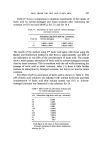
SKIN CREAM FOR DRY AND FLAKY SKIN 533 It is extensibility and not water content which is important for the corneum in its resistance to flaking and cracking. The water content is only important in so far as it affects extensibility. Lactic acid, therefore, appears to have a dual action on the corneum. It increases extensibility by increasing the water holding capacity in the same way as conventional humectants. This effect is lost on rinsing the corneum in water, but is sufficient to result in some effect on skin dryness and flaking as shown in the consumer tests with sodium lactate lotions. The second effect, which is not shown by con- ventional humectants, is that the adsorbed lactic acid increases extensibility. In treated and unrinsed corneum, there is no evidence of an additive effect between the extra water and the adsorbed lactic acid, and the effect of the adsorbed lactic acid only becomes apparent on rinsing. This means that the effect of lactic acid is likely to be more persistent than that of sodium lactate, and should therefore result in less skin dryness and flaking. This was confirmed in the results of the second consumer test where the comparison of the sodium lactate and lactic acid lotions showed that the lactic acid lotion results in a significantly better hand skin condition. (Received: 8th March 1974) REFERENCES (1) (2) (3) (4) (5) (6) (7) (8) (9) (lo) (•) Kligman, A.M. In: Montagna, W. and Lobitz, W. C. The epidermis 410 (1964) (Academic Press, New York). Middleton, J. D. The mechanism of water binding in stratum corneum. Brit. J. Dermatol. 80 437 (1968). Middleton, J. D. The effect of temperature on extensibility of isolated corneum and its relation to skin chapping. Brit. J. Dermatol. 81 717 (1969). Middleton, J. D. The influence of temperature and hun-fidity on stratum comeurn and its relation to skin chapping. J. Soc. Cosmet. Chem. 24 239 (1973). Speir, H. W. and Pascher, G. Zur analytischen und funktionellen Physiologie der Haut- oberfl•iche. Hautarzt 7 55 (1956). Jacobi, O.K. About the mechanism of moisture regulation in the horny layer of the skin. Proc. Sci. Sect. Toilet Goods Assoc. 31 22 (1959,. Blank, I. H. Factors about which influence the water content of the stratum corneum. J. Invest. Dermatol. 18 433 (1952) Middleton, J. D. The mechanism of action of surfactants on the water binding properties of isolated stratum corneum. J. Soc. Cosmet. Chem. 20 399 (1969). Acheson, D. T. In: Humidity and moisture measurement 3 521 (1965) (Reinhold, New York). Harry, R. G. In: The principles and practice of modern cosmetics 2 580 (1963) (Leonard Hill Books Ltd, London). Barker, S. B. and Summerson, W. H. The colorimetric determination of lactic acid in biological material. J. Biol. Chem. 138 535 (1941).

534 JOURNAL OF THE SOCIETY OF COSMETIC CHEMISTS (12) Bruno, G. A. and Christain, J. E. Determination of carbon-14 in aqueous bicarbonate solutions by liquid scintillation counting techniques. Anal. Chem. 33 1216 (1961). (13) Gibson, I. M. The evaluation of hand-care preparations. J. $oc. Cosmet. Chem. 24 31 (1973). (14) Laden, K. and Spitzer, R. J. Identification of a natural moisturizing agent in skin. J. $oc. Cosmet. Chem. 18 351 (1967). (15) Reese, G. Adsorption of carboxylic acids on hair keratin. Fette $eifen Anstrichm. 68 371 (1966).
Purchased for the exclusive use of nofirst nolast (unknown)
From: SCC Media Library & Resource Center (library.scconline.org)