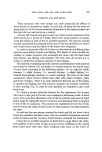
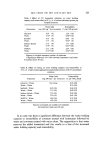
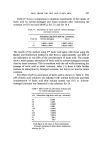
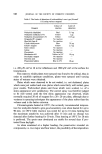
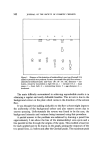
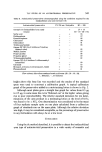
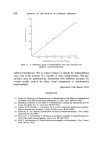
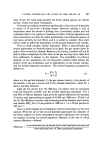
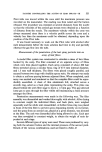
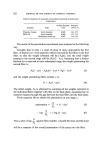
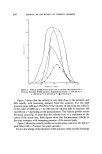
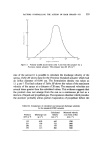
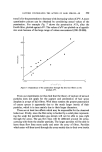
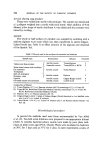
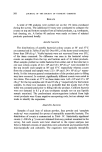
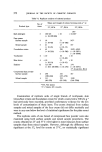
FACTORS CONTROLLING THE ACTION OF HAIR SPRAYS--Ill 555 20 ø I0 ø 0 ø I0 ø 20 ø Degrees of rotation Figure 5. Velocity profile across spray cone 5 cm from the actuator for a Precision 2-piece actuator. The pressure was 221 kN m -a. rate of the aerosol it is possible to calculate the discharge velocity of the sprays. Table III shows data for the Precision Standard actuator which had an orifice diameter of 0.041 cm. The formulation density was taken as 1.1 g cm -a. The final column of Table III shows the values of the maximum velocity of the sprays at a distance of 20 mm. The measured velocities are several times greater than the calculated values. This evidence suggests that the product does not emerge from the can as a continuous jet but as a mixture of liquid and propellant gas. The expansion chamber which precedes the atomizer probably allows partial evaporation of propellant before the Table III. Comparison of calculated and measured discharge velocities for the standard RTBU actuator Calculated Measured velocity Pressure Discharge rate velocity 2 cm from orifice (kN m -a) (g s -x) (cm s -•) (cm s -x) 152 0.92 645 1700 221 1.03 722 2600 290 1.11 778 3900 359 1.15 806 5200

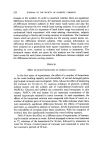
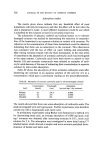
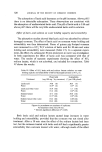
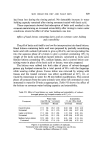
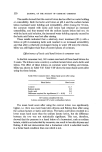
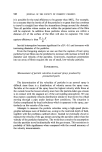
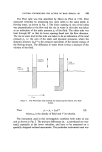
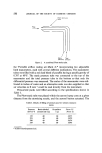
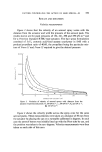
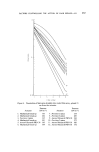
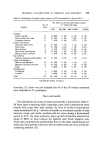
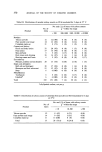
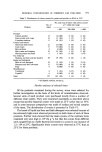
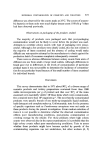
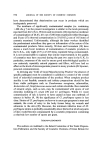
556 JOURNAL OF THE SOCIETY OF COSMETIC CHEMISTS product enters the orifice. The product then leaves the actuator in a partially atomized condition as a mixture of gas and liquid. The mixture has a lower overall density and consequently higher discharge velocity. Penetration measurements Penetration measurements were made with sprays produced by aerosol packs fitted with swirl chamber actuators of the Precision two-piece and Aerosol Research PKN 38 design and with a conventional mechanical break-up actuator with an exceptionally large orifice diameter of 0.75 mm. Each actuator was used with aerosol cans packed with 5.6•o crotonic acid/ vinyl acetate copolymer in IMS with a product/propellant ratio of 40/60, and with mixtures of Freon 11 and Freon 12 to give pressures ranging from about 138 to 359 kN m -•'. A series of experiments was performed with the model fibre array at a distance of 150 mm from the actuator. The results for the series of experiments are shown in Fig. 6 where the data is presented as plots of log N/No versus filter number. In general linear plots, as predicted by the theoretical analysis, are obtained. Deviations occur for the poorly atomized sprays produced by the mechanical break-up button with 0.75 mm orifice diameter at the lower pressures. These sprays are jet-like and the capture theory breaks down since capture of individual droplets is no longer the controlling mechanism. Figure 6 shows certain trends which can be seen by simple inspection. The sprays produced by the 0.75 mm orifice diameter mechanical break-up actuator were more penetrating than those produced by either of the swirl chamber actuators at equivalent pressures. Furthermore, for a given type of actuator the penetration generally increases with decreasing pressure of the aerosol pack. Both of these observations indicate that coarse sprays, con- taining large droplets, are more effective in producing penetration into the array of fibres. This is directly opposite to the effects expected from theoretical consideration. Direct comparison of the penetration plots allows a ranking order of penetration to be obtained. This order is shown in Table IV. Particle capture theory predicts that the efficiency of capture increases with increasing inertia of the particles, that is with increasing diameter and velocity of the particles. Our data, on the other hand, indicate that this condition does not apply for particles encountered in aerosol hair sprays. Thus the coarser the spray the more penetrating it proves to be.
Purchased for the exclusive use of nofirst nolast (unknown)
From: SCC Media Library & Resource Center (library.scconline.org)