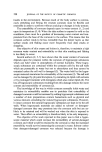
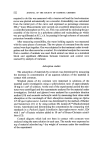
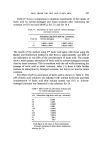
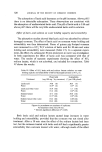
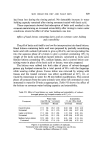
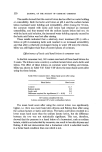
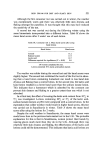
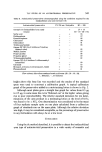
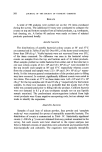
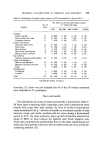
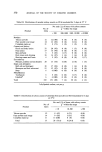
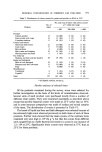
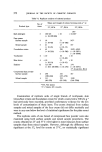
568 JOURNAL OF THE SOCIETY OF COSMETIC CHEMISTS RESULTS A total of 190 analyses were carried out on the 172 items purchased during the survey. The additional 18 tests were conducted to compare the counts on top and bottom samples from all tubed products, e.g. toothpaste, hair dressing, etc. A further 60 analyses were made on items of selected products purchased locally. Aerobic bacteria The distributions of aerobic bacterial colony counts at 30 ø and 37øC are summarized in Tables H and III. Over 80•o of the items tested contained fewer than 300 cfu g-•. Viable bacteria were not recovered from over 50•o of the items examined. No difference was seen in the bacterial colony counts on samples from the top and bottom ends of 16 tubed products. Most samples yielded no viable bacteria from either end of the tube but in one case colony counts of 2.6 x 10⁴ and 3.0 x 10⁴ cfu g-• were recorded for the top (nozzle end) sample at 30 ø and 37øC respectively whereas counts from the crimped end sample were 1.32 x 10⁵ and 1.34 x 10⁵ cfu g-X respec- tively. In this instance general contamination of the product prior to filling may have occurred. In contrast, significantly different counts were noted in two items. The counts at 37øC on these items were 1.65 x 10⁴ and 2.5 x 10 a cfu g-• for the top samples and 10 and 35 cfu g-• respectively for the bottom samples. In these two instances it is probable that the nozzle end of the tubes was contaminated prior to filling with the product. Coliform bacteria were not detected in 0.1 g of any toothpaste sample nor on any lipstick sample examined. The predominant microorganisms isolated from high count products were Gram negative non-sporing rods, but no attempt was made to identify the organisms. Anaerobic bacteria Samples of each item of talcum powder, face powder and 'complete make-up' were examined for spores of mesophilic anaerobic bacteria. The distribution of counts is summarized in Table IV. Statistically significant counts (300 cfu g-•) were not obtained from any product examined in the survey, but such counts were later observed in the repeat analyses (see below). Selected colonies of anaerobes were subcultured and examined both microscopically and culturally. The organisms were typically mesophilic

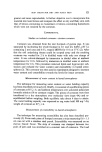
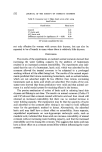
MICROBIAL CONTAMINATION OF COSMETICS AND TOILETRIES 569 Table II. Distribution of aerobic colony counts on PCA incubated for 3 days at 30 ø C No. of Product items No. and (5/o) of items with colony counts g-• within the range 300 300-1000 1001-10000 10000 Powders Talcum powder 12 12(100) 0 (0) 0 (0) 0 (0) Face powder and rouge 14 12 (86) 0 (0) 2 (14) 0 (0) Complete make-up 11 7 (64) 0 (0) 3 (27) 1 (9) Creams and lotions Hand and body lotion 21 19 (90) 1 (5) 1 (5) 0 (0) Face cream 17 12 (70) 2 (12) 1 (6) 2 (12) Skin perfume 6 4 (67) 2 (33) 0 (0) 0 (0) Hair cream and dressing 16 15 (94) 1 (6) 0 (0) 0 (0) Shaving cream and foam 6 5 (83) 0 (0) 0 (0) 1 (17) Eye make-up Mascara, eyeliner and eye shadow 20 13 (65) 3 (15) 1 (5) 3 (15) Soaps and detergents Bath oil and detergent 18 16 (89) 0 (0) I (6) I (6) Shampoo and hair colourant 13 12 (92) 0 (0) 1 (8) 0 (0) Soap 6 6 (100) 0 (0) 0 (0) 0 (0) Miscellaneous Toothpaste 6 6(100) 0 (0) 0 (0) 0 (0) Lipstick* 6 6(100) 0 (0) 0 (0) 0 (0) Total 172 145 (84) 9 (5) 10 (6) 8 (5) * cfu/lipstick surface, not per g. clostridia. Cl. tetani was not detected but 16 of the 50 isolates examined were identified as Cl. perfringens. Yeasts and moulds The distribution of counts of yeasts and moulds is presented in Table V. Of those items containing viable organisms, most were contaminated more heavily with yeasts than with moulds, the level of mould contamination rarely exceeding 50 cfu g-L Growth of moulds on moistened samples of cake mascara, rouge, and similar products did not occur during a three-month period at 25øC. On three occasions, heavy growth of bacteria occurred on plates of SDA. In each instance the bacteria were Gram negative rods, which also comprised the predominant flora of the items tested (liquid eye make-up). Such growth could have been avoided by the use of an antibiotic- containing medium (15).
Purchased for the exclusive use of nofirst nolast (unknown)
From: SCC Media Library & Resource Center (library.scconline.org)