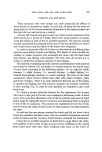
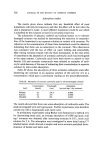
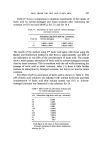
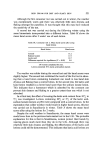
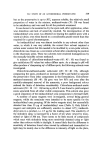
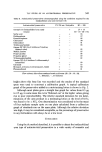
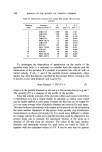
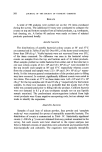
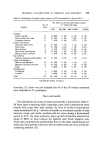
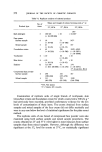
SKIN CREAM FOR DRY AND FLAKY SKIN 527 Table IV shows a comparison in duplicate experiments of the uptake of lactic acid by solvent-damaged and intact corneum after immersing the corneum in 0.01 mol acid (0.09•o) for 2 h and for 24 h. Table IV. Adsorption of lactic acid by solvent-damaged and intact corneum Adsorption (mg lactic acid mg -• corneum) Time (h) Solvent-damaged Intact 2 0.0089, 0.0089 0.0007, 0.0012 24 0.0094, 0.0093 0.0016, 0.0021 The results of the method using C x4 lactic acid agree with those using the Barker and Summerson method in that there is approximately one fifth of the adsorption at one fifth of the concentration of lactic acid. The results show a much greater adsorption of lactic acid by solvent-damaged corneum than by intact corneum. This is consistent with the cell walls preventing the passage of lactic acid in intact corneum. After 2 h there is little further increase in adsorption by damaged corneum, but this is not true for intact corneum. The effect of pH on adsorption of lactic acid is shown in Table V. The pH of lactic acid solutions was adjusted with sodium hydroxide and final concentration of lactic acid plus sodium lactate was 0.01 M. Solvent- damaged corneum was immersed in the solutions for 2h. Table V. Effect of pH on adsorption of lactic acid by solvent-damaged corneum pH Adsorption (mg lactic acid mg -• corneum) 2.9 0.009 3.0 0.009 3.4 0.0085 3.8 0.006 3.95 0.0045 4.2 0.0034 4.55 0.0020 4.85 0.0036 5.1 Zero 6.2 Zero Each figure is the mean of three experiments. Corneum immersed in 0.01M lactic acid/lactate solution for 2 h.

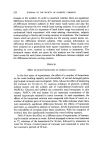
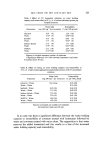
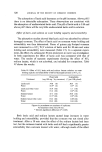
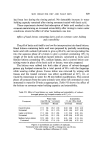
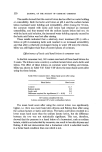
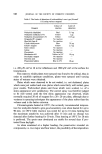
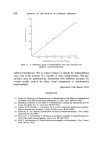
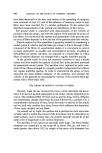
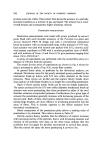
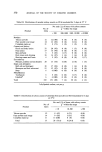
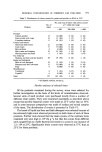
528 JOURNAL OF THE SOCIETY OF COSMETIC CHEMISTS The adsorption of lactic acid decreases as the pH increases. Above pH 5 there is no detectable adsorption. These observations are consistent with the adsorption of undissociated lactic acid. The pH of lactic acid is 3.88 and above pH 5 there will be very little undissociated lactic acid in solution. Effect of lactic acid solution on water holding capacity and extensibility The adsorption studies showed that lactic acid was adsorbed by solvent- damaged corneum. The effect of lactic acid on corneum water holding and extensibility was then determined. Pieces of guinea pig footpad corneum were immersed in a 105/o W/V solution of lactic acid for 30 min and water holding and extensibility were measured (Table VI). In a separate experi- ment, the effect of a subsequent 30 min immersion in water was investigated. In both experiments the effect of lactic acid was compared with that of water. The results of separate experiments showing the effect of 10• sodium lactate, which is not adsorbed, are included for comparison. Table VI shows the results. Table VI. Effect of 10% lactic acid and sodium lactate solution on water holding capacity and extensibility of solvent-damaged comeurn at 81 •o r.h. Treatment Water held Extensibility (mg 100 mg -• dry corneum) (% per 100 g load) Lactic acid 34.0 (6) 30.6 (6) Water 18.9' (6) 0.5* (6) Lactic acid then water 16.9 (10) 1.1 (10) Water 15.6 (10) 0.6* (10) Sodium lactate 47.3 (10) 29.8 (10) Water 19.1' (10) 0.9* (10) Sodium lactate then water 18.0 (10) 0.85 (10) Water 18.0 (10) 0.61 (10) Figures in parentheses are numbers of replicates. All treatment times were 30 min. * Denotes significant difference (P 0.05). Both lactic acid and sodium lactate caused large increases in water holding and extensibility, provided that the corneum was not rinsed after treatment. After a 30 min rinse the effect of the sodium lactate had been lost, but the corneum treated with lactic acid still had a significantly greater extensibility than corneum treated with water, although much of the effect
Purchased for the exclusive use of nofirst nolast (unknown)
From: SCC Media Library & Resource Center (library.scconline.org)