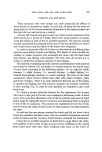
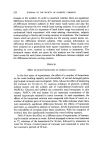
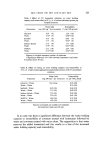
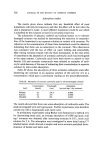
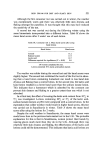
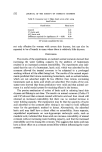
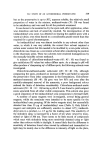
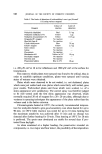
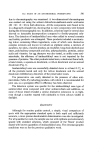
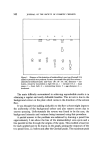
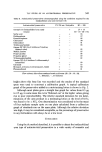
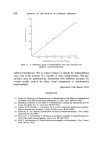
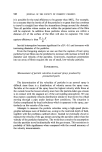
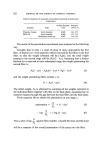
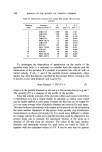
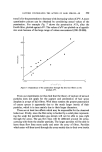
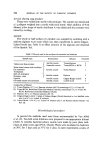
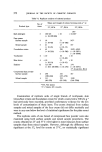
TLC STUDY OF AN ANTIMICROBIAL PRESERVATIVE 543 Table II. Antimicrobial preservatives chromatographed using the conditions required for the imidazolidinyl urea type (Germall 115) Anti-microbial preservative UV 254 nm Ninhydrin Rf x 100 Germall 115 (Imidazolidinyl urea type) -- + 27 + 35 (traces) (0 + 15 + 60 + 72) Sorbic acid -- + 86 Dichlorophene + -- 87 Hexachlorophene + -- 88 Chlorcresol q- -- 90 Chlorxylenol q- -- 91 Trichlorocarbanilide q- -- 88 Irgasan DP 300 (2,4,41-trichloro-2•-hydroxy diphenyl ether) q- -- 92 Methyl paraben + -- 85 Propyl paraben q- -- 88 Propylene glycol -- -- 69 Tribromosalicylanilide + -- 92 Irgasan CF3 (4,4X-dichloro-3-trifluoromethyl - carbanilide) + -- 89 Cetrimide -- + 65 Bronopol, (2-bromo-2-nitropropane-l,3-diol) + -- 80 Phenoxyethanol + -- 91 Flow solvent, chloroform-methanol-acetic acid-water (50: 30: 10: 10). +, Detected --, not detected. height above this base line was recorded and the results of the standard spots were used to construct a calibration graph. A typical calibration graph of the preservative added to a moisturizing lotion is shown in Fig. 2. Although most plates gave a straight line graph for values from 0.5 gg to 2.5 gg, in some cases the curve 'flattened out' at the higher values giving rise to poor reproducibility. The relative standard deviation for ten deter- minations of the urea product in a moisturing lotion at the level of 0.5• was found to be • 10•. One determination was considered to be the mean of four replicate sample spots on one plate calculated from a calibra5on graph of standards run on the same plate. Although the relative deviation was high, it may be Considered acceptable, as the percentage of preservative in any formulation will always be at a low level. CONCLUSION Using the tic method described, it is possible to detect the imidazolidinyl urea type of antimicrobial preservative in a wide variety of cosmetic and

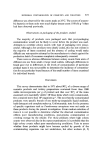
544 JOURNAL OF THE SOCIETY OF COSMETIC CHEMISTS Figure 2. 5O 40 30 •1 I I I I 0'5 1.0 1.5 2 0 2.5 I 3,0 lmidazolidinyl urea (Germoil 115)(p.g) A calibration graph of imidazolidinyl urea type (germall 115) added to a moisturizing lotion. toiletry formulations. The uv colour reaction is specific for imidazolidinyl urea, even in the presence of a number of other antimicrobials. The pre- servative may be quantitatively determined with sufficient accuracy for routine quality control by either visual comparison or densitometric measurements. (Received: 12th March 1974) REFERENCES (1) KOnig, H. Trennung und Identifizierung von Bactericiden auf der Basis von halogenierten Aromaten dutch DQnnschicht-Chromatographie. Z. Anal. Chem. 246 247 (1969). (2) Karleskind, Valmalle, G and Wolff, J.P. Identification et dosage des bact•ricides dans les savons de toilette. Rev. Ft. Corps Gras 19 297 (1972). (3) Graber, M. B., Domsk•, I. I. and Ginn, M. E. A TLC method for identification of germi- cides in personal care products. J. Amer. Oil Chem. Soc. 46 529 (1969). (4) Schwartz, H. Zur Analyse antimikrobiell wirksamer Waschmittelzusfitze. Fette, Seifen, Anstrichm. 71 223 (1969). (5) Porcaro, P. J. and Shubiak, P. Detection of nanogram quantities of hexachlorophene by ultra violet liquid chromatography. Anal. Chem. 44 1865 (1972). (6) Wolf, T. and Semionow, D. Rapid liquid chromatography of bacteriostats. J. Soc. Cosmet. Chem. 24 363 (1973).
Purchased for the exclusive use of nofirst nolast (unknown)
From: SCC Media Library & Resource Center (library.scconline.org)