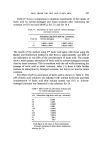
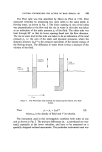
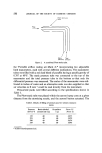
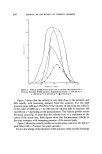
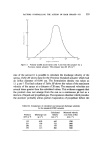
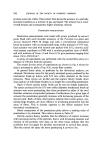
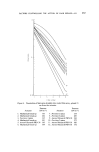
FACTORS CONTROLLING THE ACTION OF HAIR SPRAYS--III 551 Pitot tube was moved within the cone until the maximum pressure was recorded on the manometer. The reading was then noted and the button released. The procedure was repeated at several distances from the nozzle so that the velocities of the aerosol gas stream were obtained as a function of distance from the nozzle. The maximum velocity within the cone was always measured since there is a velocity profile across the cone and a velocity less than the maximum could be obtained, depending upon the position of the Pitot tube. It was found necessary to wash out the Pitot tube with alcohol after each measurement before the resin solution had time to dry and partially obstruct the gas flow into the tube. Measurement of the penetration of the hair spray particles into an array of hair fibres A model filter system was constructed to simulate a mass of hair fibres backed by the scalp. The filter consisted of six separate arrays of fibres which were then placed together. Each array consisted of about 200 hair fibres stretched across a circular brass ring of 47.5 mm internal diameter, and 1.5 mm wall thickness. The fibres were placed roughly parallel, and secured between two rings with Araldite epoxy resin. No attempt was made to obtain a uniform spacing between adjacent fibres. When completed, each array was marked and numbered so that the complete filter could be repro- ducibly assembled. A sheet of thin aluminium foil, attached across a seventh ring, acted as a back plate representing the scalp. This plate was placed behind the sixth filter stage to leave a 1.5 mm gap. This gap allowed some gas to pass through the filter whilst still maintaining a back pressure amongst the fibres. Penetration measurements were made in the following way. The filter assembly was dismantled and washed thoroughly with alcohol. After drying to constant weight the individual filters, and back plate, were weighed separately and the whole unit reassembled. A further brass ring was placed in front of the first filter to prevent spray depositing directly on its former, and the spray from an aerosol can, placed at a given distance, was directed at the filter. The unit was dismantled after being allowed to dry. Each part was then reweighed to constant weight, to obtain the weight of resin de- posited at each stage. Several different types of spray were used. These were produced by vary- ing both the actuator button and the internal pressure of the aerosol pack. Details of the various combinations used are listed in Table II.

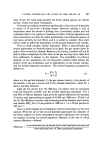
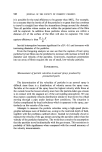
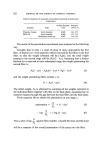
552 JOURNAL OF THE SOCIETY OF COSMETIC CHEMISTS Table II. Summary of actuators and products examined in penetration experiments Orifice diameter Pressures Actuator Type (cm) (kN m -a) Precision 2-piece Swirl chamber 0.045 145-372 PKN-38 Swirl chamber 0.040 152-372 Mechanical break-up 0.075 165-359 The results of the penetration experiments were analysed in the following way. Consider that in time t a total of (No)g of spray approaches the first filter. A fraction Ax of the particles will be removed by the fibres in the first filter, so that the weight collected will be (No)AX, and the total weight passing to the second stage will be (No)(1 -Ax). Assuming that a further fraction Ax is removed at each subsequent stage, the weight penetrating the second filter is: No(1 - Ax) - NoAx(1 - Ax) = No(1 - Ax) • (3) and the weight penetrating filter number y is: N = No(1 - Ax) y. (4) The initial weight, No, is obtained by summing all the weights captured on the individual filters together with that on the back plate, assuming that no material escapes through the gap between the final filter and the back plate. From equation (4) we obtain the penetration at any stage y: N penetration - - (1 - Ax) • (5) No N .'. log - y log (1 - Ax). (6) No N Thus a plot of log •oo against filter number y should be linear and the slope will be a measure of the overall penetration of the spray into the filter.
Purchased for the exclusive use of nofirst nolast (unknown)
From: SCC Media Library & Resource Center (library.scconline.org)