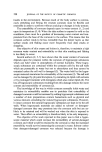
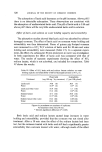
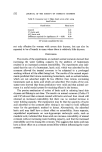
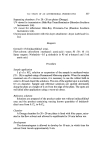
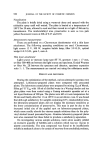
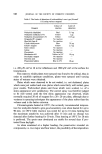
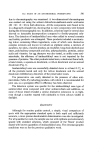
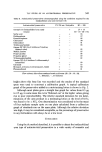
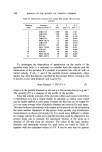
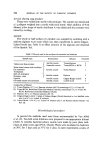
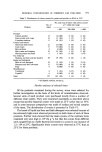
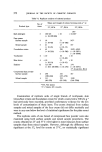
558 JOURNAL OF THE SOCIETY OF COSMETIC CHEMISTS Table IV. Penetration of sprays into model filter placed 150 mm from actuator Ranking Actuator/ d V d s V order pressure (kN m -s) (l•m) (cm s -•) (cm 3 s-x) 1 MBU/165 1000 200 2.00 2 MBU/262 500 400 1.00 3 P2P/165 270 200 0.146 4 MBU/303 121 450 0.066 5 PKN-38/165 75 400 0.023 6 MBU/359 81 600 0.039 7 P2P/214 225 400 0.203 8 PKN-38/283 160 200 0.051 9 P2P/234 100 450 0.045 10 P2P/372 60 600 0.022 11 PKN-38/303 80 450 0.029 12 PKN-38/372 63 600 0.024 To investigate the dependence of penetration on the inertia of the particles more fully, it is necessary to consider both the velocity and the dimensions of the particles. If a particle is projected into still air with an initial velocity V cm s -1, and if the particle motion subsequently obeys Stokes law, then the distance travelled by the particle before coming to rest is known as the 'stop distance' and is given by: 'stop distance' = 307 d 2 p V (7) where d is the particle diameter in cm and p is the particle density in g cm -a. The quantity d2V is a measure of the inertia of the particle. Since the velocity and size of the particles within each spray both follow a distribution it is not a simple matter to calculate an inertia value which can be rigidly applied to each spray. Perhaps the best that can be hoped for is to use some average value of particle diameter and velocity for each spray. This may be done conveniently with respect to the particle size by calculating the mass median diameters of the sprays from particle size distribution measurements as shown previously (3). It is much more difficult to obtain an average velocity for each spray and the best that could be obtained in the present study was to measure the maximum velocity of the spray at a distance of 150 mm from the actuator. The values of the mass median diameter and maximum velocity for each spray are listed in Table IV together with the calculated values of d•V. It can be seen that the general

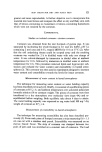
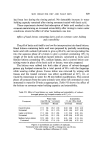
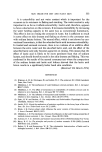
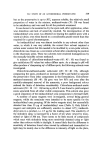
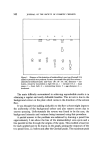
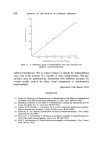
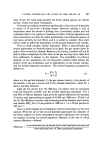
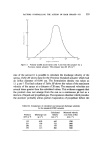
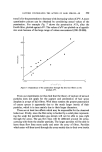
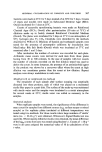
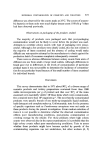
FACTORS CONTROLLING THE ACTION OF HAIR SPRAYS--III 559 trend is for the penetration to decrease with decreasing values of d 2 V. A more quantitative picture can be obtained by considering actual values of the penetration. For example Fig. 7 shows the penetration N/No after the fourth filter, plotted against d a V. The values of d a V are plotted on a logarith- mic scale because of the large range of values encountered (200-20 000). 0'3 0'2 0'1 o ol ¸ I I IO •'• •,(crn • Figure 7. Dependence of the penetration through the first four filters on the product d 2 V. From our experiments we thus find that the theory of capture of aerosol particles does not apply for the capture and penetration of hair spray droplets in arrays of hair fibres. With these systems the greater penetration of coarse sprays is apparently due to the much larger inertia of their particles, which is in turn mainly due to their larger diameters. There are at least two effects which may be responsible for the observed behaviour. Firstly, since the fibre array is backed by a solid plate represent- ing the scalp the particle-laden gas stream will not be able to pass right through the array. The gas flow lines will be deflected around the array, carrying with them the smaller particles. The larger particles will be able to leave these flow lines more easily and enter the array of fibres. Particles which enter will then travel through the array mainly due to their own inertia
Purchased for the exclusive use of nofirst nolast (unknown)
From: SCC Media Library & Resource Center (library.scconline.org)