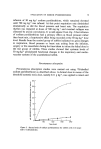
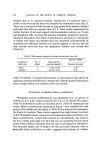
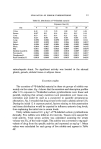
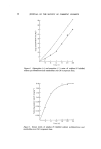
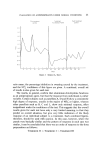
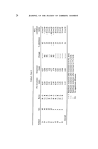
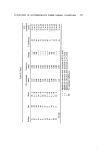
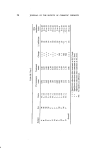
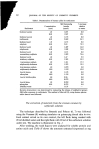
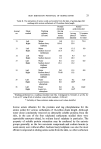
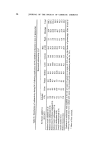
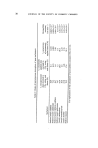
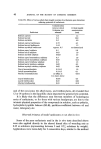
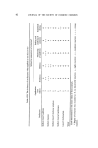
EVALUATION OF ANTIPERSPIRANTS UNDER NORMAL CONDITIONS 27 It is likely that this order is a dosage effect, and that the effect of the vehicle is minimal. The actual sweating rates for panellists were, as anticipated, very variable, but it was noted that certain panellists, noteably E and F, sweated cdn- sistently at a much greater rate, an average of 20-30 times greater, than many of the others. In a normal 3 h sweat collection period up to 5 g of sweat could be collected from one axilla in the case of these subjects, whereas some of the other panellists rarely gave more than 0.2 g. There was no indication that initial rate of sweating influenced the response to aluminium chlorhydrate treatment. It is also of interest to note that, whereas the majority of panellists have a ratio approaching unity, certain individuals, notably panellists D and F, sweat also twice as much on one arm as on the other. As there was only one left-handed panellist, whose ratio was close to unity, the effect of right- or left-handedness of an individual sweating ratio could not be assessed. CONCLUSIONS A test method has been developed whereby it has been possible to assess the effectiveness of antiperspirant preparations under normal or near normal conditions of use. Three preparations containing aluminium chlorhydrate have been tested on panels of 11-12 subjects who used the preparations twice daily, and significant (1 in 1000) overall sweat reductions were ob- tained of a magnitude varying from 18 to 36•o. These results agree with other workers (6, 9). The most important single result appears to be that the response of individuals to the various aluminium chlorhydrate preparations is very varied. Some subjects responded significantly with a reduction in sweating as high as 60•, and in the region of 40• for all three preparations, whereas others consistently gave nil or marginal results. It is, therefore, misleading to quote overall panel sweat reduction figures obtained under normal con- ditions of use, unless they are qualified by giving the range of individual responses, which in this case was from insignificant responses, usually within 4-20•o, to very high significant responses in the region of 40-60•o. ACKNOWLEDGMENT The author would like to thank the Statistical Services Unit of the

28 JOURNAL OF THE SOCIETY OF COSMETIC CHEMISTS Reckitt and Colman Group Management Services Department for their contribution to the paper. (Received: 19th August 1973) REFERENCES (1) Daley, E. W. Antiperspirant testing--a comparison of two methods. Proc. Sci. Sect. T.G.A. 3O 1 (1958). (2) James, R. J. A new and realistic electronic approach to the evaluation of antiperspirant activity. J. Soc. Cosmet. Chem. 17 749 (1966). (3) Fredell, W. G. and Read, R. R. Antiperspirant--Axillary method of determining effective- ness. Proc. Sci. Sect. T.G.A. 15 23 (1951). (4) Fredell, W. G. and Longfellow, Dr J. Report on evaluating antiperspirant and deodorant products. J. $oc. Cosmet. Chem. 9 108 (2) (1958). (5) Martin, J. J. Jr and Rubino, A. B. Antiperspirants expand underarm cosmetic market. Aerosol Age (April) (1969). (6) Wooding, W. M. et al. Statistical evaluation of quantitative antiperspirant data. J. $oc. Cosmet. Chem. 15 579 (1964). (7) Moroney, M. J. Facts and figures 233 (1969) (Pelican, London). (8) Finhey, D. J. Statistical method in biological assay 27 (1964) (Griffin). (9) Brun, R. Studies on perspiration. J. Soc. Cosmet. Chem. 10 70 (1959).
Purchased for the exclusive use of nofirst nolast (unknown)
From: SCC Media Library & Resource Center (library.scconline.org)