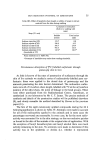
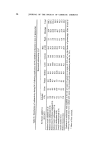
6O JOURNAL OF THE SOCIETY OF COSMETIC CHEMISTS intraperitoneal or subcutaneous administration. It was thus thought valid to assume that [•4C] surfactant penetrating the skin and entering the blood stream would be excreted at a similar rate. The turnover of the C•4: 0, Cx6: 0 and C•8: 0 soaps was slow but for the other [•4C] surfactants levels of •4C in the excreta could be used as good indications of percutaneously absorbed material. The in vivo techniques used in this study have been used for a variety of consumer type applications to experimental animals and have been shown to be reproducible for a number of compounds (15). The limit of detection for this type of assay is governed by the specific activity of the isotopically-labelled compound, the dilution in metabolic pools of the test animals and the overall counting efficiency for the isotope in these pools. For [•4C] labelled compounds, routine assays of 24 h collections of urine, faeces and expired CO2 gave limits of accurate measurement of 2.0, 5.0 and 10.0 x 10 a dpm of •4C respectively. For analysis of whole carcass a limit of accurate measurement of 1 x 10⁴ dpm is possible. These limits have been set by taking a count rate of twice background as the limit of sensitivity. Thus, in this #7 vivo study 0.1 gg of [•4C] surfactant penetrating per cm • of skin could be measured. The exception is the [•4C] SDI which had the lowest specific activity [1.7 gCi mg -•] for which the limit of sensitivity was 0.3 [tg cm -2. Penetration of the [•4C] soaps in vivo followed the same order as those obtained with excised human epidermis, i.e. C•2: 0C•0: oC•4: 0 C•6: o-•-C•8: o. The actual amounts of soap which penetrated from the 15 rain wash and rinse applications to untreated skins with the 6 mM soap solutions ranged from0.674-0.34 I•g cm-" for the C•,: 0 to 0.7-+-0.02 !lg for the C•s: o. These amounts are considerably higher than those predicted from the in vitro study with excised rat skin. Prewashing the skin with 300 mM model soap solution--approximately 7.5•o w/v solution which is similar to that found during consumer use, increased the permeability of the skin, especially for the Clo: o and the Ci•: o soaps. With regard to the synthetic detergents, the small amounts of SDS penetrating the skin (0.264-0.09 Isg cm -•) from the application in vivo with a 25 mM solution, was not predictable from the in vitro studies. Blank and Gould (12) also found no measurable penetration in vitro of SDS which is inconsistent with the known irritancy of SDS to skin. Sprott (3) showed that SDS could penetrate rat skin, but in that study, based on urinary levels after washing with [asS] SDS, some of the urinary aaS could have been due to the animal ingesting [aaS] SDS deposited on the skin.

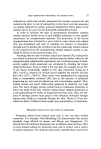
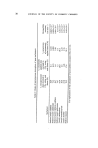
PERCUTANEOUS ABSORPTION OF ANIONIC SURFACTANTS 61 The SDI penetration in vivo was below our limits of accurate measure- ment in this study, i.e. 0.3 gg cm -2 penetrated from a 15 min wash and rinse. Small amounts of •4CO•. were detected frpm the topically treated animals (approximately 10 cpm above background) which indicated that small amounts (0.1-0.2 I, tg cm -•) did penetrate in vivo. Subsequent experi- ments with [•4C] SDI with a specific activity of 17.6 gCi mg 4 have confirmed that small amounts (0.09 gg cm -2 from a 15 rain application of a 10 m•t solution) did penetrate from this type of application. The penetration of the DOBS isomer was below our limits of detection (0.1 gg cm -•) for all experiments. This is probably due to the very low solubility of this isomer (•----0.3 mM at 37 ø) which although present in com- mercial dodecylbenzene sulphonate, is not typical of DOBS. The 3.0 mM suspension used in the topical studies at 37 ø was below the critical micellar concentration of this DOBS isomer. Thus the in vivo studies show that all of these [•C] surfactants penetrate rat skin with the exception of the [•C] DOBS, the solubility of which was very low. From the in vivo penetration data presented, it can be seen that there is an order of magnitude difference between the most penetrating of the soaps (Cx•: 0-0.6 gg cm -•) and the least penetrating (C18: 0-0.07 gg cm -•) when applied as 6 mu solutions. The penetration of the synthetic surfac- tants from 25 mM solutions showed that some 0.25 pg of SDS and 0.15 gg of SDI penetrated per cm a of skin. Thus, provided a linear relationship between the amount penetrating and concentration of these surfactants in the applied solution exists, then the C•: 0 soap is about ten times as pene- trating as SDS or SDI which penetrate at similar rates to the C•8: 0 soap. Autoradiography of the treated skins from the 15 min wash and rinse applications showed deposition of surfactant on the skin surface and in the hair follicles especially at their entrances. This deposition suggests that penetration occurs both transepidermally and via the hair follicles which have been regarded as the main source of penetration for applications of short duration (16, 17). The presence of •C in the epidermis and upper dermis at 6 h after application of the C•o: 0 and Cx•.: 0 soaps shows the penetration of these soaps but gives no indication when they penetrated. Penetration may have occurred only during the 15 min washing time but penetration may also have taken place from the labelled soap deposited on the skin surface. The fact that the rate at which •CO2 was recovered from the animals washed with C•: 0 soap was slightly slower than from animals injected with C•: 0 soap may be a reflection of the route of administration
Purchased for the exclusive use of nofirst nolast (unknown)
From: SCC Media Library & Resource Center (library.scconline.org)