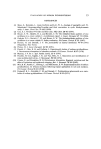
28 JOURNAL OF THE SOCIETY OF COSMETIC CHEMISTS Reckitt and Colman Group Management Services Department for their contribution to the paper. (Received: 19th August 1973) REFERENCES (1) Daley, E. W. Antiperspirant testing--a comparison of two methods. Proc. Sci. Sect. T.G.A. 3O 1 (1958). (2) James, R. J. A new and realistic electronic approach to the evaluation of antiperspirant activity. J. Soc. Cosmet. Chem. 17 749 (1966). (3) Fredell, W. G. and Read, R. R. Antiperspirant--Axillary method of determining effective- ness. Proc. Sci. Sect. T.G.A. 15 23 (1951). (4) Fredell, W. G. and Longfellow, Dr J. Report on evaluating antiperspirant and deodorant products. J. $oc. Cosmet. Chem. 9 108 (2) (1958). (5) Martin, J. J. Jr and Rubino, A. B. Antiperspirants expand underarm cosmetic market. Aerosol Age (April) (1969). (6) Wooding, W. M. et al. Statistical evaluation of quantitative antiperspirant data. J. $oc. Cosmet. Chem. 15 579 (1964). (7) Moroney, M. J. Facts and figures 233 (1969) (Pelican, London). (8) Finhey, D. J. Statistical method in biological assay 27 (1964) (Griffin). (9) Brun, R. Studies on perspiration. J. Soc. Cosmet. Chem. 10 70 (1959).

J. Soc. Cosmet. Chem. 26 29-46 (1975) ¸ 1975 Society of Cosmetic Chemists of Great Britain Factors which determine the skin irritation potential of soaps and detergents COLIN PROTTEY and TERRY FERGUSON* Presented on 28th August 1974 in London at the IFSCC VIIIth International Congress on 'CosmeticsmQuality and Safety' organized by the Society of Cosmetic Chemists of Great Britain. Synopsis---Skin-surfactant interactions have been examined using specific laboratory tesis with a series of pure SURFACTANTS. Effects of these compounds upon the STRATUM CORNEUM have been studied by means of KERATIN denaturation and the extraction of PROTEINS and AMINO ACIDS. It was found that strongly ANIONIC SURFACTANTS, such as sodium LAURYL SULPHATE, sodium LAURYL ETHER SULPHATE and sodium LAUROYL ISETHIONATE (Igepon A) had considerable activity, by virtue of their polar head groups, whereas sodium laurate and non-ionic ethoxylates had minimal effect upon the stratum corneum. The effect of lipophilic chain length of the surfactants was important in their overall activity, in particular, the lauryl moiety. PERCUTANEOUS ABSORPTION of RADIOACTIVELY-LABELLED surfactants by guinea-pigs in vivo has been studied sodium laurate and lauryl triethoxylate penetrated to a far greater extent than other compounds: lauryl hexaethoxylate, sodium lauroyl isethionate and sodium lauryl triethoxy sulphate, had lower penetrabilities and sodium lauryl sulphate and sodium LAURYL SULPHONATE were lower still. The effect of pure surfactants upon living cells was studied by means of measuring HISTAMINE release from rat peritoneal MAST CELLS in vitro. ALKYL SULPHATES, ALKYL ETHER SULPHATES and alkyl tri- and hexaethoxylates were potent mast cell lysins, whereas monoethoxylate and sodium laurate and sodium lauroyl isethionate were less effective. Chain-length studies showed that the capryl, lauryl- and myristyl moieties were the most potent lipophilic groups for releasing histamine. Some of these surfactants were applied directly to the skin of RATS and the overall skin response determined by visual examination. Sodium laurate caused erythema after 24 h applica- * Environmental Safety Division, Unilever Research Laboratory, Colworth House, Sharnbrook, Bedford. 29
Purchased for the exclusive use of nofirst nolast (unknown)
From: SCC Media Library & Resource Center (library.scconline.org)