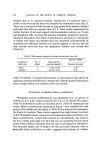
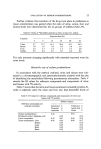
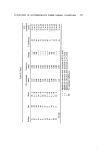
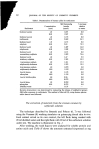
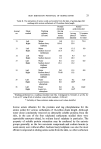
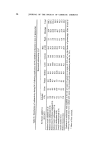
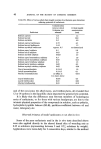
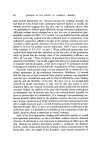
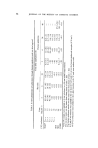
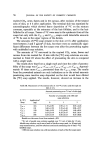
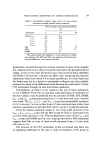
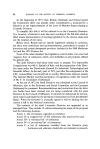
56 JOURNAL OF THE SOCIETY OF COSMETIC CHEMISTS expired CO•., urine, faeces and in the carcass, after excision of the treated area of skin, at 6 h after application. The terminal skin was examined by autoradiography which showed heavy deposition of x4C on the stratum corneum, especially at the entrances of the hair follicles, and in the hair follicles for all soaps. Traces of •4C were seen in the epidermis from all the soaps but only with the Cx•.: o and Cx•: o soaps could detectable amounts of •sC be seen in the upper regions of the dermis. The amounts of [x•C] soap present in the skin at 6 h after application were between 2 and 5 gg/cm •' of skin, but there were no statistically signi- ficant differences between the five soaps even after the prewashing regime with unlabelled soap solution. The amounts of x•C recovered in the expired CO•., urine, faeces and carcass from rats washed for 15 min with the [•4C] soap solutions are sum- marized in Table III where the effect of prewashing the skin is compared with a single wash. The results show that from a single wash and rinse the order of penetra- bility of the soaps was C•.: o C•o: o • C•: o Cx6: o -•- C•s: o. Approxi- mately 10 times more C•.: o penetrated than the C•6: o soap. The results from the prewashed animals are only indications as to the actual amounts penetrating since inactive soap deposited on the skin would have diluted the [•C] soap applied. The results, however, showed an increase in the Table III. Penetration of the sodium salts of n-[1-•4C] fatty acids through rat skin in vivo Amount penetrating over 7.5 cm 2 of skin (11g) Number of prewashes with 300 soap solutions [1-•4C] Application* Soap (Isg) 0 1 3 Cxo: o 116 1.78 5:0.70 2.99 4-1.71 8.92 4-4.26 C•a: o 131 5.06 5:2.59 5.29 5:3.44 9.04 5:2.57 C•4 :o 150 2.044-0.39 1.525:0.42 1.605:0.18 Cxo :o 167 0.53 5:0.18 0.554-0.17 0.634-0.16 C•o :o 184 0.53 5:0.14 0.365:0.13 0.355:0.02 Results are the mean from three animals 4-SD. * 0.1 ml of model soap solution applied over 7.5 cm 2 of skin for 15 min. Model soap solution was 6 mm of each of the five soaps used, i.e. 30 mM total soap concentration, and five solutions used each containing one of the [1-x•C] labelled soaps. 'l' 300 mM soap solution was a 60 mM solution of each of the five soaps used.

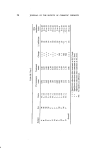
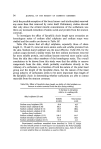
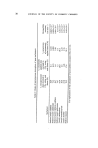
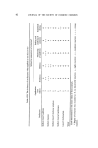
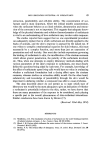
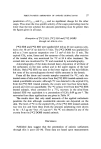
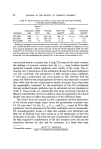
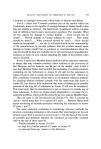
PERCUTANEOUS ABSORPTION OF ANIONIC SURFACTANTS 57 penetration of C10: 0 and C19,: 0 and no significant change for the other soaps. Thus since the true specific activity of the soaps penetrating must be lower than the test solution the amounts penetrating must be greater than the figures given in all cases. Absorption of [x4C] SLS, [•4C] SDI and [•C] DOBS through rat skin in vivo [x4C] SDS and [•4C] SDI were applied (0.5 ml) as 25 mM aqueous solu- tions over 10 cm •' of rat skin for 15 min. The [•4C] DOBS was applied (0.2 ml) as a 3 m•t aqueous suspension over 7.5 cm •' of skin for 15 min. The expired CO•., urine, faeces and the carcasses of the animals, after excision of the treated skin, was monitored for •4C at 24 h after treatment. The excised skin was monitored for •4C and examined by autoradiography. Autoradiography of the skins showed heavy deposition of all three of the surfactants on the skin surface and in the upper regions of the hair follicles. Only [uC] SDS was seen in the lower regions of the hair follicles but some of the autoradiograms showed visible amounts in the dermis. From all the tissue and excreta samples examined for •4C, only the treated areas of skin and the urine from the [•4C] SDS treated animals con- tained quantifiable amounts although •4C was detected in the expired CO•. from the [•C] SDI treated animals, the counts were less than twice back- ground and were not quantifiable. The •C urinary level from the [•4C] SDS treated animals, when corrected for a 775/0 recovery in the urine from injected SDS was equivalent to a penetration of 0.264-0.09 [tg cm -•'. The recoveries from these applications are given in Table IV. The results show that only small amounts of the applied surfactants penetrate the skin although considerable amounts are deposited on the skin. The level of •4C in the expired CO•. of the [•4C] SDI treated animals was very low and from these levels the amounts penetrating were shown to be :0.3 [tg cm -x but 0.1 [tg cm -•'. No 14C was detected in any of the excreta from the [•4C] DOBS treated animals. DISCUSSION Published data suggest that the penetration of anionic surfactants through skin is poor (12-14). These data are based upon measurements
Purchased for the exclusive use of nofirst nolast (unknown)
From: SCC Media Library & Resource Center (library.scconline.org)