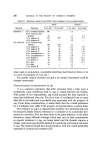
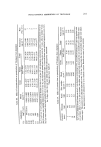
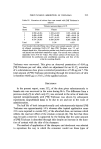
186 JOURNAL OF THE SOCIETY OF COSMETIC CHEMISTS Reasonably exaggerated exposure in cosmetic safety evaluation may theoretically be achieved by designing 'in use' tests. Human volunteers use the test material for a few weeks with more frequent applications than would normally be made and subject to repeated examination for adverse effects. Such a procedure may involve a risk that the investigator will be unable to control the amount and frequency of application effectively and that comparisons with suitable controls may be difficult to arrange. Unless the conditions of testing prove suitable for achieving threshold responses, interpretation may depend on negative findings which will limit the relia- bility of the study. 'In use' testing warrants serious consideration, however, as an alternative to the highly empirical, grossly exaggerated procedures currently favoured by some investigators. ACKNOWLEDGMENT The authors are indebted to Mr J. Brown for the data given in Table 11I. (Received: loth April 1974) REFERENCES (1) Frazer, A. C. Pharmacological Aspects of Chemicals in Food. Endeavour 12 43 (1953). (2) Phillips, L., Steinberg, M., Maibach, H. I. and Akers, W. A. A comparison of rabbit and human skin response to certain irritants. ToMcol. Appl. Pharmacol. 21 369 (1972). (3) Yankell, S. L. Animal studies as predicters of skin irritants. CTFA Cosmet. J. 4 8 (1973). (4) Malkinson, F. D. Studies on the percutaneous absorption of C '4 labelled steroids by use of the gas-flow cell. J. Invest. Dermatol. 31 19 (1958), (5) Spearman, R. I. C. The Integument 125 (1973) (Cambridge University Press, London). (6) Bartek, M. J., La Budde, J. A. and Maibach, H. I. Skin permeability in vivo: comparison in rat, rabbit, pig and man. J. Invest. Dermatol. 58 114 (1972). (7) Davies, R. E. Toxicological appraisal of cosmetics. Soap, Perrum. Cosmet. 40 887 (1967). (8) Finkelstein, P., Laden, K. and Miechowski, W. New methods for evaluating cosmetic irritancy. J. Invest. Dermatol. 40 11 (1963). (9) Freeman, M. V., Alvarez, E. and Draize, J. H. Cutaneous absorption of phenol from intact and damaged skin. Fed. Proc. 9 273 (1950). (10) Draize, J. H., Woodward, G. and Calvery, H. O. Methods for the study of irritation and toxicity of substances applied topically to the skin and mucous membranes. J. Pharmacol. Exp. Therap. 82 377 (1944). (11) Gaunt, I. F. and Harper, K. H. The potential irritancy to the rabbit eye of certain com- mercially available shampoos. J. Soc. Cosmet. Chem. 15 209 (1964). (12) Van Abb6, N.J. Eye irritation: studies relating to responses in man and laboratory animals. J. Soc. Cosmet. Chem. 24 685 (1973). (13) Kligman, A.M. and Wooding, W. M. A method for the measurement and evaluation of irritants on human skin. J. Invest. Dermatol. 49 78 (1967).

EXAGGERATED EXPOSURE IN PREDICTIVE TESTING 187 (14) Uttley, M. and Van Abb6, N. J. Primary irritation of the skin mouse ear test and human patch test procedures. J. Soc. Cosmet. Chem. 24 217 (1973). (15) Marzulli, F. N. and Maibach, H. I. Antimicrobials: experimental contact sensitization in man. J. Soc. Cosmet. Chem. 24 399 (1973). (16) Hardy, J. Allergy, hypersensitivity and cosmetics. J. Soc. Cosmet. Chem. 24 423 (1973). (17) Kligman, A.M. The identification of contact allergens by human assay. III. The maximiza- tion test: a procedure for screening and rating contact sensitizers. J. Invest. Dermatol. 47 393 (1966). (18) teLintum, J. C. A. and Nater, J.P. On the persistence of positive patch test reactions to balsam of Peru, turpentine and nickel. Brit. J. Dermatol. 89 629 (1973). (19) Maguire, H. C. Jr. The bioassay of contact allergens in the guinea-pig. J. Soc. Cosmet. Chem. 24 151 (1973).
Purchased for the exclusive use of nofirst nolast (unknown)
From: SCC Media Library & Resource Center (library.scconline.org)