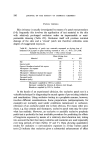
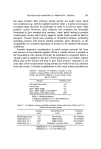
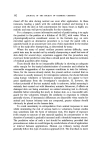
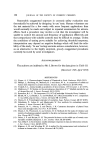
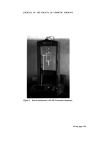
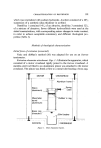
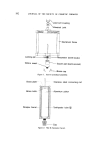
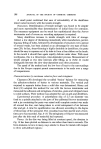
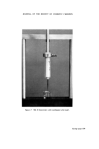
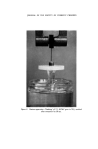
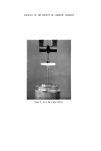
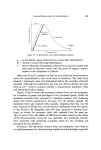
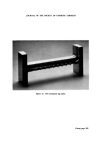
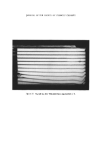
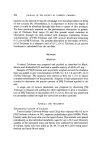
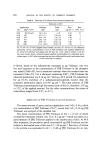
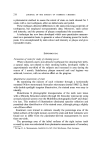
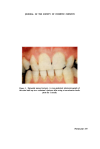
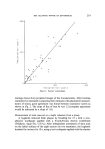
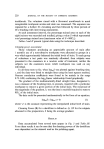
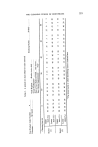
192 JOURNAL OF THE SOCIETY OF COSMETIC CHEMISTS Orifice insert •••Load c II I' e coupling i• Universal joint l lStator [Crosshead lJ Aluminium frame Locking pin• •-'•"-----Rheometer barrel locator I •'"'•'•- Swivel joint (ball & socket) [• •- -Brass cap Figure 3. lnstron crosshead assembly. Brass plate-- - Brass bolts Perspex barrel Cap Stainless steel connecting rod Aluminium piston Toothpaste tube (•') Figure 4. Mk II rheometer barrel.

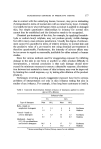
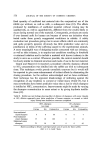
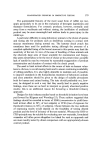
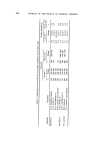
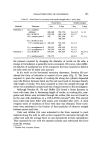
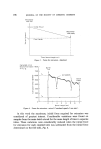
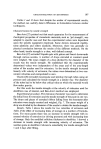
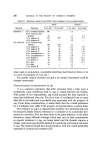
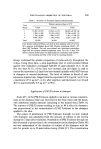
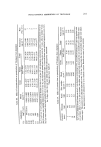
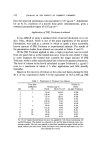
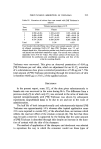
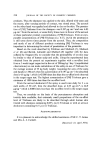
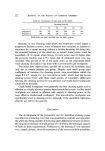
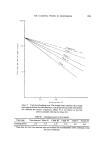
CHARACTERIZATION OF DENTIFRICES 193 which held the orifice insert, Fig. 2. It was later found more convenient to fit the piston to a standard, inverted, uncrimped tube of dentifrice supported in a Perspex holder, Fig. 4. The latter was attached to the lnstron crosshead, which was linked as usual by a pin to coupling of the load cell. Experimental procedure. Tests with a stopwatch and dentifrices extruded manually from standard tubes showed an extrusion velocity of about 1.3 cm sec 4. Speeds of 5 and 10 cm sec 4 for the Instron crosshead corresponded to extrusion velocities of 0.9 and 1.8 cm sec 4 from the tube. Inverted tubes were filled to a fixed height, stoppered and left for 24 h. They were then placed, one at a time, in the Perspex barrel. The screw cap and rubber stopper were removed and the piston was inserted in the inverted tube. As the crosshead began to descend and the piston began to extrude the paste, the force for extrusion, which was recorded, rose sharply the rapidly attained maximum was taken as the 'initial force for extrusion'. A repeat run was made with the empty tube. The initial force for extrusion recorded on the emptied tube, due to friction between piston and the aluminium walls, was subtracted from the initial force for extrusion for the filled tube. Results. Table I shows the results for the initial force for extrusion determined at two shear rates, corresponding to consumer practice when extruding dentifrice from this standard size of tube. Table H shows the effects of time of storage on this parameter. For most pastes, there was an increase in the force required for extrusion with increase in velocity of extrusion, as was expected. Table H shows that for most pastes, the initial force required increased with the time elapsed between filling of a tube and extrusion. The modified cellulose thickener in dentifrice 1 was the only material to show a decrease in initial force for extrusion with increasing speed. The two types of xanthan gum showed a remarkably low force for extrusion in both dentifrices, as can be seen in Table II. The effect persisted in a mixture with sodium carboxymethyl cellulose. A small panel of laboratory staff confirmed that ease of extrudability of the dentifrices tested varied directly with the initial force for extrusion. Discussion. The initial force for extrusion from a new tube of dentifrice is particularly important for the consumer, who makes a judgement on the quality of the product from this sensory cue. With some pastes, the force required varies dramatically with temperature and this could prove un- satisfactory in either summer or winter. There seems to be a range of acceptable pressures for deforming the tube and extruding the paste, outside which products are judged unfavourably. Although it is possible to alter
Purchased for the exclusive use of nofirst nolast (unknown)
From: SCC Media Library & Resource Center (library.scconline.org)