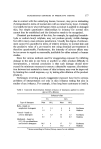
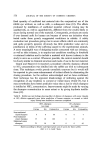
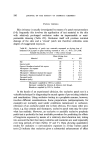
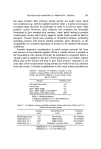
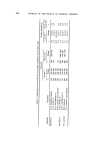
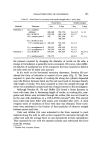
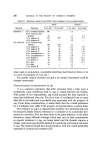
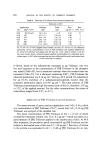
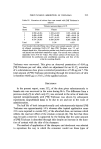
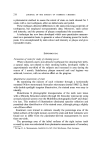
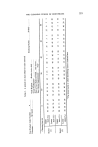
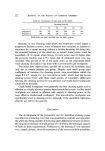
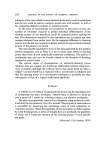
200 JOURNAL OF THE SOCIETY OF COSMETIC CHEMISTS Table III. Maximum cohesive force (MCF) and stringiness at two crosshead speeds Material Thickener MCF S-factor 5 cm min -1 10 cm min -• 5 cm min -x 10 cm min -1 Dentifrice 1 70% Sorbitol 0.3% modified cellulose 240 -- 1.2 -- 0.8 % Carboxy-vinyl polymer 56 -- 3.5 4.4 1.2% Alginate A 215 295 5.6 7.9 1.0% Alginate B 80 -- 9.9 -- 0.5% Carboxy-vinyl polymer 150 185 3.3 -- 1.5% Alginate C 70 95 16 16 1.5% Alginate D 38 45 16 16 1.5% Alginate E 40 40 12 16 0.9% Carragheenan A 64 70 2.4 7.0 0.7% Carragheenan A 58 65 2.8 3.5 2.0% SCMC C 54 68 16 14.2 1.7% SCMC C 20 25 9.2 15.0 20% silica 44 -- 8.8 11.5 19% silica 24 -- 1.3 -- 1.2% SCMC B -- -- 7.5 -- when used in conjunction. Acceptable dentifrices had S-factors below 4 cm at a rate of extension of 5 cm sec-L For quality control of pastes and gels a far simpler instrument could be cheaply constructed. Characterization by measurement of sag It is a common experience that after extrusion from a tube upon a toothbrush, some dentifrices tend to sag or slump between the bristles. With pastes of low dispersibility, sag would increase the time required to clean the toothbrush after use. The slow ooze of toothpaste from an open tube left in the bathroom is probably also associated with the property of sag. From these considerations, it seems likely that the overall preference for a toothpaste may suffer if the property of sag falls below a certain limit. The tendency to sag is a characteristic property of a semisolid and may be measured simply without reference to a container or to a particular pro- cedure for extrusion. This has been done in the paint industry. In the paint laboratory, many different coatings, which may vary in their requirements as regards resistance to sag, are being tested and the chemist requires a simple, rapid and reproducible method for specifying and testing resistance to sag. The method should have good precision, with test results preferably expressed in unequivocal numbers (32).

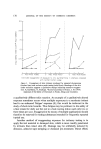
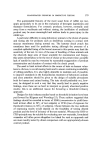
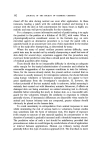
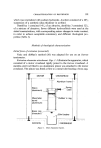
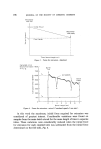
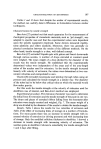
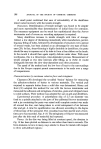
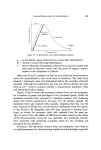
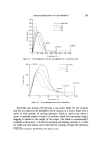
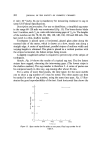
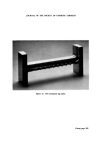
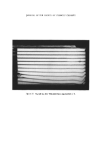
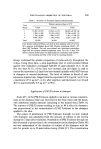
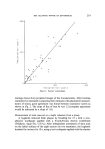
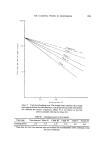
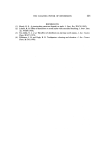
CHARACTERIZATION OF DENTIFRICES 201 90 f ::"' 80 -- 5cm/min i ........ I0 70 : '• -- -- -- 20 :t •o i i*• ................ •o • !l.t: ß ,,:.., ./ • 5o s-rector s-foctor ,o '"• .......... i ...... s-foctor 0 I'0 2'0 3.0 4'0 5.0 6'0 7.0 8.0 Extension cm Figure 11. Force-distance curve for carragheenan A in sorbitol syrup. •oo 200 I00 0 0 -rvl---c--g - -.•... x • m/min - _ :" F/".. '• '•. I ß . ...•....• ß ....,..•... ........................ ! .0 2-0 3.0 4,0 .5.0 Extension crn F/g.r• •2. Por½½-distan½½ ½ur¾½ for a dcntioeric½. Reynolds and Larsen (33) devised a sag index blade for the purpose and this was improved by Schaeffer (32). It consists of a doctor blade with a series of wide notches of varying clearance which is used to lay down a series of parallel stripes of paint of uniform width but increasing height. Sagging is related to the height of the stripe. The blade is commercially* available in three sizes: 1-6 mils for spraying and dipping enamels, 3-12 mils for trade sale type paints and 14-60 mils for coatings of high film thickness * The Leneta Company, Ho-Ho-Kus, New Jersey, U.S.A.
Purchased for the exclusive use of nofirst nolast (unknown)
From: SCC Media Library & Resource Center (library.scconline.org)