194 JOURNAL OF THE SOCIETY OF COSMETIC CHEMISTS

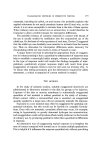
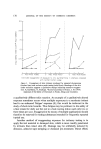
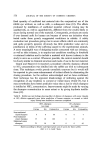
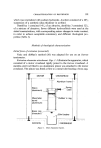
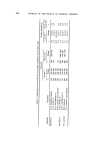
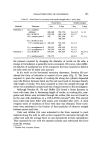
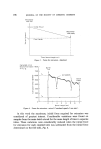
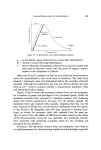
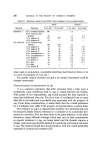
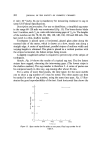
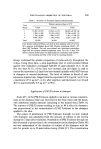
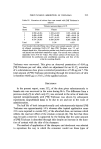
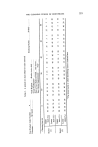
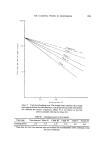
CHARACTERIZATION OF DENTIFRICES 195 Table II. Initial force for extrusion and tensile strength after 1 and 2 days Initial force Tensile strength Material Thickener I day 2 days I day 2 days Dentifrice 2 1.2% modified cellulose 600, 400 780, 750 0.9% SCMC B 670, 760 960, 1160 1.0% xanthan gum B 105 295, 260, 260, 260 9.6, 10.5 11, 18 5.5, 5.7 2.7 2.7, 2.8 0.5% SCMC B with 0.3% xanthan gum A 440, 460 530, 590, 4.2, 4.2 620 1.1% carragheenan B 390, 435 620, 620 4.2, 4.2 1.3% carragheenan A 370, 370 450, 495 3.4, 3.5 Dentifrice 3 1.5% SCMC B 650, 685 780, 820 6.6, 6.3 9.0, 10.3, 9.6 1.7% xanthan gum B 190, 170 4.9, 4.9 the pressure required by changing the diameter of nozzle on the tube, a change in formulation is generally more convenient. Of course, when differ- ent batches of toothpaste are to be compared, the force required to deform the tube need not be taken into account. In his work on the horizontal extrusion rheometer, Prentice (8) con- sidered the force of extrusion to consist of two parts (Fig. 5). The force required to push the sample of cooking fat along the cylinder depended upon the friction between metal and fat and was found to decrease linearly with length of stroke. The force required to drive the sample through the orifice was considered constant and was of major interest to this investigator. Although Prentice (9, 10) and Hoffer (25) found a linear decrease in force with time, that is, decreasing length of stroke, as cooking fats, mar- garine and butter were extruded through the orifice, this was not found to be the case with dentifrices on a FIRA-NIRD extruder* (26). The smooth brass tubes had been filled with pastes and extruded after 24 h. A most irregular series of variations of force with time was obtained. These varia- tions were attributed to the friction of hard particles of abrasive wedged between piston and tube. Vasic and deMan (16) were interested in the force required to push material along the tube as well as that required for extrusion through the orifice and used the average force on one downstroke in their calculations. They repeated the run with the emptied cylinder and subtracted this force from the average. * Gaydon Ltd, Croydon, Surrey.
Purchased for the exclusive use of nofirst nolast (unknown)
From: SCC Media Library & Resource Center (library.scconline.org)