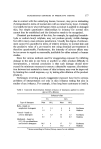
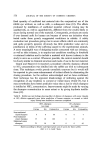
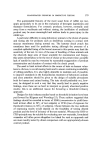
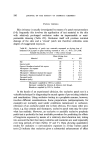
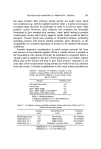
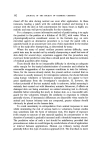
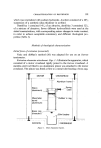
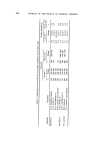
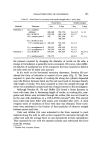
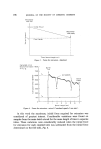
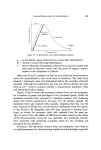
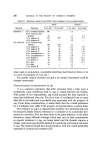
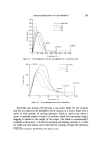
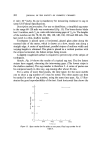
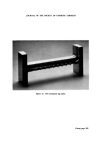
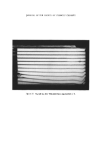
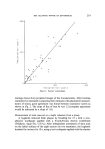
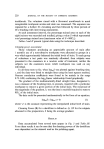
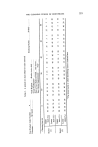
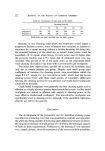
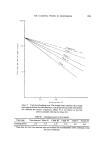
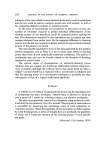
CHARACTERIZATION OF DENTIFRICES 199 M.C.F w A-full recovery '••_•or Extension cm Figure 10. Force-distance curve during adhesion-cohesion. A -- in this elastic region total recovery occurs after deformation B --recovery occurs with some deformation C -- beyond the point of maximum cohesive force, recovery cannot take place and so free flow occurs until the point of rupture, charac- terized as the stringiness or S-factor. Henry and Katz (31) pointed out that the area under the force-extension curve was proportional to the work done in extension. The total force reached a maximum value and diminished before the extended semisolid ruptured. Although the tensile force per unit area did not decline, the total force (g cm-•'x area in contact) reached a characteristic maximum value and diminished before rupture. Results. Table III shows the maximum cohesive force and the stringiness for a number of pastes and mucilages at two crosshead speeds. While the maximum cohesive force increased or remained constant with increasing speed, the S-factor increased in all cases. For all systems studied, the maximum force was reached fairly quickly, indicating that this was the force required to lift the disc over the first few millimetres from the surface. It was found to be dependent upon the time required to develop thixo- tropy, as shown by successive trials with material from the same jar. Figs. 11 and 12 show the effects of differing crosshead speeds on the shape of the force-extension curves for two materials. The maximum cohesive force increased with increasing crosshead speed for the mucilage but decreased for the dentifrice. Discussion. The maximum cohesive force and stringiness were found to be useful parameters for characterizing dentifrices and mucilages, especially
Purchased for the exclusive use of nofirst nolast (unknown)
From: SCC Media Library & Resource Center (library.scconline.org)