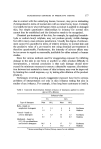
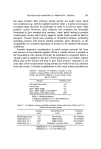
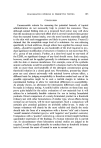
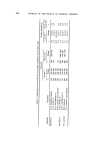
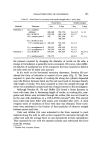
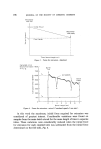
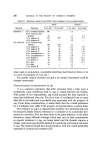
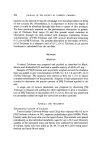
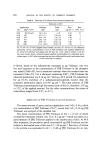
212 JOURNAL OF THE SOCIETY OF COSMETIC CHEMISTS thus the observed penetration was equivalent to 5.57 gg cm -2. Adjustment for an 81.3•o excretion of a known dose given subcutaneously, gives a corrected penetration figure of 6.85 [tg cm -2. Application of [alii Triclosan in ethanol It was difficult to spray a standard dose of aerosol deodorant on to rat skin. Thus, ethanol, which is one of the main ingredients of the aerosol formulation, was used as a solvent in which to apply a more accurately known amount of [all] Triclosan to experimental animals. The results of the penetration studies from ethanol are recorded in Tables V and VI. Of the [all] Triclosan applied to skin, a high proportion was recovered from the patch lint or in the treated skin area. It can be seen (Table V) that in some instances the treated skin contains the larger amount of [all] Triclosan, while in other cases the patch lint contains the greater proportion. The level of tritium in the blood calculated as ppm Triclosan (i.e. gg ml -•) rises to a maximum at about 6 h after application and falls steadily thereafter. Based on the recovery of tritium in the urine and faeces during the first 48 h of the experiment (Table VI) the equivalent of 36.3+5.88 gg [all] Table V. Penetration of Triclosan from ethanol Time after Tritium in application Residue ([tg) in blood Rat (h) Patch Skin (7.5 cm 2) (as ppm Triclosan) 1 1 21.06 ! 63.63 O. 294 2 138.98 27.56 0.070 3 2 14.73 166.73 O. 194 4 21.04 167.50 0.362 5 4 128.16 27.65 0.114 6 133.67 23.85 0.190 7 6 93.08 38.48 0.301 8 112.32 29.96 0.228 9 24 81.26 25.75 0.241 10 48 79.36 21.84 0.119 I l 96 69.84 17.74 0.072 12 63.43 16.33 0.074 To 7.5 cm 2 clipped dorsal female rat skin was applied 0.2 ml ethanol containing 162 [tg [•H] Triclosan. The alcohol was allowed to dry and the skin protected with a non- occlusive patch. The rats were placed in individual metabolism cages, killed and the patch, treated skin and blood, urine and faeces were collected separately every 24 h and analysed for tritium.

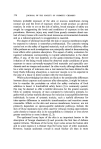
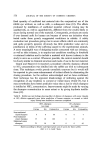
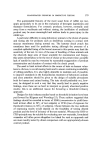
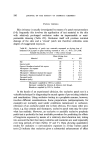
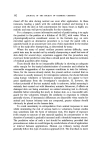
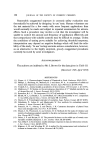
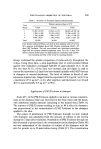
PERCUTANEOUS ABSORPTION OF TRICLOSAN Table VI. Excretion of tritium from rats treated with [all] Triclosan in ethanol 213 Tritium recovery (dpm x 10 -6) Time (days) Urine Faeces Total I 0.702 4-0.216 1.233 4-0.353 1.935 4-0.240 (4) 2 0.406 +0.095 1.277 -•0.481 1.683 4-0.410 (3) 3 0,234 -•0.064 0.437 +0.153 0.671 4-0.089 (2) 4 0.197 4-0.016 0.189 4-0.047 0.386 +0.062 (2) Total 1.539 3.136 4.675 Four female Colworth-Wistar rats (120 g) were treated topically with 0.2 ml ethanol containing 16.09x10⁶ dpm [aH] Triclosan over 7.5 cm a clipped dorsal skin. Non-occlusive patches were fixed in position and the rats placed into individual metabolism cages. The excreta were collected separately every 24 h for 4 days. The tritium content of the faeces was determined by combusion and scintillation counting and that of the urine by counting directly. Triclosan were recovered. This gives an observed penetration of 4.84 txg [3H] Triclosan per cm • skin, which on adjustment for an 81.3•o excretion of a subcutaneous dose gives a corrected penetration of 5.96 gg cm -•'. The total amount of [alii Triclosan penetrating through the treated area of skin is therefore 44.68 [tg or 27.65/0 of the applied amount. DISCUSSION In the present report, some 33•o of the dose given subcutaneously to female rats was recovered in the urine during 96 h. The difference from a previous study (5) in which only 8•o was excreted in the urine of male rats injected intraperitoneally with [all] Triclosan was shown by subsequent experiments (unpublished data) to be due to sex and not to the route of administration. The half life of both intraperitoneally and subcutaneously-injected [alii Triclosan was approximately 14 h whereas after topical application some 23 h were required to excrete 50•o of the absorbed dose, an increase which reflects the reservoir effect of the stratum corneum (6). The fact that there may be such a reservoir is supported by the finding that the same amount of [all] Triclosan is absorbed through skin despite an increase in the dura- tion of contact with the skin of the shampoo. The method of application of the shampoo and deodorant was selected to reproduce the way in which the consumer would use these types of
Purchased for the exclusive use of nofirst nolast (unknown)
From: SCC Media Library & Resource Center (library.scconline.org)