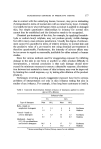
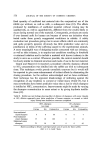
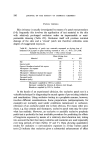
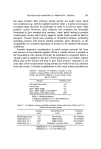
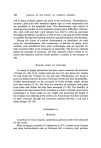
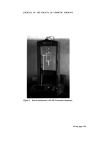
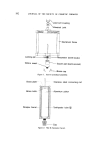
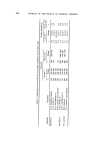
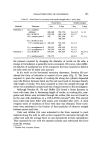
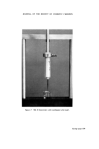
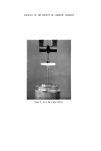
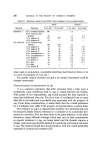
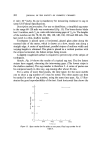
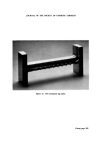
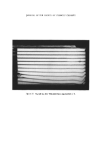
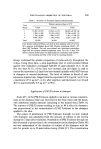
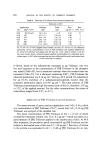
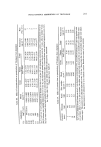
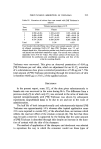
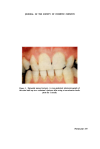
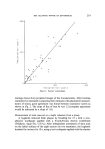
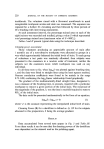
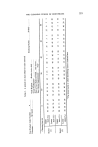
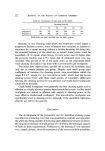
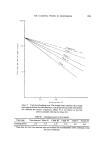
CHARACTERIZATION OF DENTIFRICES 197 Tables I and H show that despite the scatter of experimental results, the method can usefully detect differences in formulation between similar toothpastes. Characterization by tensile strength Ben-Arie (27) pointed out that much apparatus for the measurement of rheological properties of viscoelastic materials, such as 'gel strength', was adapted to specific uses and that the experimental values were dependent upon the specific equipment employed. Some devices measured rigidity, some plasticity and others elasticity. Moreover, there was generally no physical correlation between the results of the different methods. On the other hand, tensile strength is a clear, well-defined concept. Ben-Arie (27) extruded Napalm gels with piston and barrel downwards through various nozzles. A number of drops extruded at constant speed were weighed. The mean weight of a drop divided by the diameter of the nozzle was the tensile strength. He established that the experimentally determined values were independent of the areas and of the area-length ratios of the nozzles used for extrusion. As the tensile strength increased linearly with velocity of extrusion, the values were determined at two con- venient velocities and extrapolated to zero. Charm (28) extruded mayonnaise and ketchup through tubes using air pressure and calculated the tensile strength in a similar way. The diameter of the tubes had to be below that critical value at which the material would flow under gravity. For this work the tensile strength at the velocity of extrusion used for dentifrices was of interest, and Ben-Arie's method was employed. Experimentalprocedure. The extrusion rheometer was used to determine the initial force for extrusion and the tensile strength of the paste in one run. The drops and pieces of extruded ribbon falling from the rheometer after extrusion were simply counted and weighed, Fig. 7. The mean weight of a drop was divided by the diameter of the nozzle to obtain the tensile strength. Results. Table I shows the results for two velocities of extrusion and Table H the effect of increasing times of storage on a number of formula- tions. For most pastes there was an increase in tensile strength with in- creased velocity of extrusion (or driving pressure) and with increasing time of storage. Only the modified cellulose thickener in dentifrice 1 showed a decrease in tensile strength with increasing velocity of extrusion. The xanthan gums in dentifrice 2.showed a remarkably low tensile strength both I and 2 days after filling.

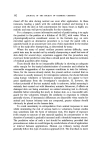
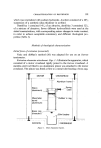
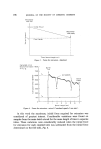
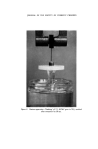
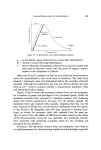
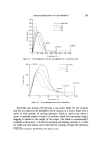
198 JOURNAL OF THE SOCIETY OF COSMETIC CHEMISTS A small panel confirmed that ease of extrudability of the dentifrices tested varied inversely with the tensile strength. Discussion. Determination of tensile strength was found to be simpler and more reproducible than determination of initial force for extrusion. The necessary equipment can be much less sophisticated than the Instron tensiometer and of course no recording equipment is required. Many dentifrices increase in tensile strength with time of storage. Indeed, a low degree of thickening immediately after manufacture, permit- ting easy filling of tubes, followed by development of structure over a period of several weeks, has been claimed as an advantage for one type of thick- ener (29). In fact, shear-thinning is highly desirable in dentifrices the paste should be easy to squeeze out of its tube to form a firm ribbon on the brush. In the mouth it should then again rapidly deform under shear. With most toothpastes, this is a thixotropic, time-dependent process. Measurement of tensile strength at two time intervals after filling, as in Table II, would distinguish between the slow time-dependent and other processes. The speed of the method and the low loss of heat to the surroundings due to the Perspex support permit measurements to be made over a range of temperatures. Characterization by maximum cohesive force and stringiness Claassens (30) developed the so-called 'hesion' balance for measuring the adhesion-cohesion of butter to various materials. The vertical pull required to separate butter from a solid disc was determined. Henry and Katz (31) adapted this method for use with the Instron tensiometer and measured the adhesion and stringiness of starches, gums and whipped cream to solid surfaces. Their method was adopted for use on gels and dentifrices. Experimental procedure. A polyethylene disc of 2.5 cm diameter was fixed to a spindle attached to the jaws of the calibrated Instron tensiometer and a jar containing the paste was raised until complete contact was made all around the disc, care being taken to avoid entrapment of air between disc and gel. A time for equilibration was allowed, according to the degree of thixotropy of the semisolid. The crosshead was then started and a force- time curve was recorded, Figs. 8-10. The stringiness or S-factor was measured just after the thin neck of semisolid had ruptured. Theory. As the disc was being lifted at constant speed, the abscissa in Fig. 10 has been plotted as distance in cm rather than time in seconds. The force-distance curve is in many ways similar to those for metals with respect to three well-defined regions:
Purchased for the exclusive use of nofirst nolast (unknown)
From: SCC Media Library & Resource Center (library.scconline.org)