338 JOURNAL OF THE SOCIETY OF COSMETIC CHEMISTS Provided suitable parameters are chosen, a great deal of information for dermatological and cosmetological purposes can be obtained from dielectric measurements. The problem of skin hydration and its evaluation is among the most debated by specialists. A variety of in vitro methods are available for the determinations (chemical methods, gravimetry, radio-tracer techniques) but a non-destructive in vivo method was lacking. It has been known for a long time that the electrical parameters of biological tissues are at least partly related to their water content. Human skin, in particular, demon- strates electrical characteristics which vary with the frequency of the measur- ing current. Accordingly, on determination of the impedance in human skin, at least three zones of relaxation can be recognized: low-frequency or a-relaxation (10-100 Hz), radio-frequency or [3-relaxation (10-100 kHz) and hyper-frequency or T-relaxation (free water relaxation, 21 G Hz). It should be underlined that O-relaxation is characteristic of most biological tissues: lung, muscle, liver, cell suspensions, biological macromolecules (1-3). The aim of the present work was to investigate a-relaxation in human skin as well as the effects of various treatments on its parameters. A major problem is to measure the electrical characteristics without interfering with the condition of the skin, especially its state of hydration. Skin reactions to the electrical current may be prevented by working at very low current intensities, i.e. below 1 ira cm-•: further, the actual water content of the skin should not be affected by the electrodes. Dry electrodes must be rejected not only because they give rise to polarization, but also because they will rapidly become wet with the accumulation of insensible perspira- tion beneath their surface. The electrolytic junction should come up to precise standards: It should be sufficiently conductive so its own impedance be negligible with respect to that of skin. It should not penetrate into the stratum corneum. It should be in equilibrium with the environment, i.e. neither take up water from nor lose water to the surrounding atmosphere. It should not prevent insensible perspiration. MATERIALS AND METHODS Measuring assembly Either of the following impedance-meters may be used. ALCATEL, type T 2531, frequency range 5 Hz-10 kHz, intensity 2 gA.

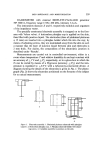
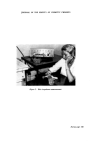
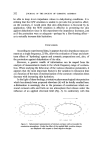
SKIN IMPEDANCE AND MOISTURIZATION 339 RADIOMETER with external HEWLETT-PACKARD generator HP 3300 A, frequency range 15 Hz-100 kHz, intensity 3.2 I•A. The instruments measure Z and 0, respectively modulus and argument of the impedance vector. The specially constructed electrode assembly is strapped on to the fore- arm with Velcro velvet. A bottomless plexiglas cup is applied on the skin, then filled with junction liquid. The electrodes (discs of platinized platinum q• 15 mm) are inserted into a plexiglas holder which fits into the cup by means of adjusting screws, they are maintained away from the skin in such a manner that the layer of junction liquid between skin and electrodes is 2 mm thick. For clarity, the composition of the electrolytic junction is described under 'Results'. Measurements are carried out in controlled environment, either in a room where temperature T and relative humidity rh are kept constant with an accuracy of q- IøC and :E3•o respectively, or in a glove-box in which the rh can be varied by means of a Hygrocon (accuracy q-2•o) and the tem- perature is regulated to 4-0.5øC with a laboratory-constructed device. A diagram showing the details of the electrodes is given in Fig. 1. The photo- graph (Fig. 2) shows the electrodes positioned on the forearm of the subject for an actual measurement. II Skin Figure 1. Electrode assembly. 1. Platinized platinum electrode with plexiglas support. 2. Bottomless plexiglas cup. 3. Plexiglas electrode holder with adjust- ing screws. 4. Complete assembly in position on the skin.
Purchased for the exclusive use of nofirst nolast (unknown)
From: SCC Media Library & Resource Center (library.scconline.org)