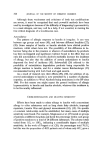
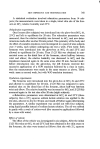
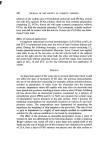
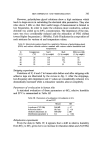
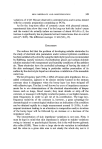
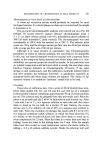
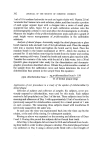
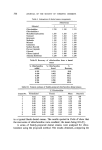
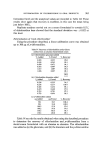
366 JOURNAL OF THE SOCIETY OF COSMETIC CHEMISTS as is. Each was added as a solution from a burette to approximately 50 mg of blank dental cream. In the case ofp-chloroaniline the hydrolysis step was omitted from the procedure. The results quoted in Table IV show that the recovery is adequate for this procedure. Replicate analyses carried out on a cream formulated to contain 0.5•o of chlorhexidine base showed that the standard deviation was 4-0.038 at this level. The data recorded in Table V are for typical analyses of a range of dental creams. In this table the 'initial' value for the level of chlorhexidine (deter- mined by the extractable chlorhexidine procedure) is compared with the percentage found by the described 'total' chlorhexidine method at a variety of ageing times. Different abrasive systems and chlorhexidine salts are used. Table V. Typical analyses of a series of aged chlorhexidine dental creams %Chlorhexidine base At ageing Initial time Total Chlorhexidine (Cetri- (Cetri- (via Abrasive salt Ageing time Formulated mide) mide) p.c.a.) Alumina Diacetate 1 year RT 0.4 0.39 0.34 0.43 Alumina Gluconate 6 m RT 0.4 0.43 0.23 0.43 Alumina Gluconate 3 m RT 0.4 0.36 -- 0.36 Alumina Fluoride 2 years RT 0.5 0.47 0.44 0.50 Silica (gel) Diacetate 1 m 110øF 0.1 Nil Nil 0.12 Silica Diacetate 2 years RT 0.5 0.51 0.44 0.50 Alumina Gluconate 3 m 110øF 0.5 0.50 0.44 0.50 CaCOa/SiO2 -- c. 1 year RT -- -- 0.030 0.052 A series of dental creams were analysed using a slightly different technique, namely Cetrimide extraction followed by the determination of total chlorhexidine on the residue left after the extraction. The sum of the two results should equal the original chlorhexidine level in the cream so that any losses shown can be proven not to be due to sampling. All the results are given in Table VI together with details of abrasive types and chlorhexidine salts. Using the method as intended, the results quoted illustrate that we can obtain a good indication of the level of chlorhexidine present in the product when fresh or when sampled after any ageing time. It can be seen that in some cases the level found, by the described 'total' method is higher than that found initially in the cream by the 'extractable' method. This means

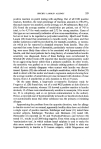
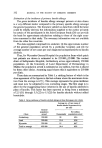
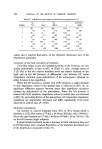
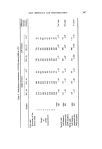
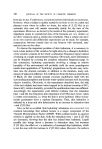
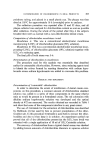
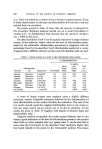
DETERMINATION OF CHLORHEXIDINE IN ORAL PRODUCTS 367 Table VI. Determination of free and total chlorhexidine in a variety of aged dental creams % Chlorhexidine salt Total in Cream Chlorhexidine Ageing Formu- Free Residue Total in no. salt details lated (Cetrimide) (pca) product 1. Alumina-Alcoa C333 1 Gluconate 2 n-lauroyl Sarcosinate 3 n-lauroyl Sarcosinate 2 weeks 110øF 0.9 0.843 0.050 0.893 1 month 110øF 0.838 0.047 0.885 3 months 110øF 0.830 0.044 0.874 1 month RT 0.844 0.051 0.895 3 months RT 0.842 0.036 0.878 2 weeks 110øF 0.5 0.413 0.003 0.416 1 month 110øF 0.412 0.004 0.416 1 month RT 0.426 0.003 0.429 2 weeks 110øF 0.5 0.499 0.004 0.503 1 month 110øF 0.492 0.003 0.495 1 month RT 0.499 0.002 0.501 2 weeks 110øF 0.5 0.459 0.014 0.473 3 months 110øF 0.8 0.720 0.020 0.740 3 months RT 0.726 0.018 0.744 6 months RT 0.9 0.796 0.064 0.860 6 months RT 0.9 0.816 0.047 0.863 6 months RT 0.9 0.806 0.043 0.849 2 years RT 0.5 0.478 0.018 0.496 years RT 0.8 0.755 0.013 0.768 4 n-lauroyl Sarcosinate 5 Gluconate 6 Gluconate 7 Gluconate 8 Gluconate 9 Hydrochloride 10 Gluconate 2 2. Alumina-MEL MH 100 1 Gluconate 2 1 3 1 3 2 Gluconate 3 n-lauroyl Sarcosinate 4 Gluconate 5 Gluconate 6 Gluconate weeks 110øF 0.9 0.861 0.012 0.873 month 110øF 0.870 0.016 0.886 months 110øF 0.853 0.030 0.883 month RT 0.865 0.013 0.878 months RT 0.848 0.030 0.878 New 0.9 0.900 0.010 0.910 1 month 110øF 0.892 0.022 0.914 1 month RT 0.906 0.002 0.908 2 weeks 110øF 0.5 0.430 0.011 0.441 1 year RT 0.9 0.871 0.038 0.909 1 year RT 0.9 0.875 0.030 0.905 1 year RT 0.9 0.916 0.020 0.936 3. Calcium carbonate/silica 1 Gluconate 1 year RT 0.05 0.029 0.023 0.052 that some chlorhexidine is lost immediately a dental cream is formulated-- presumably by a type of irreversible adsorption. Determination of trace levels of chlorhexidine (dental plaque study) From the results listed in Table VII, it is apparent that a substantial
Purchased for the exclusive use of nofirst nolast (unknown)
From: SCC Media Library & Resource Center (library.scconline.org)