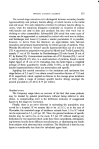
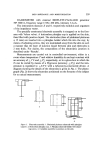
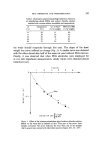
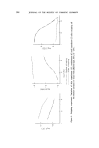
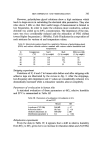
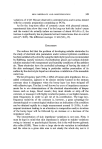
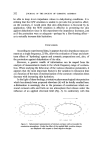
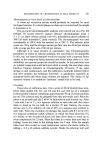
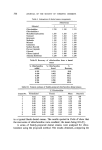
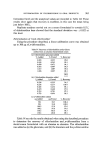
SKIN IMPEDANCE AND MOISTURIZATION 345 However, polyethylene glycol solutions show a high resistance which leads to large errors in calculating the electrical skin parameters. They also relax above 5 kHz so that their useful range of measurement is limited to low frequencies. In order to make the solutions more conductive, sodium chloride was added up to 0.9•o concentration. The impedance of the mix- tures was thus considerably reduced and the relaxation of PEG shifted toward higher frequencies ( 100 kHz). Table Ilindicates the composition of such mixtures for various rh and temperature values. Table II. Electrolytic junction liquid (low resistivity). Mixtures of polyethylene glycol (PEG) and sodium chloride solution matched with various relative humidities and temperatures rh Temperature NaC1 HaO PEG (mw 400) (%) (øC) (% by weight) (% by weight) (% by weight) 66 25 0.9 13.1 86 86 25 0.9 29.1 70 66 22 0.9 7.5 93.6 86 22 0.9 25 74.1 Stripping experiment Variations of Z, G and C in human skin before and after stripping with adhesive tape are illustrated by the curves in Fig. 5. After the strippings, low-frequency skin impedance and C values are considerably reduced, G is dramatically increased while a-relaxation vanishes almost completely. Parameters of a-relaxation in human skin A statistical evaluation of these parameters at 665/0 relative humidity and 25øC is summarized in Table III. Table III. Parameters of e-relaxation (14 subjects) at 66% rh and 25øC Means SD Impedance Z (25 Hz) 346 kf• 4- 67 Relaxation time 'r 10.5 ms 4- 6.6 Dielectric decrement A• 560 ESU 5:240 Distribution parameter tx 0.4 :t: 0.04 Dehydration experiments From the data in Table IV, it appears that a shift in relative humidity from 86•o to 66•o gives rise to an increase in relaxation times and Z (25 Hz)

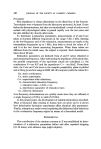
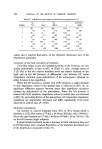
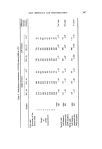
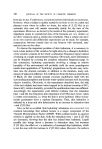
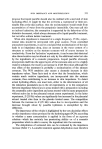
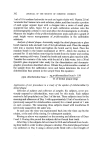
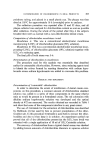
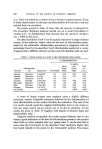
346 JOURNAL OF THE SOCIETY OF COSMETIC CHEMISTS Table IV. a-Relaxation parameters in dehydration experiment (25øC) rh x A• Z (25 Hz) Subject (%) (ms) (ESU) a (k •) 1 86 3.9 480 0.34 313 66 12 730 0.39 350 2 86 1.8 390 0.29 313 66 3.9 365 0.34 407 3 86 4.3 538 0.35 307 66 8.9 580 0.38 378 4 86 10.5 775 0.41 314 66 16 700 0.40 415 5 86 6.4 707 0.44 310 66 120 1980 0.45 385 values and a random fluctuation of the dielectric decrement and of the distribution parameter. Symmetry of the body and effect of emulsions Z (25 Hz) values in any two symmetrical sites of the forearms are very similar individually, at least at 86•o rh (Table V). Also, average values of Z (25 Hz) at the two relative humidity levels are almost identical on the right and on the left forearm. A differential t-test between AZ values (impedance variation upon dehydration of the atmosphere) obtained on either forearm is not significant. When the left forearm is treated with O/W emulsion, a slight decrease in skin impedance values in the treated area is observed at 86•o rh no significant difference appears between mean skin impedance variations induced by dehydration of the atmosphere. When the left forearm is treated with W/O emulsion, impedance values in treated sites are increased at 86•o rh upon dehydration of the atmosphere, AZ values (skin impedance variations) are appreciably decreased and differ significantly from those observed in control sites (P0.05). Hydration experiments An increase in relative humidity from 66•o to 86•o brings about a decrease in Z (25 Hz) values of 78 kflq- 54 (from 382 kf14- 86 to 304 kf14- 69) on the right forearm and 77 kf14- 49 (from 393 kf14- 65 to 316 kfl4- 43) on the left forearm (eight subjects). Sodium lactate treatment causes a decrease in both relaxation time and Z (25 Hz) values and a random fluctuation of the dielectric decrement and of the distribution parameter (Table I/I).
Purchased for the exclusive use of nofirst nolast (unknown)
From: SCC Media Library & Resource Center (library.scconline.org)