SPECIFIC LANOLIN ALLERGY 331 any other concomitant hypersensitivity, might be necessary for the success- ful treatment of such patients. This fundamental distinction has been lacking in almost all the published literature, and so the true picture of the lanolin allergy situation has inevitably been distorted. Moreover, when an investigation has included not the whole patient list of a skin clinic or hospital but only a selection from the list, then a second source of doubt arises. Baer et al. (31) made a particular point of the fact that a distorted picture can be drawn from results based on a deliberate selec- tion of suitable subjects for testing. Bearing these distorting factors in mind, the gross incidence of lanolin/lanolin alcohol sensitivity amongst patients at skin hospitals may be derived by starting with the tabular summary given by Peter, Schr/Spl and Franzwa (3) and, to be cautious, discount all results prior to 1957 inclusive, since lanolin allergy was then not being as diligently sought as it is today, and may therefore have been less frequently diagnosed. A weighted average of the lanolin and lanolin alcohol hypersensitivity incidence out of a total of 22 523 subjects gives the figure of 1.70•o and it should be remembered that not only were these patients at skin hospitals, but that they also included such highly non- representative results as those of Reichenberger (25) who tested exclusively patients with ulcus cruris, only one-third of whom did not show hyper- sensitivity to some substances, and those of Stolze (35) who employed exceptionally potent test media. These figures, although atypical, have not been excluded from the ensuing calculations in order that the latter should tend to err on the high side rather than otherwise. A second basis for calculation is the extensive European study (28), where 115 out of 4825 patients showed a positive reaction to lanolin alcohols (note: not lanolin, which was not tested). The proportion of positive re- actions here was 2.38•o and this may be combined, again as a weighted average, with the previous percentage to give a mean gross incidence of positive reactions out of 27 348 patients of 1.82•o. The term 'gross' implies that the figure has been arrived at without discounting any of the known exaggerating factors. That is to say, the figure relates to all skin patients whether or not they were specially selected, and no matter whether they were tested with lanolin, lanolin alcohols, eucerin or mixtures of these with keratolytics. This gross incidence of 1.82•'• ignoring its inherent exaggeration, seems modest and relatively insignificant amongst the patients in relation to the great usefulness and convenience of lanolin and lanolin alcohols in ointment bases used for treating the other 98.18• or more of dermatitis patients.

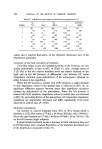
332 JOURNAL OF THE SOCIETY OF COSMETIC CHEMISTS Estimation of the incidence of primary lanolin allergy The gross incidence of lanolin allergy amongst patients at skin clinics is a very different matter compared to the primary specific allergy amongst the general population. The literature yielded no data from which the latter could be reliably derived, but information supplied to the author privately by certain of the participants in the Joint European Study (28) can provide the basis for approximate calculations relating to three of the eight coun- tries concerned in that study. The necessary information was not available from the other five countries. The data supplied comprised two statistics: (i) the approximate number of the general population served by a particular hospital and (ii) the average number of new cases per year diagnosed as hypersensitive to lanolin alcohols. Thus, for Wycombe General Hospital the population from which patch test patients are drawn is estimated to be 225 0004-25 000. The contact clinic at Sahlgrenska Hospital, Gothenburg serves approximately 350 000 population. At the University of Lund Department of Dermatology in Malmo the population served is estimated at one million, but this is shared by three other clinics. Assuming equal shares this is equivalent to 250 000 per clinic. These data are summarized in Table I, a striking feature of which is the close agreement of the figures in the last column where the maximum devia- tion from the average is 6.5•o. This average represents the gross incidence and must now be subjected to two correcting stages. The first stage is to allow for the exaggerating factor inherent in the use of lanolin alcohols in place of lanolin. This factor has been reported as being from a minimum of 2.5 (31) through 5.5 (22) to 15 (25) for lanolin alcohols without added keratolytic. Table I. Gross incidence of lanolin alcohol allergy at three European skin clinics Average no. of new cases of lanolin alcohol hypersensitivity per year General population Per million Clinic served Numerically population served Gothenburg 350 000 24 68.6 Lurid 250 000 15.4 61.6 Wycombe 225 000 15 66.7 Total or average 825 000 54.4 65.9
Purchased for the exclusive use of nofirst nolast (unknown)
From: SCC Media Library & Resource Center (library.scconline.org)