SKIN IMPEDANCE AND MOISTUR1ZATION 347 • E v z z a•

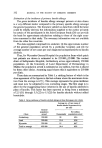
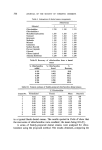
348 JOURNAL OF THE SOCIETY OF COSMETIC CHEMISTS Table VI. a-Relaxation parameters in sodium lactate experiment 66% rh- 25øC Relaxation Dielectric Distribution Subject time decrement parameter Z (25 Hz) (*) -r (ms) As (ESU) a (kf•) 1 B 10.5 840 0.39 266 A 8.2 860 0.40 235 2 B 7.0 590 0.37 304 A 6.0 1120 0.52 297 3 B 17.5 760 0.41 195 A 9.2 500 0.39 113 (*) B, before treatment A, after treatment (10% aq. Na lactate solution). Table VII. a-Relaxation parameters in liquid paraffin experiment 66% rh- 25øC Relaxation Dielectric Distribution Subject time decrement parameter Z (25 Hz) (*) ß (ms) A• (ESU) a (k•) 1 B 9.1 710 0.37 269 A 6.7 430 0.44 470 2 B 8.0 735 0.39 289 A 5.8 390 0.34 569 3 B 6.8 640 0.35 332 A 6.5 340 0.45 450 4 B 7.5 610 0.37 226 A 6.8 430 0.42 362 Liquid paraffin treatment induces a decrease in relaxation time and dielectric decrement and an increase in Z (25 Hz) values the distribution parameter varies randomly (Table VII). The vehicle which serves for application of the hydrating agent PCNa plays seemingly a considerable role since strikingly different effects are achieved according to whether an identical concentration (2•o) of the sub- stance is applied in the form of solution or of cosmetic preparation. With 2•o aqueous PCNa solution, the mean Z (25 Hz) variation is as low as -0.5 kf• (SD• 18) whereas with 2•o PCNa in the cosmetic preparation, the variation averages -113 kf• (SD+67). Now, with 10• aqueous PCNa solution, the mean variation is - 90 kf• (SD q-68). Thus, to achieve similar results, a 10• concentration of the substance is required when the vehicle is water against only 2•o when the vehicle is a cosmetic preparation. No
Purchased for the exclusive use of nofirst nolast (unknown)
From: SCC Media Library & Resource Center (library.scconline.org)