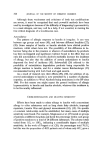
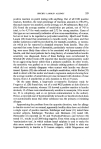
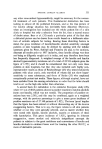
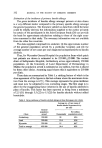
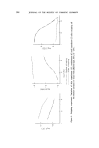
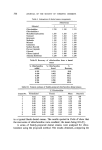
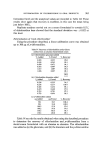
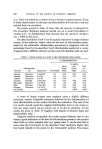
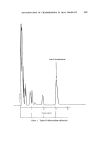
372 JOURNAL OF THE SOCIETY OF COSMETIC CHEMISTS A chromatogram obtained from one of the p-chloraniline calibration solutions is shown in Fig. 1. Figs 2 and 3 show the chromatograms obtained from a blank dental plaque and a typical test sample respectively. Examina- tion of these chromatograms shows that although additional minor peaks are present in the sample chromatogram there is adequate resolution of the p-chloroiodobenzene peak. It can be seen from Table VIII that the chlorhexidine content of the dental plaque collected is quite substantial and also that there is a significant difference in the uptake of the chlorhexidine from the two different rinses. More chlorhexidine is taken up by users of the chlorhexidine rinse than by users of the chlorhexidine/reducing agent rinse. However, the absolute quantities of chlorhexidine found in the plaque are very small when compared with the total chlorhexidine lost during rinsing and it was not possible to account for this total chlorhexidine loss. It is possible that the bulk of the chlorhexidine present adheres to the mucous membranes or some similar place in the mouth. This is confirmed to some extent by the results quoted in Tables LY and X', i.e. after 52 days there is still some evidence for the presence of chlorhexidine in the plaque Table VIII. Chlorhexidine content of plaque collected--Day 4 Nanograms i.e. ppm Dry plaque chlorhexidine chlorhexidine Subject No. wt (mg) base found base Rinse A Rinse B 1 0.95 253 266 2 1.20 343 286 3 0.38 99 . 261 4 1.48 180 122 5 1.00 101 101 6 2.56 166 65 Table IX Chlorhexidine content of plaque collected--Day 32 Subject No. Nanograms i.e. ppm Dry plaque chlorhexidine chlorhexidine wt (mg) base found base Rinse A Rinse B 1.84 122 66.3 3.10 124 40.0 1.06 148 139.6 3.08 121 39.3 1.60 131 81.9 --off panel--

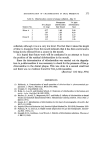
DETERMINATION OF CHLORHEXIDINE IN ORAL PRODUCTS 373 Table X. Chlorhexidine content of plaque collected--Day 52 Nanograms i.e. ppm Dry plaque chlorhexidine chlorhexidine Subject No. wt (mg) base found base Rinse A 1 0.77 1.60 2.08 2 3.97 3.20 0.80 3 0.72 1.60 2.22 Rinse B 4 1.49 1.60 1.07 5 1.11 1.40 1.26 collected, although it is at a very low level. The fact that it takes this length of time to disappear from the mouth indicates that it has been stored and is being slowly released from a source in the mouth. It is hoped that future work will be conducted in an attempt to locate the position of the residual chlorhexidine in the mouth. Since the determination of chlorhexidine was carried out via degrada- tion to p-chloroaniline it was necessary to check for the presence of free p- chloroaniline in the dental plaque. This was done in a second small test and there was no evidence found for free p-chloroanaline. (Received: 13th May 1974) REFERENCES (1) Holbrook, A. Determination of small quantities of chlorhexidine in pharmaceutical pre- parations. J. Pharm. Pharmacol. 10 (6) 370 (1958). (2) Cropper, E. Unpublished work. (3) Rolla, G., Loe, H. and Rindom Schiott, C. Retention of chlorhexidine in the human oral cavity. Archs. Oral Biol. 16 1109 (1971). (4) Heyden, G., Arwill, T., Magnusson, B.C. and Rolla, G. Affinity of chlorhexidine to dental tissues and materials demonstrated with a histochemical staining method. Swed. Dent. J. 64 233 (1971). (5) Guven, K. C. Identification of chlorhexidine by thin layer chromatography. Eczacilik. Bul. 12 (7) lll (1970). (6) Imperial Chemical Industries Ltd, Standard Official Method No. PH 129 B, December 1959. (7) Puttnam, N. A. and Lee, S. Rapid sample preparation for gas chromatography. Speciali- ties Feb. 1967 p. 15. (8) Goodall, R. R., Goldman, J. and Woods, J. Stability of chlorhexidine solutions. Pharmacol. J. 200 33 (1968).
Purchased for the exclusive use of nofirst nolast (unknown)
From: SCC Media Library & Resource Center (library.scconline.org)