356 JOURNAL OF THE SOCIETY OF COSMETIC CHEMISTS product to remove interfering fatty compounds, was found not to be required in the case of dental creams. The modification described here is based on direct extraction of the dental cream with 10•o Cetrimide solution. This is shown later to remove all of the 'available' chlorhexidine from the cream with a single extraction. The procedure mentioned above enables only the determination of 'cetrimide extractable' chlorhexidine. This is not only water soluble chlor- hexidine, but all of the chlorhexidine which can be extracted from the product using Cetrimide. It is possible for chlorhexidine to be 'present' in a product in essentially four states, namely 'Free' soluble (a) 'Free' insoluble (b) Physically absorbed into/onto a surface (c) Chemically degraded (d) By 'free' is meant not irreversibly or even weakly adsorbed on a surface. This would include any chlorhexidine solubilized by surface active agents. Both (a) and (b) above would always be extracted using a Cetrimide solution but extraction (c) would depend on the strength of the absorption, i.e. whether the chlorhexidine is in the lattice of the absorbent as opposed to on the surface. Of course (d) would involve breakdown of chlorhexidine to yield p-chloroaniline which would never be measured by the Holbrook colorimetric procedure. This therefore means that we are always measuring the degree of variation of adsorption, absorption and degradation. However, the lack of degradation has been established previously (2). It has always been found, however, that there are apparent losses of chlorhexidine in dental creams during ageing, and since it has been shown that this is not due to break down, it must be due to absorption. This absorption must take place in such a way that Cetrimide is not powerful enough to replace chlorhexidine on or in the absorbent. In view of these phenomena it would be useful to have available a method capable of determining total (i.e. initial or formulated level of) chlor- hexidine. This idea is to some extent analogous to the procedures available for the determination of total and soluble fluoride and derivatives in dental creams. Such a method is the second procedure described. It should be noted at this stage that it has not been possible to link oral activity of chlorhexidine dentifrices with the level of analytically available chlorhexidine. Also it is very important to check for free p-chloroaniline in the dental creams before applying this method for total chlorhexidine via

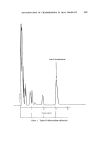
DETERMINATION OF CHLORHEXIDINE IN ORAL PRODUCTS 357 p-chloroaniline formation. Free p-chloroaniline is present in the raw material at manufacture and could appear in some formulations due to degradation after product manufacture. The determination of total chlorhexidine can be quite readily carried out by hydrolytic decomposition of the chlorhexidine into p-chloroaniline (8). The hydrolysis takes place under acid conditions at elevated temperature and pressure. The p-chloroaniline produced is determined colorimetrically by preparing a diazonium salt and then coupling the salt with t•-naphthol to give an azo dye. This total chlorhexidine determination may be carried out on the product 'As is' or on the residue of the product after cetrimide extraction. Clinical studies over the past few years have shown that chlorhexidine inhibits plaque formation when applied as a mouthrinse (3). This has been attributed by Rolla to a retention of chlorhexidine in the mouth in 'reser- voirs', e.g. on the teeth or the oral mucosa. The presence of chlorhexidine was demonstrated by Rolla by the measurement of biological activity. It was claimed that the usual colorimetric (1) and thin-layer chromato- graphic (5) techniques for chlorhexidine measurement were insensitive and easily interfered with by components of saliva. The affinity of chlorhexidine for various tissues was further demonstrated by Heyden (4) by use of a histochemical staining method. To a large extent this confirmed the earlier findings of possible reservoirs of chlorhexidine in the mouth. The purpose of the investigation reported here was to attempt to quantify these findings of Rolla and Heyden by measuring the retention or uptake of chlorhexidine by dental plaque. The 'apparent uptake' of chlorhexidine was monitored to see how much was lost during the usage of a chlorhexidine mouthwash both with and without a reducing agent as an additive. A mouthwash, rather than a dental cream, was selected in order that a rela- tively rapid build-up of dental plaque could be obtained. For the reasons previously mentioned the direct determination of chlorhexidine at the anticipated level in plaque samples did not appear to be feasible. The previously described degradation to p-chloroaniline method was also rejected due to lack of sensitivity. The only obvious answer to the problem appeared to be by utilizing gas liquid chromatography, using an electron capture detector, after the chlorhexidine salt had been hydrolysed to p-chloroaniline. This meant that in order to be able to apply gas liquid chromatography it would be preferable to remove the amino group from the p-chloroaniline. The simplest way of achieving this was via diazotization and since the response of the electron capture detector is far greater for
Purchased for the exclusive use of nofirst nolast (unknown)
From: SCC Media Library & Resource Center (library.scconline.org)