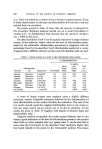
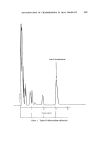
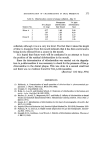
SKIN IMPEDANCE AND MOISTURIZATION 349 variations of Z (25 Hz) are observed in untreated areas and in areas treated with the cosmetic preparation containing no PCNa. As for the long-term effect of cosmetic cream with placental extract, experimental data show that even if in the long run both the 'active' cream and the control do actually induce an increase of about 40 kf• in Z, the increase is significantly less in placental extract treated areas than in control sites (PO.05). The difference averages 11 kf• (SD•15). DISCUSSION The authors feel that the problem of developing suitable electrodes for the study of electrical skin parameters under various hydration conditions has been satisfactorily solved by using the electrolytic junctions recommended by Edelberg, namely mixtures of polyethylene glycol and sodium chloride solution matched with temperature and humidity conditions of the ambient air. These electrodes have the unrivalled advantage of leaving the state of the skin unchanged, there being in particular neither penetration of its surface by the electrolytic liquid nor alteration or inhibition of the insensible water loss. The low-frequency part (5 Hz-1 kHz) of human skin impedance, the so- called a-relaxation, appears to be almost entirely located in the stratum corneum since it disappears when the horny layer has been stripped off with adhesive tape. The fact is well known by users of impedance measure- ments for in vivo determinations of the electrical characteristics of deeper tissues such as lungs, blood vessels they must abrade or strip off the corneum, or massage it with highly conductive pastes, or use higher measure- ment frequencies in order to get rid of its contribution. The huge low- frequency resistivity of the corneum is, however, a great advantage for dermatological or cosmetological studies since an indication of its condition can be obtained rapidly in a single measurement around 15-35 Hz. A sub- sequent treatment leading to an alteration in composition and/or structure of the horny layer will be followed by an increase or a decrease of the impedance value. The interpretation of skin impedance variations is not easy. First, it must be kept in mind that skin impedance is subject to sudden variations owing to internal or psychological factors this is the well-known galvanic skin reflex (GSR). There is also a large site-to-site variation in individuals and the value in a given skin area is not steady the whole day nor is it

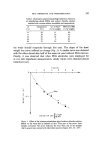
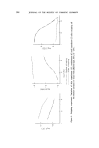
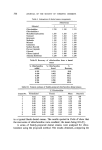
350 JOURNAL OF THE SOCIETY OF COSMETIC CHEMISTS from day to day. Furthermore, variations between individuals are enormous. However, when a subject is quietly seated for an hour or two in a calm and pleasant room where he suffers no stress, the value of Z (25 Hz) in an untreated skin area will remain reasonably steady for the time of the experiment. Moreover, as shown by the results of the symmetry experiment, impedance values in symmetrical sites of the forearms are very similar so are their variations upon a similar skin treatment. Thus a subject can serve as its own control and differential experiments can be made, for example, comparisons between treated sites on one forearm with untreated, sym- metrical sites on the other. To discuss the important problem of skin hydration, it is necessary to have a clear picture of the variation brought about by a change in hydration of the stratum corneum in the whole e-relaxation frequency region instead of relying on a single measurement frequency. Obviously, more information can be obtained by covering the complete relaxation frequency-range. In this connection, hydrating experiments involving a change in relative humidity of the environment will probably yield the most unambiguous results since application of 'hydrating' preparations on the skin may intro- duce into the stratum corneum, in addition to the moisture, many sub- stances of unknown influence. It is well known from the famous experiments of Blank (5) that isolated stratum corneum equilibrates itself with the surrounding atmosphere and that the water-uptake increases with increasing relative humidity. Obviously, in the experiments described here, the skin of the test subjects had more water trapped in its stratum corneum at 86•o than at 66•o relative humidity, provided the equilibration time was sufficient. Accordingly, the experiments yield definite evidence that the relaxation time z and the low-frequency skin impedance Z (25 Hz) have lower values in wetter environments, i.e. when the skin is more hydrated. Other charac- teristic parameters show a random fluctuation. Thus, skin hydration is reflected by a drop and skin dehydration by an increase in relaxation time z and Z (25 Hz). Now, as far as so-called 'skin hydrating' substances are co•cerned, it is common knowledge that sodium lactate is a major component of the 'Natural Moisturization Factor' (NMF). When sodium lactate in aqueous solution is applied on the skin, both the relaxation time z and Z (25 Hz) are decreased, showing that the skin has indeed been hydrated. Liquid paraffin also brings about a decrease in relaxation time, but increases Z (25 Hz) the effect on z is indicative of increased skin hydration, which is not the case with the increase in Z (25 Hz) values. However, the authors
Purchased for the exclusive use of nofirst nolast (unknown)
From: SCC Media Library & Resource Center (library.scconline.org)