SKIN IMPEDANCE AND MOISTURIZATION 353 model, the relaxation time is inversely proportional to ion mobility, which parameter has an essential role. Since in hydrated skin the mobility of the ions is increased, the drop in relaxation time observed experimentally would thus be satisfactorily explained. ACKNOWLEDGMENTS We would like to express our appreciation to Mr G. Gervaise for the very fine job he did in designing and building the electrodes. We would also like to recall the memory of our dear friend, the late Dr K. Walkley from Unilever Research, Port Sunlight, whose enthusiastic collaboration stimulated uq in the early stages of our work. (Received: 29th May 1974) REFERENCES (1) Schwan, H. P. Advan. Biol. Med. Phys. V 147 (1957). (2) Davies, M. Dielectric ProlJerties and Molecular Behaviour, 364 (1969) (Van Nostrand Reinhold, London). (3) Grant, E. M. Protides of the Biological Fluids. Proc. Nineteenth Colloquium Bruges, 347 (1971) (H. Peeters, Pergamon Press, Oxford). (4) Edelberg, R. Ann. Acad. $ci. (Bioelectrodes Symposium) 148 252 (1968). (5) Blank, I. H. J. Ira,est. Dermatol. 18 433 (1952). (6) Clar, E. J., Her, C. P. and Sturelle, C. G. L'imp•dance Bio•lectrique. Recherche et applica- tions cliniques, Seminaire INSERM. 127-37 (1972) (INSERM 1973, Paris).

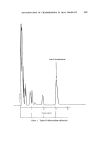
J. Soc. Cosmet. Chetn. 26 355-373 (1975) ¸ 1975 Society of Cosmetic Chemists of Great Britain Analytical procedures for the determination of chlorhexidine oral products in E. CROPPER, P. PLATT and N. A. PUTTNAM* Presented on 26-30th August 1974 in London at the IFSCC VIIIth International Congress on 'Cosmetics--Quality and Safety' organized by the Society of Cosmetic Chemists of Great Britain Synopsis--Three METHODS are described for the specific DETERMINATION of CHLOR- HEXIDINE and its salts at various levels in DENTAL CREAMS and related ORAL MATERIALS. The method of measuring the coloured reaction product with alkaline sodium hypobromite is less sensitive than that based on hydrolysis of chlorhexidine to give p-chloroaniline. This p-chloroaniline is then reacted with nitrous acid and 0•-naphthol to give a red-coloured deriva- tive. The third method is for the determination of submicrogramme quantities. After conversion to 1: 4 Iodochlorobenzene this is determined by electron capture GAS CHROMATOGRAPHY. This method has been applied to the measurement of the uptake of significant amounts of chlorhexidine by DENTAL PLAQUES from a mouthrinse. INTRODUCTION The primary existing method available for the determination of chlorhexidine and its salts in a variety of cosmetic products is a colorimetric procedure described by Holbrook (1). However, the extraction procedure used by Holbrook, namely several chloroform extractions of acidified * Divisional Research and Development Department, Colgate Palmolive Ltd, Manchester M5 3FS. 355
Purchased for the exclusive use of nofirst nolast (unknown)
From: SCC Media Library & Resource Center (library.scconline.org)