360 JOURNAL OF THE SOCIETY OF COSMETIC CHEMISTS Procedure Preparation of calibration data. Transfer by burette 0, 2, 4, 6, and 8 ml of the standard p-chloroaniline solution into 50 ml amber volumetric flasks. Add sufficient 0.1N hydrochloric acid to give a total volume of approxi- mately 30 ml in each flask. Add 0.5 ml of 45/0 sodium nitrite solution, swirl the flask contents and leave for 1 min. Add 1.0 ml of 5•o ammonium sul- phamate solution, shake and leave for 5 min. Then add 2.5 ml of 0.1•o N-naphthyl-ethylenediamine dihydrochloride and make up to volume with deionized water. Shake well and leave in the dark for 30 min. Read the absorbance at 555 nm with the zero p-chlor- aniline solution as the reference, in 20-mm cells. Plot the absorbance at 555 nm versus the weight ofp-chloraniline (gg). Care should be taken when reading the absorbance since bubbles of nitrogen tend to form on the cell faces and must be removed before making the absorbance measurement. The instrument should be set to zero before running the spectrum and the absorbance at 555 nm measured as quickly as possible before the bubbles have a chance to reform. Application to samples. Accurately weigh approximately 50 mg of dental cream into a glass bomb reaction tube and add 3 ml of 5 N hydrochloric acid. Place the reaction tube in a bomb, screw to finger tightness (excessive pressure is not required) and place the bomb in the heating block maintained at 185øC. Allow the reaction to proceed for 15 min, then remove the bomb from the heating block and cool under running cold water. Unseal the bomb and remove the glass reaction tube. Transfer the contents of the reaction tube into a 50 ml volumetric flask using 2 x 3 ml water washes. If the abrasive does not settle out, the sample should be centrifuged at this stage. Make the volume in the volumetric flask up to approximately 30 ml using 0.1N hydrochloric acid. Then proceed from the appropriate section in the preparation of calibration data section and from the calibration curve determine the corresponding weight ofp-chloroaniline and calculate this as a percentage of the dental cream from: •o w/w p-chloroaniline = p-chloroaniline determined ([tg) 10 x sample weight (mg) •o w/w chlorhexidine base = 5/0 w/w p-chloroaniline x 1.98. Any free p-chloroaniline present in the product may be determined using the above method, but without the hydrolysis step, and should be sub- tracted from the total p-chloroaniline.

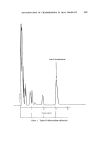
DETERMINATION OF CHLORHEXIDINE IN ORAL PRODUCTS 361 Determination of trace levels of chlorohexidine A 'clean up' extraction system would probably be required for most biological samples. For dental plaque no clean up is required and the sample is processed as is. The gas liquid chromatographic analyses were carried out on a Pye 104 (Model 74) heated electron capture detector chromatograph using a 5' x x o.d. glass column packed with 10•o polyethylene glycol adipate on 100-120 mesh diatomite C (acid washed). The chromatograph was used isothermally at 150øC with the detector set at 250 ø C. The detector pulse space was 150 g and the nitrogen carrier gas flow rate was 50 ml per minute with a purge gas flow rate of 60 ml per minute. Although it is usual practice in quantitative Gas Chromatographic procedures to utilize an internal standard, this was found to be impossible in this case. An internal standard would be required with a response factor similar to the compound being measured and which elutes close to it. Also solubilities and general properties should be similar. In this particular case no suitable compound could be found which is usually the case when using Electron Capture detectors in chromatography. However, if the same syringe is used continuously, and the calibration standards injected before and after samples, the technique described is satisfactory especially at nanogram levels and where large volumes are injected. The choice of 5•1 injection volume is to enable an 'optimum' sample size to be used. Procedure Preparation of calibration data. Into a series of 30 ml Quickfit glass stop- pered tubes pipette 0.0, 2.0, 4.0, 6.0 and 8.0 and 10.0 ml of a standard p-chloroaniline solution containing approximately 50 ng of p-chloroaniline per ml. This solution may be prepared from that previously used. Place the tubes in an ice bath and add 2 ml of 3N hydrochloric acid to each one. After 5 rain add 2 ml of 1}/o w/v aqueous solution to each tube and then allow them to stand in the ice bath for a further 25 min. Destroy the excess nitrous acid by the addition of 2 ml of 10•o w/v aqueous urea solution to each tube. When the evolution of nitrogen has ceased add 0.5 ml of 10• w/v aqueous potassium iodide solution, in which has been dissolved 5• w/v iodine, to the ice-cold solutions and then allow them to warm up to room temperature for 25 min. Place the tubes in a water bath and heat to boiling. Leave the tubes in the boiling water for 5 min. After the sample tubes have then cooled to room temperature remove the excess iodine by adding c. 0.2 g of sodium sulphite powder. Shake the solutions well, add
Purchased for the exclusive use of nofirst nolast (unknown)
From: SCC Media Library & Resource Center (library.scconline.org)