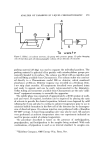
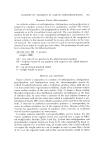
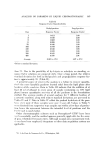
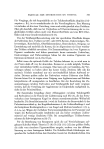
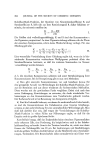
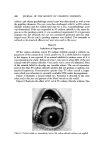
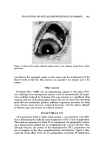
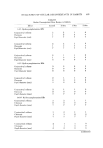
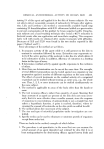
ANALYSIS OF PARABENS BY LIQUID CHROMATOGRAPHY 379 1 ' ,/' 3 4 5 7 To wasfe Figure I. HPLC: (1) solvent reservoir (2) pump with pressure gauge (3) pulse damping coil (4) injection port (5) chromatographic column (6) uv detector (7) recorder packing material (37-44/•) was used to separate the individual parabens. The packing material is spherical silica particle with octadecylsilane groups per- manently bonded to its surface. The column was fitted with an injection port and end fitting available from Chromatronix. The column outlet was connect- ed directly to a Chromatronix model 200 uv detector, which monitored absorbance at 254 nm. Detector response was recorded on a Beckman 10-in. 1-mv strip chart recorder. All components described were purchased intact and ready to operate and can be easily interconnected in the laboratory. Teflon tubing and connectors available from Chromatronix are the only "addi- tional" equipment necessary to assemble the apparatus. The mobile phase was comprised of approximately a 20:80 mixture of meth- anol and water. If required, resolution can be improved by altering the ratio of solvents to provide the desired separation. Solvents were degassed by mild refluxing for 5 min and also by cooling to ambient temperature prior to use to minimize bubble formation in the flow cell of the detector due to decompres- sion of dissolved gases. On-column injection was performed with a Hamilton HP 305* syringe. A closed loop-sampling valve may also be used. All analyses were performed at ambient tempcrature since our experiments indicated no need for precise control of column temperature. The procedure described is based on the presence of methylparaben, propylparaben, and butylparaben in the samples being analyzed. With such combinations, ethylparaben is used as an internal standard. In samples con- *Hamilton Company, 4960 Energy Way, Reno, Nev.

380 JOURNAL OF THE SOCIETY OF COSMETIC CHEMISTS taining otl•cr combinations of the parabcns, any one of the four parabens re- ferred to in this paper may be used as an internal standard to determine the other parabens. In addition, external calibration standards may also be used. Sample Preparation Approximately 10 g of an emulsified sample containing the parabens is weighed into a 50-ml glass-stoppered Edenmeyer flask. The emulsion is bro- ken by acidification with a few drops of 10% w/v sulfuric acid, addition of salts, or other suitable solvents. Ten ml of an internal standard solution of ethylparaben, dissolved in 95% ethanol, are pipetted into the flask. The mix- ture is diluted by the addition of 30 ml of 95% ethanol and shaken vigorously for a few minutes to ensure complete removal of the parabens into the aque- ous/alcohol phase. If required, gentle warming (ca. 60øC.) can be used to melt any lipid pha•se and facilitate extraction of the parabens into the aque- ous/alcohol phase. After "extraction" is complete, the mixture is filtered or centrifuged and a sufficient volume, usually 1-to-2 ml, retained for chromato- graphic analysis. The exact concentration of the internal standard solution and the sensitivity range of the detector will depend on the per cent concen- tration of the parabens in the sample. For levels of 0.1-to-0.2% w/w of me- thylparaben and propylparaben, an internal standard solution having a con- centration of 1.5 mg/ml is satisfactory. A 3-/z injection of the extracted sam- ple produces at least a 50% deflection at 0.64 absorbance units full scale with a 254 nm detector. A realistic detection limit for the parabens is about 30 ng, hence a 10-g sample having a concentration as low as 0.01% is easily ana- lyzed under the conditions described. For suspension-type products, approximately 10 g of sample should be added to a beaker containing 10 ml of internal standard solution and 30 ml of ethanol. The resulting slurry should be stirred for 10 min before filtering, and then the flitrate may be analyzed as above. The exact quantity of alcohol and internal standard solution may be modified to suit the viscosity of the suspen- sion and the levels of parabens expected. No interferences were found from other ingredients in any of the products analyzed however, each case must be evaluated separately in this respect. As a precautionary measure, it is useful to flush the column periodically with 100% methanol to prevent the accumulation of hydrophobic materials at the top of the column. The frequency and duration of column use, as well as the nature of the samples analyzed, will dictate how often the column should be cleaned. Erratic retention data and baseline drift are usually symptomatic of this problem.
Purchased for the exclusive use of nofirst nolast (unknown)
From: SCC Media Library & Resource Center (library.scconline.org)