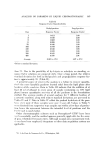
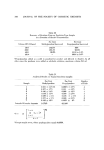
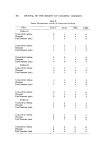
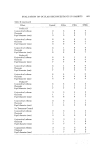
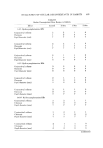
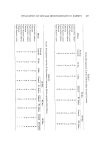
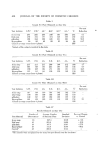
RESIDUAL ANTIMICROBIAL ACTIVITY ON tIUMAN SKIN 4.03 taining 1% of this agcnt and applied it to the skin of human subjects. He was not able to detect measurable amounts of radioactivity 24 hours after applica- tion. Lilly and Lowbury (19,) studied a commercially available liquid soap containing 3% hexachlorophene with 0.3% chlorocresol added as a preservative to prevent contamination of the product by Gram negative bacilli. Using hu- man subjects and a hand-washing technique they found a 46.7% reduction in bacterial counts after one application and immediate sampling. This compares fairly well with results we obtained after similar treat•nents with pHisohex. Decreases of 52.5 and 37.9,% were found in the two studies reported in this paper (Tables I and V). Some advantages of the method are as folloxvs. 1. It measures activity of the agent while it is still present on the skin in contrast to extraction followed by assay. Extraction may regenerate ac- tivity if the active portion of the molecule is also the site which allows it to be substantive to skin. In addition, ettlciency of extraction is a limiting factor in this type of assay. 2. It determines residual activity against specific organisms to the exclusion of others. 3. More than one determination can be run at the same time. For example, several different preparations can be tested against one organism or one preparation against a number of different organisms on the same subject. The effect of several treatments on the residual activity of a compound or product can be studied without treating an entire area, e.g., the whole arm. Thus, 1, 2, 3, or more treatments can be studied simultaneously on the same subject. 4. The method is applicable to areas of the body other than the hands or arms. 5. The test measures ettlcacy rather than quantity of agent. Showing that large amounts of an agent are present on the skin does not mean neces- sarily that it is more effective than a smaller amount, since the response of organisms to concentrations of antimicrobials is not a straight line, but rather a logarithmic function. A point is reached, therefore, where in- creasing the amount of bactericide on the skin yields no added benefit. 6. The method allows free movement of the subject. 7. The size and type of microbial population under investigation are con- trolled. 8. Specific media can be used to eliminate or minimize growth of organisms except those under test. There are faults in the method, examples of which follow. 1. The procedure is not quantitative in the sense that one can measure the actual amount of an agent deposited and retained by skin. But it is at least semiquantitative for determining ettlcacy against known kinds and

4•4 JOURNAL OF THE SOCIETY OF COSMETIC CHEMISTS numbers of bacteria. It can be used for ranking test materials run simul- taneously, and these rankings are reproducible from test-to-test. 2. It is dependent on diffusion of material from the skin into the agar plate, and this may not occur. One point in its favor, however, is that it does provide one of the important parameters for the study of activity, that is, moisture. The EPA has proposed recently that claiming residual bacteri- cidal activity on dry surfaces is not valid since organisms are not affected by baeterieides unless moisture is present (13).* The organisms applied to the skin in this technique are in such a moist environment-the agar •ncdium. Although in this ease, the EPA is referring to inanimate sur- faces and the residual effect of sprays and liquid sanitizers, the principle may still apply for certain drier areas of the body such as the arms, back, chest, etc. 3. This method has one of the drawbacks that most microbiological assays have. If the antimicrobial agent reacts with any part of the medium, then inaetivation may take place and misinterpretation of data may oc- cur. This might be overcome by studying the interaction of media and baeterieide in vitro prior to in vivo testing. (Received November 12, 1974) I•EFERENCES ,'1) J. A. Ulrich, Technics of skin sampling for microbial contaminants, Hosp. Top., 43, 121-3 (Mar. 1965). (2) D. M. Updegraff A cultural method of ouantitatively studying the microorganisms in the skin, J. Invest. Dermatol., 43, 129-37 (Aug. 1964). (3) A. R. Cade, Antiseptic soaps: a simplified in vivo method for determining their de- •_erming efficiency, Soap Sanit. Chern., 26, 35-8, 73 (Jul. 1950). (4) P. B. Price, The bacteriology of normal skin a new quantitative test applied to a study of the bacterial flora and the disinfectant action of mechanical cleansing, J. Infec. Dis., 63, 301--8 (1938). (5) C. M. Shaw, J. A. Smith, M. E. McBride, and W. C. Duncan, An evaluation of tech- niques for sampling skin flora, I. Invest. Dermatol., •4, 160-3 (1970). (6) D. Taber, J. C. Lazanas, O. E. Faneher, and J. C. Calandra, The accumulation and persistence of antibacterial agents in human skin, J. Soc. Cosmet. Chem., 22, 369- 77 (1971). (7) A.M. Kligman, The Bacteriologq of Normal Skin, in H. I. Maibach and G. Hildick- Smith, Eds., Skin Bacteria and Their Role in Infection, B]akiston Division, McGraw- Hill, New York, 1965, p. 26. (8) D. Newman, The distribution of range in samples from a normal population, ex- pressed in terms of an independent estimate of standard deviation, Biometrika, 31, 20-30 (1039). (9) J. G. Black, W. E. St)rott. D. Howe% and T. Rutherford, Percutaneous absorption of hexachlorophene, Toxicologgt, I•, 127--139 (1974). •Prop0sed statement of policy 162.200. Claims for residual bacteriostatic and/or self-s•n- itizing activity in labeling of pesticide products statement of policy (40 CFR Part 162).
Purchased for the exclusive use of nofirst nolast (unknown)
From: SCC Media Library & Resource Center (library.scconline.org)