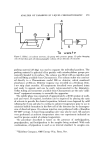
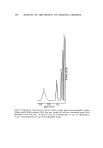
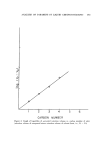
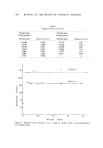
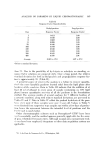
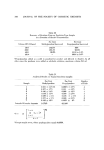
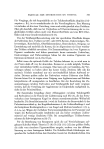
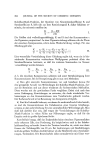
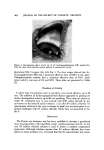
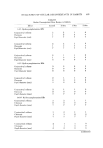
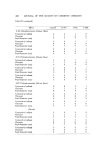
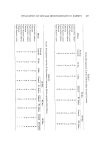
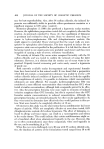
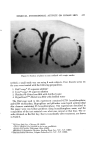
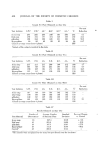
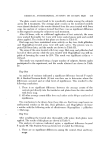
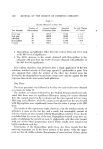
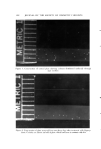
ANALYSIS OF PARABENS BY LIQUID CHROMATOGRAPHY 381 Respom'e Factor Determination An alcoholic solution of methylparaben, ethylparaben, and propylparabcn is prepared to calculate response factors for quantitative analysis. The relative alnounts of methylparabcn and propylparaben should be of the same order of magnitude as in the lornrelation being analyzed. The concentration of ethy]- paraben should be close to the anticipated methylparabcn concentration. Rc- sp:)nse factors are calculated by dividing the weight ratio of the compound of interest, relative to the internal standard, by its area ratio relative to the inter- nal standard. The response factor can then be used to convert experimentally measured area ratios to weight per cent values. The percentage of each para- ben is determined by the following formula AR x RF x IS x 100 =% paraben sample x 1000 AN = area ratio of any paraben to the added internal standard RF = response factor for any paraben with respect to the added internal standard IS =mg of internal standard added S = sample weight in grams RESULTS AND DISCUSSION Figure 2 shows a separation of a mixture of methylparaben, ethylparaben, propylparaben, and butylparaben using the ehromatographie system de- smibed. Parahydroxybenzoie acid, a hydrolysis product, elutes with the sol- vent front under these experimental conditions. A plot of log retention volume versus carbon number of the ester moiety (Fig. 3) shows a linear relation through butylparaben, thus facilitating qualitative identification on the basis of retention data. In cases where a measure of the mass balance between p- hydroxybenzoie acid and the esters from which it originated is desired, a mo- bile phase of nearly 100% water affords separation of the acid from the solvent front. A decrease in methanol concentration produces a corresponding in- crease in column resolution, but at the expense of time. Because of the time e•ement, for quantitative analysis of parabens alone, increases in resolution beyond baseline separation are unnecessary. In routine analysis, reliab!lity and reprodueibility are key factors. For this reason, variations in the response factor were assessed over a range of differ- ent weight ratios. Results (Table I and Fig. 4) show that methylparaben and propvlparaben response factors are linear to 3% when calculated by linear re- grossion analysis over a ten-fold range of weight ratios. One would ordinarily not expect the weight ratios in a set of samples to vary by more than a factor of two over the expected result, and in this case the lincarity would be better

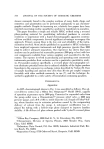
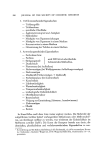
382 JOURNAL OF THE SOCIETY OF COSMETIC CHEMISTS 5 I I , 50 20 MINUTES 2 Figure 2. Separation of parabens on 30-cm Vydac reversed phase-chromatographic column. Eluent equals 20:80 methanoh H•O: flow rate equals 0.33 ml/min: attenuation equals 0.64 absorbance units full scale: (1) solvent front (2) methylparaben (3 t•g) (3) ethylparaben (3 t•g) (4) propylparaben (4 t•g) (5) butylparaben (6 t•g)
Purchased for the exclusive use of nofirst nolast (unknown)
From: SCC Media Library & Resource Center (library.scconline.org)