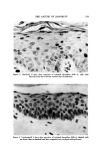
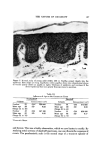
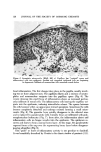
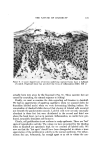
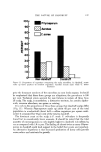
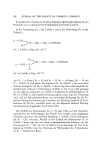
TIlE NATURE OF DANDRUFF 131 Figure 9. A saucer shaved zone of necrosis underlying ruptured horny layer is hallmark of scratch. Fingernail injury has provoked tiny focus of inflammation (H&E, 630 x) actually been torn away by the fingernail (Fig. 9). These necrotic loci are caused by scratching, the natural response to itching! Finally, we nmst re-examine the data regarding cell kinetics in dai•druff. We had no appreciation of squirting capillaries when we scanned slides for thyroidinc labeled nuclei when we were determining labeling indices. Re- examination of dandruff slides showed that clusters of labeled cells occurred just beneath the parakeratotic mounds. Labeled cells were not only unusually abundant in these loci but were distributed in the second and third row above the basal layer, just as in psoriasis. Inflammation, no matter how pro- duced, invariably stimulates cell turnover. Clearly, cell proliferation is not uniform in scalp epidermis. There are "hot" spots of reproductive activity. The values we have presented for the labeling index in dandruff are speciously high, for we counted all labeled cells. We now see that the "hot spots" should have been disregarded to obtain a truer appreciation of the proliferative activity in the normal epidermis. The infiam- nmtory loci are, fortunately, far enough apart so as not to vitiafe the-con-

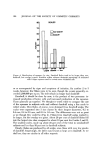
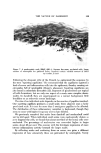
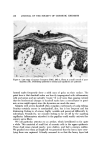
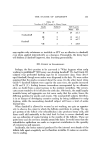
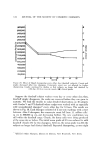
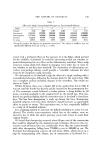
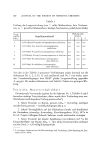
132 JOURNAL OF THE SOCIETY OF COSMETIC CHEMISTS clusion that cell turnover is increased in dandruff. Once more, we can ap- predate that two processes coexist in dandruff a general increase in mitotic activity and scattered foci of rapidly replicating cells secondary to focal in- flammatory change. The first produces more horny cells everywhere, the sec- ond produces horny cells in the form of visible scales. XI. THE SC IN DANDRUFF Any description of the horny layer must take into account the "contaminat- ing" effect of the parakeratotic scales. Their very prominence captivates the eye and leads to faulty descriptions. Ackerman and Klingman, for example, were impressed with the disorderly organization of the horny layer in dan- druff, remarking that the horny laminae were folded and wavy, with numer- ous cracks, often in such disarray as to form whorls (10). They were clearly describing large scales, not the intervening horny layer. In surface replicas, the squames looked like big irregular boulders scattered on a flat landscape. In the electron microscope, the scales somewhat resemble psoriatic horny layer (numerous intracellular lipid droplets and decreased attachment plaques ). Clearly, the squames must be studied separately, being a distinctive tissue. We have made some preliminary observations on the orthokeratotic, ap- parently normal horny layer in dandruff. Corneocytes were studied after the sample was freed of scales by coarse filtration. Individual horny cells were normal in size, shape, and staining properties. Fractures of the cell mem- branes were rare. If there are structural abnormalities these must be very subtle. In psoriasis and seborrheic dermatitis, there are easily recognized changes in the sizes and shapes of the horny cells. We found that the glistening layer was reached with fewer scotch tape strippings on dandruff scalps (10 to 15 strippings versus 26 to 48 in nondan- druff) (10). This suggests that the SC in dandrnff has fewer cell layers. To se- cure more quantitative data, we obtained intact discs of horny layers from dandruff and nondandruff scalps by the cantharidin-blister technique. After sectioning and swelling the cells in alkali, the number of cell layers was counted. The results are shown in Table IV. The number of cell layers was found to decrease with increasing scalp grade. Grade II and III scalps had 16 to 20 cell layers, decreasing sharply to 10 in moderate dandruff (Grade V) and to 7 in Grade VII. In large scales, by contrast, there were as many as 25 to 50 cell layers. Apparently, the greater the production of cells, the more readily these tend to separate and be shed, leaving fewer cells to comprise the "barrier." This implies that the scalps of dandruff subiects are more per- roeable. Assuming this to be true, antidandrttff medicaments would penetrate more rapidly and reach the germinative layer in higher concentrations. This
Purchased for the exclusive use of nofirst nolast (unknown)
From: SCC Media Library & Resource Center (library.scconline.org)