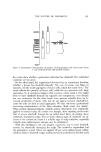
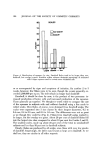
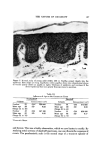
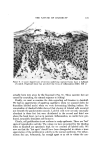
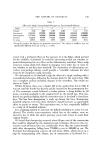
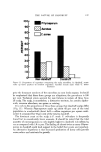
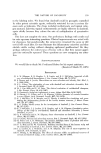
THE NATURE OF DANDRUFF 137 IOO 90- 80- 70- Pityrosporum Aerobes C.acne$ 4O 30 2O I0, 0 Dandrut Figure ii. Proportions of organisms comprising the scalp microflora. In dandruff, yeasts make up three quarters of resident organisms. Aerobes remain same while C. aches decreases prise the dominant members of the microflora in most body regions. It should be emphasized that these three groups are ubiquitous the prevalence is 100 per cent. Technical errors account for rare failures to isolate all three from all scalp. The scalp, is nonetheless, a distinctive territory, for aerobic dipthe- roids, common elsewhere, are sparse or missing. It is only in the proportions of these three groups that dandruff scalps differ (Fig. 11). Whereas Pityrosporum made up about 45 per cent of the total population in nondandruff (about half a million organisms per square centi- meter) it accounted for 75 per cent of the total in dandruff. The dominant yeast on the scalp is P. ovale. P. orbiculare is frequently found but in considerably lower amounts. It should be noted that the total quantity of microorganisms is only slightly higher in dandruff, 1.g million/sq cm as compared with 1.O/sq cm. The finding of almost twice as many Pityros- porum in dandruff could lend support to the belief that yeasts are important. An alternative hypothesis is that increased production of horny cells provide more surface and nutrients for growth.

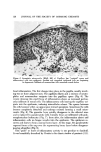
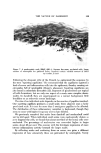
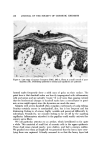
138 JOUBNAL OF THE SOCIETY OF COSMETIC CHEMISTS Curiously, the cocci were not increased in dandruff. Of surpassing interest was the substantial decrease of C. acnes in dandruff. In explaining this, it is useful to recall that C. acnes is a strict anaerobe. A slight increase in O2ten- sion will antagonize its growth. How could this occur in dandruff? Our sup- position is that the inflammatory microloci are just numerous enough to lessen the degree of anaerobiasis in the follicles where C. acn•es lives. We undertook to evaluate the rule of micro-organisms by eliminating them one at a time with appropriate antimicrobial agents and finally suppressing the entire microflora with a combination of agents (14). The effect on dan- druff was appraised by clinical grades and corneocyte counts. Suppression of C. acnes by oral tetracycline had no effect, as was expected. Inhibition of the areobes by topical neomycin had no influence whatever on grade or counts. Virtual elimination of P. ovale by topical amphotericin B for 4 weeks had no discernible effect on dandruff. This was sufficiently important to justify a longer study on the assumption that reduction in scaling might have a long lag time. This possibility was ruled out when it was found that 9 weeks of amphotericin B brought no changes in the grades or corneocyte counts. We followed the Pityrosporum trail even further hoping to put the matter to rest, once and for all. This time, dandruff and P. ovale were both sup- pressed by twice weekly shampooings for 3 weeks with 2.5 per cent SeS sham- poo. Then, half the subjects used only a bland shampoo twice weekly, while the other half received topical amphotericin to prevent the regrowth of P. ovale. In both groups, grades and counts returned to the pretreatment level at the same rate, in 4 to 6 weeks. Finally, all three medicaments were given simultaneously resulting in con- comitant suppression of aerobes, yeasts, and anaerobes. Dandruff remained unaffected. These data are strongly apothetical to the belief that micro-organisms play a role in dandruff. In our view, the reign of P. ovale is at an end. Increase of P. ovale in dandruff is a consequence of increased scaling not its cause. On the other hand, there is no room for ambiguity concerning the inflam- matory microloci. These do represent a pathologic process. The tissue in these areas is structurally and functionally abnormal. Disease exists at these sites. We have no insights as to their causation. XIV. MoI)•: or ACTION OF ANTn:)ANDRUFF AGENTS On numerous occasions, we have measured the effectiveness of ZPT and SeS shampoos on dandruff. These invariably exert a suppressive effect, the latter being more potent. Their mode of action seems to be cytostatic. They decrease epidermal proliferation by inhibiting the multiplication of germina- five cells. We found that SeS decreased the corneocyte count to about the same extent in nondandruff subjects (15). There was a corresponding decline
Purchased for the exclusive use of nofirst nolast (unknown)
From: SCC Media Library & Resource Center (library.scconline.org)