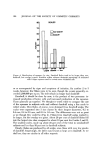
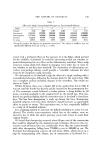
THE NATURE OF DANDRUFF 113 50 scalps, the face and body being concealed. The subjects are then scrambled and graded again. Concordance should be achieved in at least 45 of the 50 pairs. More than a keen eye and conscientiousness are required. Strict rules must be followed if serious error is to be avoided. Scalp cleanliness is a compulsive concern of increasing numbers of people. Daily washing will banish all signs of scaling. Moreover, many persons regularly use antidandruff shampoos. The suppressive effects of the more potent ones last for a month or more. Hence, we make certain that active agents have been avoided for at least that period. Then, too, grading must be done at a fixed interval after last bland sham- poo we use 4 days, since this is the approximate "restoration time" in subjects with appreciable dandruff (see below). We use a 0 to 10 grading scale (1). This is, of course, quite arbitrary and requires some explanation, since we virtually never assign grades greater than 7 or less than 1. The justification for this seemingly stretched out scale is to allow for the entire range of possibilities. For example, if dandruff sub- ieets wear bathing caps and are prevented from washing, the grades will as- cent to 9 or 10 within two weeks. Conversely, potent agents may be so effec- tive that the grade falls to 0. The descriptive equivalents of the various grades are as follows: Grade IV equals mild dandruff, Grade V equals moderate dandruff, and Grade VI equals severe dandruff. Grade III is slight sealing, not enough to warrant corrective efforts. Grade I and II are shady areas where scaling is miniscular and very difllcult to judge. Here, we would emphasize that all scalps show some sealing even though this may be very slight. Using this scoring system, we surveyed a prison population of 1,033 un- selected young adult males, mainly in the 9•5 to 35 age group. About 18 per cent fell into grade IV (mild dandruff), while another 13 per cent were grade V (moderate dandruff). Grades VI and VII accounted for less than 5 per cent. Another 18 per cent were classified as Grade I. Grades II and III were the commonest, about 93 per cent each. Bourne and Jacobs surveyed what might be regarded as a comparable group (79•g0 soldiers) and judged that only 9•.5 per cent had "gross" dan- druff (9•). If the latter description conforms to our grade VI, there then exists good agreement that severe dandruff is uncommon. In our survey, less than one in 5 young adults had moderate dandruff (Grade V). Clearly, it is not easy to recruit good panels for antidandruff assays unless one is willing to settle for mild Grade IV dandruff. Cohen looked at 500 young women, and he thought that about 15 per cent had moderate dandruff, a figure close to ours (3). Van Abbe and Dean also emphasized that good dandruff subjects are hard to find (4). The subjective element in self-assessment is brought to light when we put out a call for dandruff subjects to participate in therapeau- tie studies. Few respondents have Grade V dandruff. Most are Grade III.

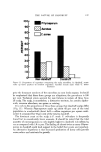
114 JOURNAL OF THE SOCIETY OF COSMETIC CHEMISTS Scaling is over-rated in our population. Women seem to have as much dandruff as men. Prevalence seems to be no different in blacks and whites. However, nothing is known about the fre- quency of dandruff among the various races of mankind nor of the influence of geography and climate. Similarly, we are quite ignorant about genetic in- fluences. Heredity can certainly not be ruled out. Although we have not conducted a formal survey of how dandruff varies throughout man's lifespan, we have formed some rather firm impressions. Young infants commonly experience a conspicious episode of scalp scaling. Large flakes are shed over a period of weeks followed by subsidence. "Cradle cap," as this condition is called, has been even less studied than dandruff. Nothing is known about it. We see no reason to call it dandruff or imply any relationship whatever. Our speculation is that it represents a wave of exfoliation of the thickened horny layer which protected the fetus in its watery intrauterine existence. Cradle cap disappears without "active" treat- ment. Dandruff is decidely rare in children. Our maxim is that excessive scaling is a prepuberal child is atopic dermatitis until proved otherwise. Seborrheic ,dermatitis, on the other hand, can be very severe in infants. It is fortunately uncommon. It resembles the adult disease, but is not necessarily the same. Dandruff begins to emerge at puberty and may be thought of as another cutaneous event that marks the onset of sexual maturation. The pubertal display includes expansion of the sebaceous glands (oiliness), appearance of public and axillary hair, apocrine sweating (axillary odor), deepened pig- mentation (melanization), thickened skin, and other signs. All these changes reflect increased cutaneous activity. Presumably, this same enhancement ap- plies to the physiologic function of desquamation the production and shed- ding of cornified cells is accelerated. Starting quietly at puberty, dandruff intensifies gradually over the next few years, probably peaking in the late teens and early twenties. It is a common belief that bad acne and severe dandruff go hand in hand, but no one has performed a comparative study that would validate such a view. The correlation, in any case, is not a strict one. The most one can say is that acne and dandruff are both quite common in late adolescence. An association between the two might be purely coincidental. We think that dan- druff levels off in young adults, gradually declining toward middle age. It can be categorically stated that dandruff falls off sharply as old age is approached. We have had intensive experience in an institution for the aged and know with certainty that after 60, Grade V subjects are about one-third as common as in young adults. After 75, dandruff is very rare, while after 85, it practically vanishes altogether. This decremental age trend contrasts sharply with sebor- rheic dermatitis which increases after middle age and indeed becomes qui.te
Purchased for the exclusive use of nofirst nolast (unknown)
From: SCC Media Library & Resource Center (library.scconline.org)