THE NATURE OF DANDRUFF 115 common in the elderly, especially among males. Many of these are misdiag- nosed as dandruff, a mistake we made for many years (see below). Fortunate- ly, seborrheic dermatitis responds to the same agents that are effective in dandruff. III. SEASONAL VARIATIONS One widely held belief, which has been sustained by formal epidemiologic investigation, is that dandruff declines in the summer months. The decrease actually begins in the late spring and bottoms out in the summer (1). The seasonal rhythm is easily perceived by comparing very low and high grades. In late spring, for example, Grade I accounts for about 25 per cent in a young, unselected population, while the comparative figure for winter is 10 per cent. Conversely, Grade VIs are more common in early winter than at any other time. These seasonal changes are not artifacts of altered visibility, which might occur from say increased sweating in summer time. Objective measurements of horny cell production also bear out the validity of the seasonal changes. Sales of antidandruff products are another indicator these fall off in summer. While biologists are keenly aware of circadian (daily) rhythms, too little attention has been paid to seasonal ones. Molting patterns are well-known in many vertebrates. In man, Orentreich has obtained evidence that physio- logic shedding of telogen (club) hairs increases in the fall, causing unneces- sary concern in women (5). We venture to say that these annual rhythms are innate and are not responses to exogenous events such as temperature changes. In any event, the summer downturn in dandruff should be taken into ac- count in therapeutic assays. The most rigorous time for testing is in the fall and winter. Weaker agents will tend to be over-rated when the trial begins in springtime. IV. RELATIONSHIP TO OILINESS (SEBORRHEA) Earlier writers created a distinction between an oily and a dry type of dan- druff, respectively called pityriasis olesa and pityricis in the pedantic jargon of the day. It takes only a moments reflection to discern the absurdity of such designations. Scalps, of course, are either oily or not oily, regardless of the presence or absence of dandruff, whether their owners are blondes or brunettes, saints or scoundrels, etc. One is reminded of a charming saying among the Pennsylvania Dutch: "When the cock crows on the dung heap, the weather will either change or it will stay the same." The real question is whether there is a statistical association between oiliness and dandruff. We undertook to settle the matter. The production of sebum was measured by having each subject dip his entire scalp for 2 rain in a liter of ethyl ether 24 hours after defatting the scalp by a similar immersion. After filtering and

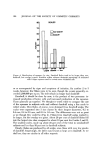
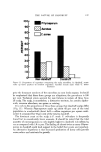
116 JOURNAL OF THE SOCIETY OF COSMETIC CHEMISTS evaporation, the residual oil was weighed, giving total scalp sebum produc- tion for a 24-hour period. This was repeated after a rest of a few days and the values averaged. 18 subiects with Grade V dandruff were compared to 16 with Grades of II and III. The mean sebum production was 378.3 mg in the latter and 419.4 mg in dandrnff subiects. The standard deviations were rather large but similar in both groups. The slightly higher sebum production in dandruff was not statistically significant ( p -- 0.05). The effect of artificially decreasing sebum production was investigated in 6 young adult females with Grade V dandruff, who also complained of oili- ness. Each took 0.1 mg of ethinyl estradiol from the fifth to the twenty-fifth day of each menstrual cycle for three cycles. This caused an average decrease in sebum production of 44 per cent (range 31 to 52). The subjects used a bland shampoo twice weekly during this time. Menstrual irregularities oc- curred, but were not considered pertinent to the issue. The clinical grades remained stable as did objective measurements of horny cell production (the corneocyte count). The subjects easily perceived that the scalps were no longer oily, but they agreed with our estimate that scaling remained at pre- treatment level. Another three females with marked oiliness and dandruff applied a 0.5 per cent solution of ethinyl estradiol in equal parts of ethanol and propylene glycol to their scalps once daily for 30 days. Corneocyte counts were not done. Oil production was so severely curtailed that two complained of ex- cessive dryness. The dandruff seemed to have actually worsened in these two. We interpret this to mean that oil tends t•o conceal scales in the same way that any grease obliterates the look and feel of dry scaly skin after its application. Light is scattered more readily when the spaces between the scales are no longer filled with fat. Defatting the scalp with either one may greatly accentuate the appearance of scaliness, even in nondandruff subjects. Thoroughly wetting the scalp with water also transiently decreases the visi- bility of scales. In any case, sealing and oiliness are independent of each other. Dandruff is not affected when female hormones are given to decrease the volume of the sebaceous glands. Estrogens, it may be noted, apparently do not affect the proliferative activity of the epidermis. V. ASSESSING THE DEGREE OF DANDRUFF: MEASUREMENT OF EPmERMAL KINETICS Cells are continually being shed from the surface. The source of new cells is the germinative layer, the bottom most row of cells directly over the derm- is. These cells comprise the reproductive compartment and undergo random mitotic divisions. Some cells in the row immediately above the basal layer also have the capacity to divide. The daughter cells of cell division are forced
Purchased for the exclusive use of nofirst nolast (unknown)
From: SCC Media Library & Resource Center (library.scconline.org)