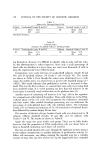
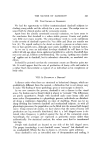
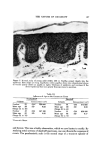
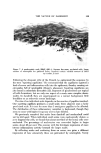
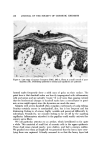
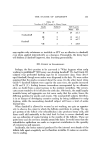
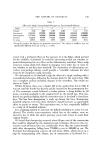
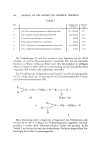
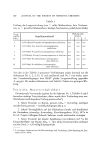
THE NATURE OF DANDRUFF Table IV Number of Cell Layers in Horny Layer 133 Grade Subjects Cell Layers Mean SD Nondandruff Dandruff II 5 20 _2.1 III 5 16 _1.1 V 8 10 ___1.7 VII 3 7 ___0.8 may explain why substances as insoluble as ZPT are so effective in dandruff, even when applied intermittently as a shampoo. Presumably, the horny layer will thicken as dandruff improves, thus lessening permeability. XII. EFFECT OF SHAMPOOING Perhaps, the first question to be answered is "What happens when scalp washing is prohibited?" Will every one develop dandruff? We had Grade III subjects wear perforated bathing caps for 21 consecutive days. None devel- oped dandruff, though more scales were dispersed in the hair. We were rather surprised that the grades remained about the same. On the other hand, when Grade V dandruff subiects wore caps for the same time, the grades increased to IX and X (1). Scaling became tremendous accompanied by an offensive odor, no doubt from a great increase in the resident microflora. The corneo- cyte counts tended to level off after the sixth day. Obviously, the small largely invisible horny cell aggregates are lost more easily that the scales, hence the differing patterns for grades and counts. The nondandruff subject, therefore, is in no danger of developing excessive scaling by being indifferent to scalp hygiene, while the nonwashing dandruff subiect will leave a trail of scales beyond him. When dandruff is allowed to worsen by not washing, one gets an opportu- nity to observe the extent to which the follicles contribute to scaling. The up- per portion of the follicle (the infundibulum) also produces horny cells, and these could add materially to the total load. In fact, in severe dandruff, one can see collarettes of scales forming in the mouths of the follic]es. These are quite loose and do not form sheaths around the hairs. It would seem that the infundibu]ar epithe]ium can make an important contribution to the quantity of corneocytes and squames. Incident]y, the horny material produced by the internal root sheath of the follicle falls apart completely and is therefore invisible. It makes no contribu- tion to scaling.

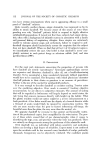
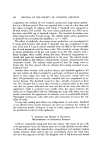
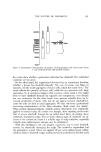
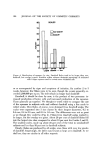
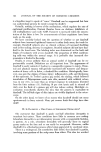
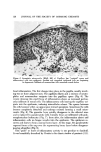
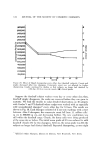
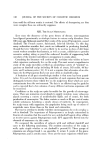
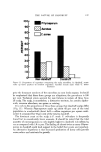
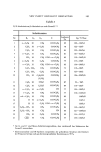
134 JOUltNAL OF THE SOCIETY OF COSMETIC CHEMISTS •oo, ooo •,4oo,ooc b•oo,ooc •ooooc •. 900,O(X) • 8oo,ooo • 5oo,ooo $00,000 200,00(1 I00,000 i0 12. 14 16 DAYS Figure 10. Effect of bland shampooing every other day (dandruff subjects). Counts and grades decreased after two shampoos. Corneoeyte count was not affected by further shampooing. Grades continued to decline so that subjects no longer had dandruff by •Oth day: (0) L.•xv neocyte counts (0) clinical grades Suppose the dandruff subject washes every day or every other day then, dandruff simply disappears the scales are removed before they can grow to maturity. We took the trouble to make detailed observations on 10 subjects with Grades V and VI dandruff whose scalps were washed with an especially mild nonmedicated shampoo • every other day for 8 times. The results are shown in Fig. 10. Each shampoo consisted of g one-rain washings with a rinse between. After g shampoos, the eorneoeyte count fell from 1.1 million cells/ sq em to 800,000/sq em-not decreasing further. The new equilibrium was still within the dandruff range. Clearly, the horny cells were being produced at the same rate as before. The initial mean grade of 5.5 was reduced to mild dandruff (Grade 3.8) by two shampoos. After six, the mean grade was III the subjects no longer had clinical dandruff. Bepeated shampooing, as one might *Johnson's Baby Shampoo, Johnson & Johnson, New Brunsxviel•, Nexv Jersey.
Purchased for the exclusive use of nofirst nolast (unknown)
From: SCC Media Library & Resource Center (library.scconline.org)