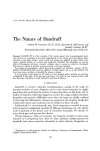
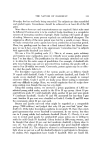
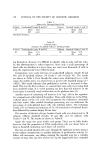
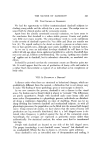
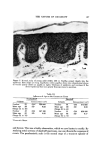
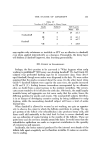
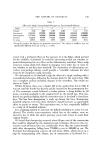
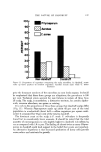
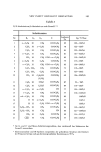
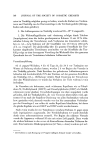
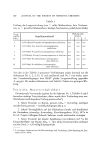
THE NATURE OF DANDRUFF Table V Effect of a Single Nonmedicated Shampoo on Ten Dandruff Subjects 135 Days 0 1 2 3 4 8 Grades a 5.29 2.00 2.57 4.00 5.14 5.57 Corneocyte 1024000 279600 532400 762600 1025000 1355000 Pityrosporum 1473000 343400 542400 791600 1486000 2109000 Aerobes 413200 61750 179200 388600 5081000 799700 C. acnes 40810 28040 5958 10200 18440 8634 "Except for grades, the figures are geometric means/era? The values in boldface type are significantly different from day zero (p = • 0.05). expect, had a profound effect on the squames. It is the flakes which account for the visibility of dandruff. It would be interesting to find out whether re- peated shampooing has any effect on the inflammatory microfoci. Many scalp conscious young adults feel obliged to shampoo every other day or more of- ten, whether or not they have dandruff. The elimination of inflammatory mi- crofoci, and perhaps itching, could provide a "scientific" rationale for what seems to be compulsive scalp cleansing. We determined on 10 dandruff scalps the effect of a single washing with a nonmedicated shampoo, following the changes daily for the next 8 days. This was a complete analysis including changes in the microflora. The results are shown in Table V. Within 24 hours, there was a drastic fall in the grades from 5.3 to 2.00. It was not until the fourth day that the grades returned to the pretreatment lev- el. The corneocyte counts followed a similar pattern, a sharp decline by 24 hours, returning gradually to the original level by the fourth day. This con- firmed our previous finding that the restoration time in dandruff is about four days. The loss from shampooing is made up during this time. Shampooing dandruff subjects every four days, therefore, should not have an appreciable effect on grades or counts. This expectation was, in fact, empirically fulfilled in a study of 15 dandruff subjects. It is of passing interest to note that the follicle-inhabiting C. acnes was not affected. The aerobic micro-organisms, which live on the surface, were re- stored by day 2 while the slower growing yeasts took 4 days to reach their original density. We found that shampooing removed about 40 per cent of the corneocytes that could be obtained by the detergent-scrub technique. However, the cor- neocyte count 24 hours later was considerably lower than the count immedi- ately after shampooing, falling from 770,000/sq cm to 288,000/sq cm. We theorized that shampooing removes oil and horny debris, which serves as a trap for desquamating cells. Hence, loss of corneocytes is facilitated for a

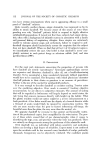
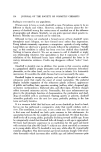
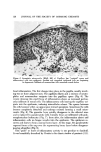
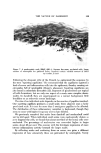
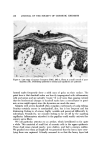
136 JOURNAL OF THE SOCIETY OF COSMETIC CHEMISTS time until the oil-horn matrix is restored. The effects of shampooing are thus more complex than one ordinarily supposes. XIII. T• Sc•v MICROFLORA Ever since the discovery of the germ theory of disease, microorganisms have figured prominantly as etiologie factors in various scalp disorders. Over 100 years ago, Malassez asserted that yeasts of the genus Pitgrosporum, caused dandruff. The French master, Sabouraud, believed likewise. To this day, many authorities consider that yeasts are influential in producing dandruff, though the term "infection" is not so likely to be used as in days of old. Some recent workers consider that bacteria, as well as yeasts, collaborate to provoke excessive sealing, citing as proof the enhanced benefits of suppressing both members of the resident mierottora in comparison to yeasts alone. Consulting the literature will confound the novitiate who wishes to know what organisms eustomarily live on the scalp. The most recent comprehensive study of the scalp microflora yielded an astonishing variety of "resident" or- ganisms on dandruff scalps including 30 kinds of yeasts, 143 molds, 44 bac- teria, and 8 actinomycetes (13). It is not a surprise that advocates of an etio- logic role for Pityrosporura find yeast moro often in dandruff scalps. A limitation of all past microbiologic studies is that none has been quanti- tative. It is only be determinin• the quantities of each organism that one can distinguish between those which live on the scalp from those which are mere contaminants from the environment. The hair is an efficient trap for particles and is expected that a few colonies of many different air-borne organisms will be recovered. Conditions on the scalp are quite favorable for the growth of micro-orga- nisms. There are numerous sweat glands to supply moisture, many sebaceous glands secreting a variety of metabolizable lipids, and of course, the brisk production of corneocytes. The latter contain as much as 20 per cent of water soluble substances furnishing a steady stream of nutrients. In consequence, the scalp teems with organisms, the population being made up of orders of magnitude more dense than on the trunk and extremities. The time is overdue to decide whether microorganisms do or do not play a role in dandruff. The importance of Pityrosporum is so deeply entrenched in theories of causation that the search for new antidandruff agents often utilizes an in vitro screen against Pityrosporum ovale. ZPT apparently flowed into the channels of commerce via this route. We compared the microflora of subjects with and without dandruff and came to the following conclusions. The resident microclora of the scalp is really quite simple whether or not dandruff is present(9). Three groups of organisms are always found 1. an anaerobe, C. acnes 2. yeasts of the genus Pityrosporum and 3. aerobic cocci. These are the same organisms which corn-
Purchased for the exclusive use of nofirst nolast (unknown)
From: SCC Media Library & Resource Center (library.scconline.org)