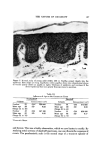
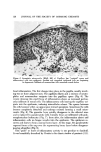
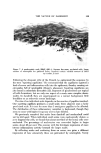
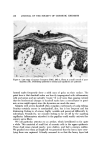
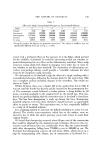
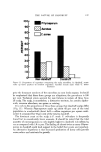
THE NATURE OF DANDRUFF 139 in the labeling index. We found that dandruff could be promptly controlled by other potent eytostatic agents, ordinarily restricted for use in serious dis- eases such as leukemia. The drugs included methotrexate and topical nitro- gen mustard. Likewise, topical eortieosteroids are highly effective in dandruff, again chiefly because they rednee the rate of multiplication of germinative cells. This does not complete the story. Our preliminary findings with crude coal tar raise up some interesting questions. Clinical improvements was noted with tar shampoos, but paradoxically, the eorneoeytes remained the same or did not fall till much later. Do tars eliminate the inflammatory microloci and thus abolish visible sealing without changing epidermal proliferation? Do they perhaps influence the eohesiveness of horny cells so that they cannot aggre- gate into noticeable squames? These questions are now occupying our atten- tion. ACKNOWLEDGMENTS We would like to thank Mr. Ferdinand Huber for his expert assistance. (Received March 9,7, 1975) I:•EFERENCES (lO) (11) (12) (13) (14) (15) (1) A.M. Kligman, R. R. Marpies, L. R. Lantis, and K. J. McGinley, Appraisal of effi- cacy of antidandruff formulations, ]. Soc. Cosmet. Chem., 25, 73 (1974). (2) S. Bourne and A. Jacobs, Observations on ache seborrhea and obesity, Brit. Med. ]., 1, 1268 (1956). (3) E. L. Cohen, The relationship of acne with dandruff and seborrheic dermatitis, Brit. ]. Dermatol. Sgph., 57, 45 (1945). (4) M. J. Van Abbe and P.M. Dean, The clinical evaluation of antidandruff shampoos, J. Soc. Cosmet. Chem. 18, 439 (1967). (5) N. Orentreich, Scalp hair replacement in man, Advan. Biol. Skin, 9, 99 (1967). (6) G. Plewig, J. E. Fulton, and A.M. Kligman, Cellular dynamics of comedo formation in ache vulgaris, Arch. Dermatol. Forsch., 237, 703 (1970). (7) K. J. McGinley, R. R. Marples, and G. Plewig, A method for visualizing and quan- titating the desquamating portion of the human stratum comeum, J. Invest. Derm- atol., 53, 107 (1969). (8) J. A. Troller, Model system for the investigation of dandruff, J. Soc. Cosmet. Chem., 22, 187 (1971). (9) K. J. MeGinley, J. J. Leyden, R. R. Marples, and A. M. Kligman, Quantitative micro- biology of the scalp in non-dandruff, dandruff and seborrheic dermatitis, J. Invest. Dermatol., in press. A. B. Aekerman and A.M. Kligman, Some observations on dandruff, J. Soc. Cosmet. Chem., 20, 81 (1969). A. Civatte, Psoriasis and seborrheie eezema, Brit. J. Dermatol. Syph., 36, 461 (1924). H. Pinkus and A. H. Mehregan, The primary histologic lesion of psoriasis and sebor- rheie dermatitis, ]. Invest. Dermatol., 46, 109 (1966). F. C. tloia and R. W. Vanderwyk, Resident microbial flora of the human scalp and its relationship to dandruff, J. Soc. Cosmet. Chem., 20, 113 (1969). J. J. Leyden, K. J. MeGinley, and A.M. Kligman, The role of micro-organisms in dandruff, Arch. Dermatol., in press. G. Plewig, A.M. Klingman, The effect of selenium sulfide on epidermal turnover of normal and dandruff scalps, J. Soc. Cosmet. Chem., 20, 767 (1969).

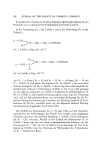
1. Soc. Cosmet. Chem., 27, 141-153 (March 1976) Neue Insektenabwehrmittel- am Sti&stoff disubstituierte tg-Alaninderivate MANFRED KLIER •) und FRIEDRICH KUHLOW -•) Synopsis -- New insect Repellents Derivatives of N-disubstituted [3-Alanine. -- A number of derivatives of N-disubstituted fl-alanine were synthesized. Among them several N-ALKYL ESTERS of 3-(N-n-ALKYL-N-ACYL) AMINOPROPIONIC ACID and of 3-(N-n-ALKYL- N-CARBALKOXY)AMINOPROPIONIC acid effectively repelled AEDES AEGYPTI MOSQUITOES from HUMAN SKIN to an extent equal to that of N,N-DIETHYLTOLU- AMIDE. An OLFACTOMETER, which permitted simple, efficient, and rapid evaluation, was developed for preliminary screening of repellency. The correlation between repellency of the synthesized compounds and their volatility and their molecular structure was studied. One compound, ETHYL 3-(N-n-BUTYL-N-ACETYL)AMINOPROPIONATE, is par- ticularly noteworthy it exhibits high mosquito repellency, possesses extremely low toxicity towards warm blooded animals, and is well tolerated by human skin. Wirkstoffe zur Abwehr stechender, blutsaugender oder sonst l•istiger In- sekten, sog. Repellents, haben eine bedeutende kosmetische, gesundheitliche und hygienische Funktion zu erftillen. Bekannte und bereits seit l•ingerer Zeit im Gebrauch befindliche Repellents sind z. B. Dimethylphthalat, 2-Athyl- hexadiol-(1,3) und m-Toluyls•iure-N, N-di•ithylamid. Ein Nachteil der be- kannten Repellents ist deren Weichmacherwirkung gegentiber Kunststoffen, f•rner ihre off'ungentigende Haut- und Schleimhautvertr•iglichkeit. Dr. Manfred Klier, Beiersdorf AG, D-2 Hamburg, Unnastrat•e 48. Prof. Dr. Friedrich Kuhlow, Bernhard-Nocht-Institut fiJr Schiffs- und Tropenkrankheiten, D-2 Hambur• 4, Bernhard-Nocht-Stratge 74. 141
Purchased for the exclusive use of nofirst nolast (unknown)
From: SCC Media Library & Resource Center (library.scconline.org)