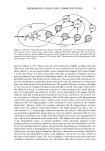
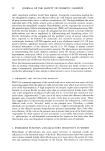
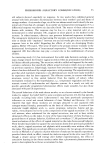
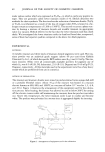
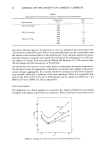
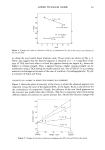
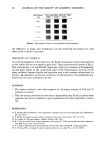
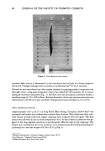
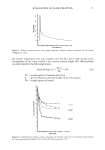
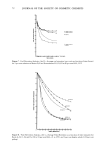
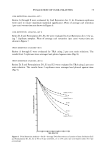
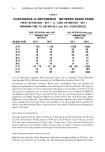
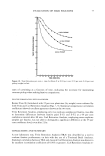
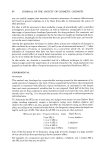
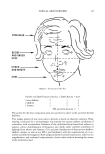
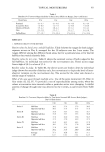
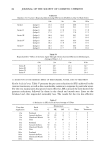
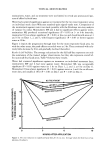
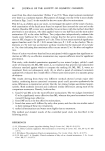
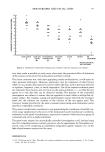
LOWER TITANIUM OXIDE 63 70 •Ti 2504-f- Ti02 '"", (•..,,. Iron Oxide Black O-- Iron Oxide Black © •0 -- 0"•---•" Ti2504 • • • • • 1•2 2 4 6 8 10 m2/g Figure 4. Change of L-value as a function of the SN2 of synthesized Ti2.,504 for the l0 per cent mixture of Ti2.504 and TiO2 to obtain the most useful lower titanium oxide. These results are shown in Fig. 3-4. These data suggest that the blackest pigment is obtained at n = 2.5 regardless of the type of TiO2 used and when n is fixed the pigment having the largest SN2 shows the highest in tinting strength. Thus, a pigment having a higher tinting strength can be synthesized using a TiO2 having the smaller particle size. Use of TiO• P-25 as a starting material is advantageous because of the ease of synthesis. Crystallographically, Ti•.•O4 is a mixture of Ti•O.• and Ti.•Os. VISCOSITY OF A SLURRY IN WHICH THE PIGMENT WAS DISPERSED Figure 5 shows the plots of viscosity of the slurry in which the obtained pigment was dispersed versus the ratio of the pigment/TiOz. In the figure, FeaO4 is also plotted for the convenience of comparison. Clearly, the influence of the new black pigments on the viscosity was smaller than that of FeaO4. This fact is important when formulating different shades of cosmetics in a given product line. Should the viscosity change with 130 --Fe30• T•• x 110 •. 90 • x x ß • 70 • a .-'/ Ti2 •04 (B) • ....... o 50 ........ •o Ti2504 (C) 30• __ • , Ti02 25 50 75 Ti2504 (white) weight ratio (black) Figure 5. Change of viscosity as a function of mixing ratio of Ti•.•O• and TiO• for the slurry

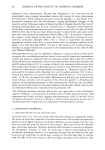
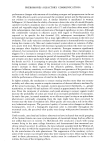
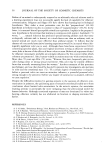
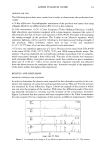
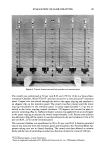
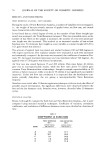
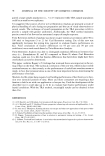
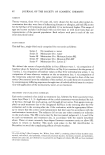
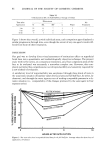
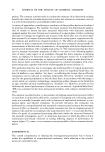
64 JOURNAL OF THE SOCIETY OF COSMETIC CHEMISTS Black Pigments White Pigment/Black Pigment (by Weight) ,,sed •ZS/2• so/so 2s/zs Fe304 ' 'ø'1 Ti2:104 Figure 6. Photographs ofslurries including different black pigments the difference in shade, then modification of each individual formulation for each shade of the cosmetic is necessary. HOMOGENEITY OF A DISPERSION As to the homogeneity of the dispersion, the FeaO4 slurries gave some striped patterns on the surface but the new pigments gave none. These phenomena are shown in Fig. 6. This characteristic is of considerable importance since it is a measure of homogeneity and has great impact on the commercial value of the final products. In terms of the safety problem, titanium dioxide has long been used in the cosmetic industry and is a proven, safe ingredient. In the test, carried out in this laboratory, the synthesized ma- terials were of course confirmed to be safe. SUMMARY 1. The authors obtained a new black pigment by calcining a mixture of TiO2 and Ti powders in vacuum. 2. This new product was noted to have better dispersibility than FeaO4 or carbon black pigments and can be considered a good replacement for these materials in cosme- tics. REFERENCES (1) P. Ehrlich, Phasenverhiiltnisse und magnetisches verhalten im system titardsauerstoff, Zeit. Elektrochem., 45,362 (1939). (2) P. Ehrlich, L6sungen von sauerstoffin metallischem titan, Zeit. Anorg. Chem., 247, 53 (1941). (3) B. Yoshiki, in "Kobutsu Kogaku," Gihodo, Tokyo, p 269, 1963. (4) R. C. Devries and R. Roy, A phase diagram for the system Ti - TiO., constructed from data in the litera- ture, Bull. Am. Cer. Soc., 33,370 (1954). (5) T. L. Hill, in Thermodynamics of SmallSystems, Part I (1963), Part II (1964) W. A. Benjamine Pub. (6) C. Herring, Effect of change of scale on sintering phenomena, J. AppL Phys., 21,301 (1950).
Purchased for the exclusive use of nofirst nolast (unknown)
From: SCC Media Library & Resource Center (library.scconline.org)